

Welcome to The Digital Creator, helping creators accelerate with AI. I show you how to use AI to start, create, grow, and scale faster.
How many blog posts have you published that brought in zero customers?
Not zero views. Zero customers.
If you’ve built a product (a SaaS, an app, a template shop, a directory), you’ve probably been told what I was told:
“Do SEO. Publish consistently. The traffic will come.”
So you did the work:
Built a 200-keyword spreadsheet you never opened again
Wrote 2,000-word “What is X?” posts for people who will never buy anything
Paid for an SEO tool you log into twice a month
Refreshed Search Console, waiting for something to happen
And after all of that, you still can’t answer the only question that matters: which page actually made you money?
You’re guessing.
Before getting into this week’s post, I would like to give shoutouts to builders who have won the last week’s leaderboard in TraffikList.
Premium and Most Upvoted Products of Last Week
✅ DomainRating.app: Free Domain Rating (DR) Checker & Tracker
Check and track your Domain Rating free, plus free domain age, expiry and website speed checkers.
✅ MuiCV
AI-assisted résumé builder with ATS optimization, templates and PDF export.
✅ MuiStory
Create and play interactive fiction and gamebooks with AI-assisted storytelling tools.
✅ Slap Alert
For every sale, a pixel monkey slaps a sticky note on your screen with who paid and how much. Celebrate your sales!!
✅ Awesome Comment
A self-hosted, cloud-native commenting system for websites.
🎉 Congratulations to all the builders…
Want to be on this list, launch your product on TraffikList.com
Back to today’s post 👇
Meanwhile, search changed under everyone’s feet.
Google now answers with an AI Overview. ChatGPT, Claude and Perplexity answer without sending a click at all. Fewer people reach your site.
But here’s the part almost nobody talks about:
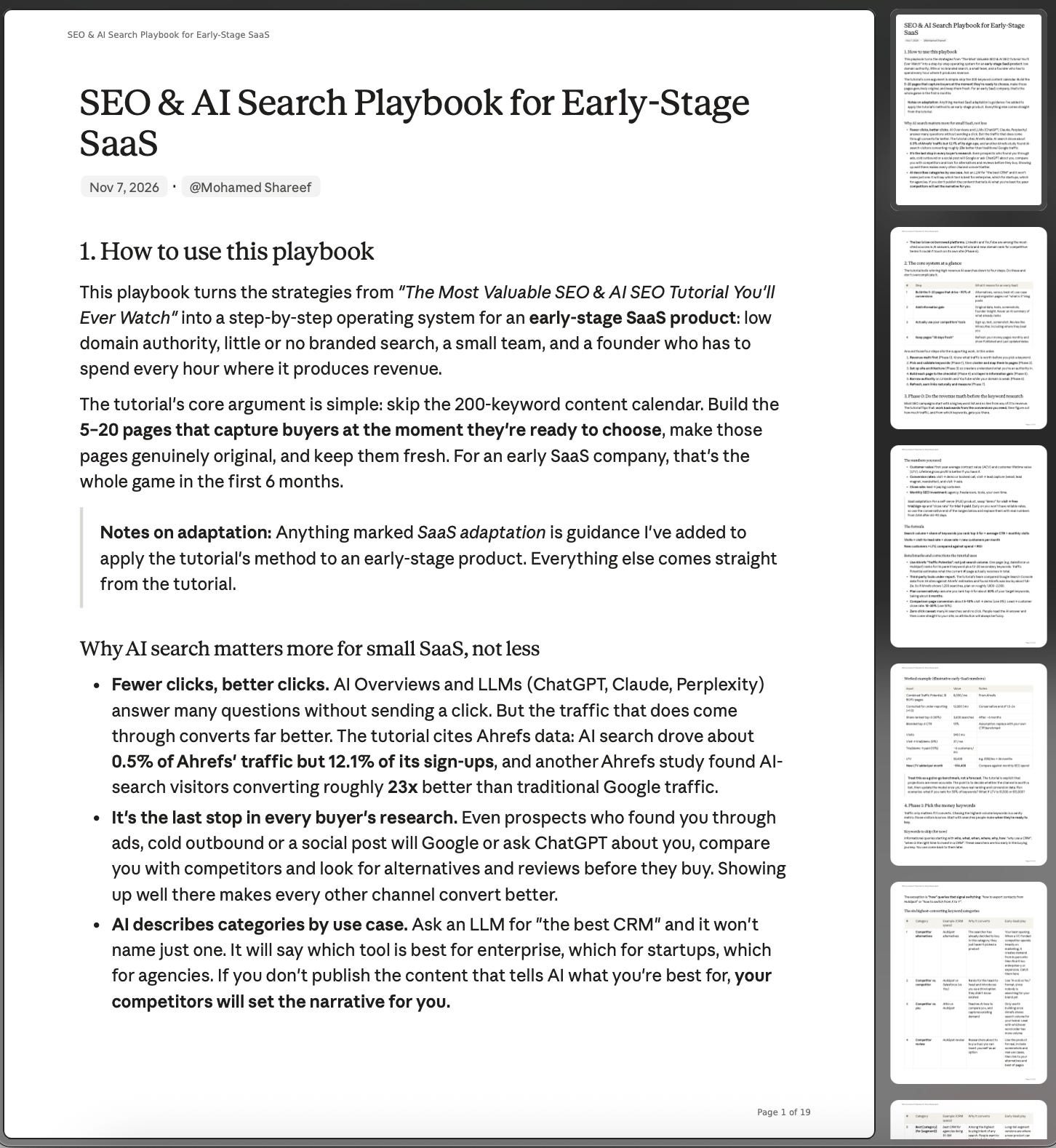
The clicks that do come through convert at a completely different level. Ahrefs found that AI search sent about 0.5% of its traffic, but 12.1% of its sign-ups.
AI search is where buyers go at the very end. To compare you. To look for alternatives. To decide. If you’re not on the page they read at that moment, you’re not in the decision.
I’ve been there.
When I launched Traffiklist, a distribution-first weekly launch board for indie makers, I had the same problem every new product has: no domain authority, no brand searches, and no idea which pages would bring the right people in.
So I stopped trying to “do SEO” and built a system instead. Then I plugged real data into it.
Here’s Traffiklist over the last 30 days (Oct 9 to Nov 7):
21,018 human visits, averaging 701 a day
1,342 visits on Nov 7 alone, up from under 400 a day at the start of the period
6,758 clicks sent to makers (32 for every 100 visits)
Visitors from 177 countries
133 live products from 118 makers

Here’s what I learned:
You don’t need more content. You need the right 5 to 20 pages.
The ones people search when they’re ready to choose. Those pages drive roughly 90% of conversions. Everything else is noise.
That’s why I turned the whole thing into something you can run yourself:
✅ A playbook: what to build, in what order, and why
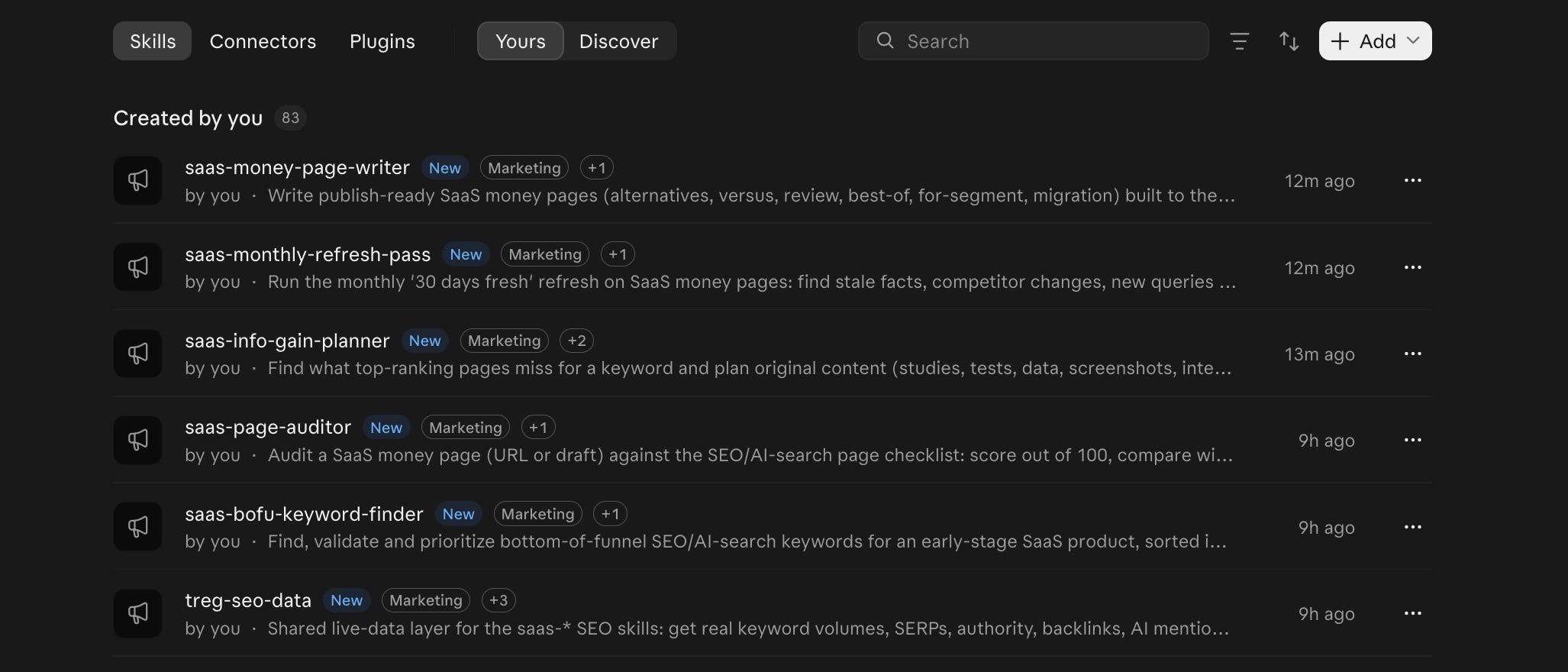
✅ 7 Claude skills: they find the keywords, plan the original content, write the pages, distribute them, audit them and refresh them
✅ A live data layer: real keyword volumes, live Google results and your own Search Console data, so nothing is an AI guess
Before: 40 blog posts, a keyword list and hope.
After: 10 pages matched to buying intent, built to a checklist, refreshed every month, measured with real numbers.
By the end of this issue, you’ll have:
✅ The 7-phase playbook at a high level (free, below)
✅ How the 7 skills turn it into a weekly workflow (free, below)
✅ The full playbook PDF, all 7 skill files and the setup guide
SEO/AEO System Developed
This isn’t theory. It’s a working system that runs inside Claude, the same $20/month Claude that sits at the center of my 3-tool stack.
It has three parts:
1. The Playbook (the strategy). What to build, in what order, and why. Seven phases, a page checklist, page templates and a 90-day rollout plan. It replaces the “publish and pray” approach with a short list of pages tied to revenue.
2. The Skill Stack (the execution). Seven Claude skills that do the actual work. You give them your product and competitors. They give you a ranked page list, publish-ready drafts, audits and monthly refresh edits.
3. The Live Data Layer (the proof). This is the part that changed everything for me. An AI writing SEO content without data is guessing with confidence. So the skills plug into Treg, a pay-per-call data service: one token for real keyword volumes, live Google results, authority scores, backlinks and your own Search Console. Every number in every output comes with a source and a date.
No $139/month Semrush plan.
No $99/month Moz plan.
You pay for the data you actually pull.
So how does it actually work? It starts with the playbook.
The Playbook: 7 Phases
Here’s the high-level version. The full PDF goes deep on every phase.
Phase 1: Do the revenue math before the keyword research
Most SEO starts with a keyword list.
This starts with money:
How many customers do you need, what is a customer worth, and how much traffic gets you there?
Search volume × share of keywords you rank for × click-through rate = visits.
Visits × conversion rate × close rate = customers.
If the math doesn’t work on paper, no amount of content will fix it.
Phase 2: Only chase money keywords
Skip “what is X”.
Those readers are months away from buying. Go after the searches people make when they’re ready to choose:
[Competitor] alternatives
[Competitor A] vs [Competitor B], with you as the third option
[Competitor] vs [You], once people search for you
[Competitor] review
Best [category] for [segment]
[Category] for [role or industry]
Plus one sneaky one: “how to export data from [competitor]”. Whoever searches, that is switching tools this week.
Someone searching “X alternatives” has already decided to buy. They just haven’t decided who from.
Phase 3: One page per buying question
Each page targets one main keyword plus 12 to 20 close variations.
If two of your pages chase the same search, Google can’t pick one, so often neither ranks.
Fewer, deeper pages beat many thin ones.
Phase 4: Give your site a clear structure
Folders like /alternatives/, /compare/, /for/ and /features/ tell Google and AI crawlers exactly what you’re an authority in. Set it up once and every page you publish after benefits.
Phase 5: Build every page to a checklist
The pages that rank and get quoted by AI all share the same parts:
Key takeaways at the top
How you tested (methodology)
A “best suited for” line for every option, including honest drawbacks
A comparison table with real numbers
An FAQ
3 to 5 calls to action that match what the reader searched
The comparison table is what AI quotes. “Best suited for” is how AI describes you. If you don’t write it, your competitors will.
Phase 6: Add something nobody else has
Google calls it information gain.
Screenshots from actually using your competitors’ tools. Your own data. A 30-minute test. A short founder video.
Not an AI summary of what already ranks. Why would Google rank your page if it says what the top 10 already say?
Phase 7: Borrow authority, then keep it fresh
New domain, weak authority? Publish a rewritten version of your page as a LinkedIn article from your company page, and a simple YouTube video. Both are among the most-cited sources in AI answers, so you rank on their authority while yours grows.
Then refresh every money page every 30 days. Fresh pages win. Stale pricing loses.
Traffic without conversions is a vanity metric.
From Playbook to Workflow: The 7 Skills
The playbook tells you what to do. The skills do it.
They run as one loop:
Find → Plan → Write → Distribute → Audit → Refresh.
1. BOFU Keyword Finder. Give it your product and competitors. It returns the first 10 pages to build, ranked, with real search volumes and how hard each one is to win for your domain. It also tells you which keywords to chase on LinkedIn and YouTube first.
2. Information Gain Planner. Reads the pages that currently rank, finds what all of them are missing, and tells you the cheapest original asset that fills the gap. It can even design a 30-minute test for you.
3. Money Page Writer. Publish-ready drafts from seven templates: alternatives, versus, review, best-of, “for [segment]”, migration guides. It leaves clearly marked placeholders for the screenshots and data only you can provide. It never fakes them.
4. LinkedIn Pulse Rewriter. I reverse-engineered a LinkedIn article that ranks #1 and gets cited in Google’s AI Overviews, and built its structure into this skill. It turns your page into a unique LinkedIn version, plus repost captions for your team.
5. Page Auditor. Scores any page out of 100, compares it with the top 3 results, and ranks the fixes from critical to polish.
6. Monthly Refresh Pass. Catches competitor price changes, new questions people are asking and ranking drops, then writes the exact edits. It never bumps a date on a page that didn’t really change.
7. Treg SEO Data. The shared data layer behind the other six. It estimates the cost before every run and saves results so you never pay for the same data twice.
Running it is one prompt:
Use saas-bofu-keyword-finder for [your product] at [your URL].
Competitors: [3 to 5 names and domains].
ICP: [who it's for].
US market, data budget $2.
You get back a keyword map, your first 10 pages and a run report showing exactly which data was pulled and what it cost.
What Changes
Before: you publish, wait and hope. You can’t tell which page earns its keep.
After:
You build 10 pages that match buying intent, not 40 that match curiosity
Every page follows the same checklist that AI answers pull from
Every number has a source and a date
Every page gets refreshed monthly, with real edits
You know which pages bring in customers
It also passes my 10:1 ROI rule.
The skills run on the Claude plan you already pay for.
The data is pay-per-call: Treg’s own example puts a weekly ranking check at about $0.12 per run.
Compare that with roughly $300 a month for Semrush, Moz and a SERP tool combined.
This is for you if you sell a SaaS, an app, a directory or a digital product, and you want search to bring in buyers.
It’s not for you if you want traffic for traffic’s sake. This system ignores vanity keywords on purpose.
Subscribe as a paid member to get this.
Note: If you need support to set this up, I am happy to sit with you and set this system; just let me know.