

Last month, I watched a friend celebrate landing their first $2,000 freelance client for social media management.
The impressive part?
They learned the skill…from zero…in just 8 weeks using AI as their personal tutor.
No $5,000 course. No 6-month bootcamp. Just AI, a clear goal, and a framework for learning that actually works.
But here’s what most people don’t tell you about learning with AI…
It can either make you genuinely skilled in months…or create a dangerous illusion that you know something when you really don’t.
The difference? How you use it.
And most creators are getting it completely wrong.
The Science Just Proved It Works (When Done Right)
A groundbreaking 2025 study from Harvard just dropped…and it’s changing everything we thought we knew about learning.
Researchers ran a randomized controlled trial comparing students who learned through an AI tutor versus those in traditional active-learning classrooms.
The results?
Students using the AI tutor learned significantly more, in less time, and felt more engaged.
Not just a little better. Significantly better.
Stanford followed up with their own research showing AI assistance improved student mastery by 4 percentage points overall…and for complete beginners, that jumped to 9 percentage points.
And a meta-analysis of intelligent tutoring systems found a 37.2% improvement in academic performance compared to traditional instruction.
Let me be clear:
AI-powered learning isn’t hype. It’s backed by rigorous science.
But…and this is critical…there’s a dark side no one’s talking about.
The Illusion of Competence
A Copenhagen University study found something alarming.
When students used generic AI like ChatGPT for learning, they developed what researchers call “the illusion of competence”….they felt skilled without actually being skilled.
An MIT study went deeper. They measured actual neural activity and found that students using ChatGPT for writing showed fewer neural connections than those writing independently.
Translation? Their brains weren’t actually learning. They were outsourcing thinking to the machine.
Here’s the distinction that changes everything:
People who treat AI as a learning partner build lasting skills and real businesses.
People who treat AI as an answer machine develop cognitive debt…and eventually get exposed.
I’ve seen both paths play out.
I’ve watched creators who “learned” with AI struggle when clients ask them to explain their process.
I’ve also watched creators like Nico…who learned to code with AI in 2 months…go on to build and sell apps for real money.
The difference isn’t the tool. It’s the method.
What This Post Will Give You
If you’ve been wanting to learn a new skill…copywriting, marketing, design, coding, content creation, SEO…but felt overwhelmed by the time investment…
This is your roadmap.
I’m going to show you:
✅ The exact 5-phase framework for using AI to learn any creative or business skill…without creating the illusion of competence
✅ The 7 roles AI should play in your learning journey (and the 2 most people default to that kill actual skill development)
✅ Real case studies of people who learned skills with AI and turned them into $3K-$10K/month businesses in 6-12 months
✅ The 5 business models that pair best with AI-learned skills…and realistic revenue timelines
✅ The critical pitfalls that derail most AI learners (and how to avoid them)
✅ Your action plan for starting this week…with specific prompts, tools, and steps
This isn’t about replacing human learning. It’s about compressing the timeline and removing the barriers that kept you from starting in the first place.
Because here’s the truth:
The market doesn’t care if you learned something in 4 years or 4 months. It only cares if you can deliver results.
And with the right approach, AI can help you get there faster than ever before…while building real expertise, not fake confidence.
Let’s dive in.
The Science Behind AI Learning (That Actually Works)
Let’s get one thing straight.
AI learning isn’t some productivity hack or shortcut that sacrifices quality for speed.
When done correctly, it’s actually superior to traditional learning methods.
The research proves it.
And I’m going to show you exactly why…so you can use this with confidence, not guilt.
What Harvard, Stanford, and MIT Actually Found
Greg Kestin and Kelly Miller at Harvard ran the first rigorous randomized controlled trial on AI tutoring in real educational settings.
Here’s what they did:
They split college students into two groups. One learned physics through in-class active learning (the gold standard of education). The other used a custom AI tutor designed with the same pedagogical best practices.
The results weren’t subtle.
Students using the AI tutor:
Learned significantly more content
Completed the material in less time (median: 49 minutes vs. 60 minutes)
Reported feeling more engaged
Felt more motivated to continue learning
This wasn’t a fluke. This was a controlled, scientific experiment showing that well-designed AI tutoring outperforms the best traditional teaching methods.
Stanford’s Tutor CoPilot research found that AI assistance improved student mastery by 4 percentage points overall.
But here’s what’s critical for you as a creator learning a new skill:
Novice learners…people starting from zero…improved by 9 percentage points.
The less you know, the more AI helps. That’s the opposite of what most people assume.
The Meta-Analysis
A comprehensive review of intelligent tutoring systems found a 37.2% improvement in academic performance compared to traditional instruction.
37%. That’s not marginal. That’s transformational.
But Here’s the Critical Distinction
Not all AI learning is created equal.
The Copenhagen University study published in Educational Psychology Review found something crucial:
Purpose-built AI tutors dramatically outperformed generic ChatGPT for actual learning outcomes.
The difference?
Pedagogically structured AI forces you to think.
Generic AI simply hands over answers.
This is the fork in the road. And most creators take the wrong path without realizing it.
The Two Types of AI Users
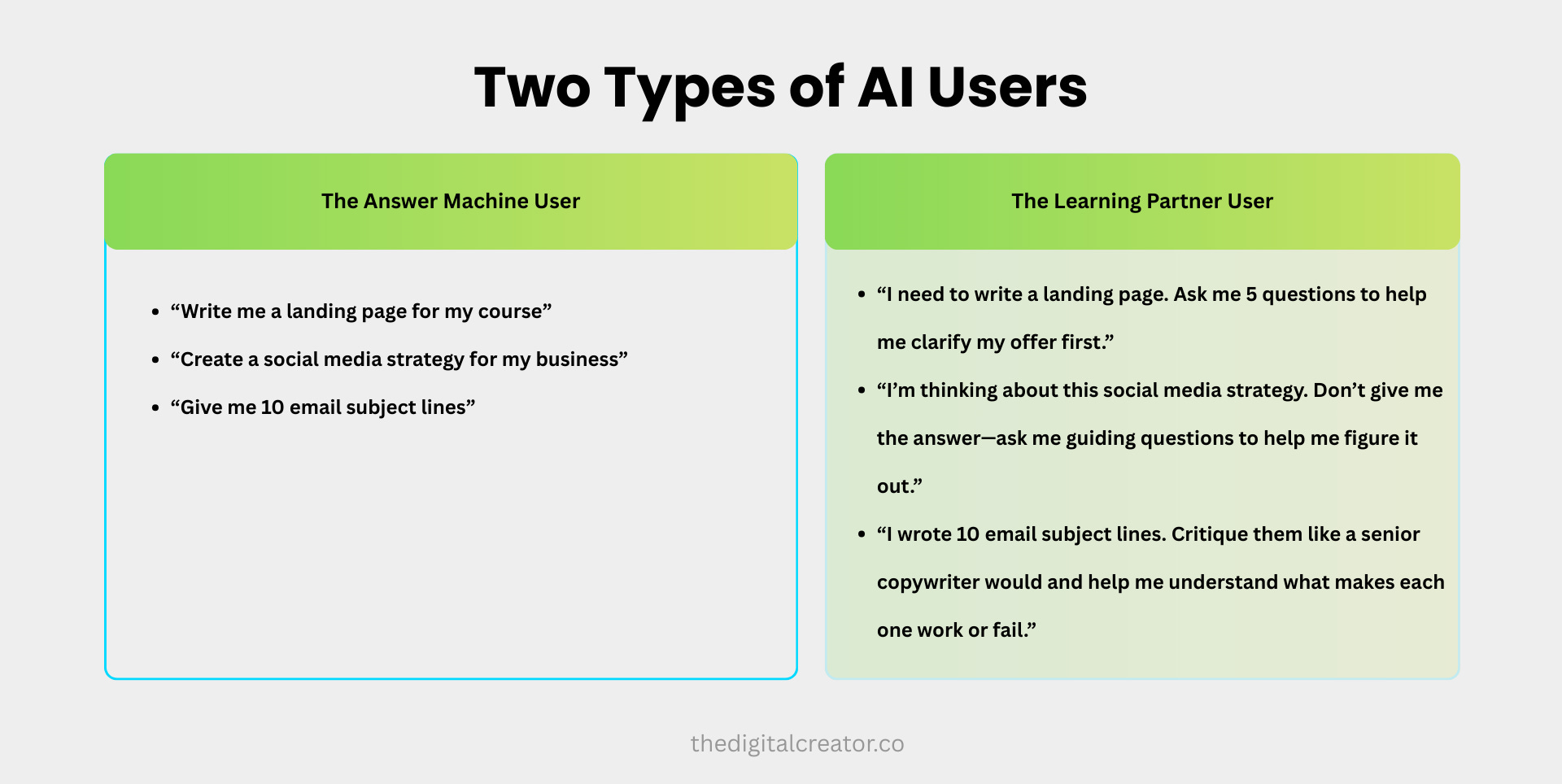
Type 1: The Answer Machine User
They open ChatGPT and say:
“Write me a landing page for my course”
“Create a social media strategy for my business”
“Give me 10 email subject lines”
They get instant output. They feel productive. They copy-paste and move on.
But their brain never engages. They’re outsourcing thinking, not accelerating it.
An MIT study on neural activity found that students using AI this way showed fewer neural connections than those working independently.
Over time, they develop what researchers call “cognitive debt”…a permanent erosion of their ability to think critically and solve problems independently.
Type 2: The Learning Partner User
They open ChatGPT and say:
“I need to write a landing page. Ask me 5 questions to help me clarify my offer first.”
“I’m thinking about this social media strategy. Don’t give me the answer—ask me guiding questions to help me figure it out.”
“I wrote 10 email subject lines. Critique them like a senior copywriter would and help me understand what makes each one work or fail.”
They use AI to accelerate their thinking, not replace it.
Their brain stays engaged. They build genuine understanding. And most importantly…they can perform the skill when AI isn’t available.
The “Lights Off” Test
Here’s how you know if you’re actually learning or just fooling yourself:
Can you perform the skill acceptably with AI completely unavailable?
If yes, you’ve genuinely learned. AI is now a force multiplier.
If no, you’ve been using AI as a crutch. And the moment a client asks you to explain your process or make a decision on the spot, you’re exposed.
I’ve seen both scenarios play out dozens of times with creators I’ve mentored.
The ones who pass the “Lights Off” test?
They’re building real businesses.
The ones who don’t?
They’re stuck in a loop of dependency and imposter syndrome.
Why This Matters for Your Business
You might be thinking: “Okay, but I’m not a student. I’m trying to build a business. Does this really apply to me?”
Absolutely.
Because here’s what I’ve learned after helping thousands of creators:
Your business growth is directly limited by your skill development.
You can’t sell copywriting services if you don’t understand copywriting principles.
You can’t build digital products if you can’t validate ideas and create structured content.
You can’t grow an audience if you don’t understand content strategy.
But here’s the good news:
You don’t need to become a world-class expert. You just need to be 2-3 steps ahead of the person you’re helping.
And with AI as a proper learning partner…not an answer machine…you can get there in months, not years.
The entrepreneurs making $5K-$10K/month with AI-learned skills?
They’re not using AI to fake expertise.
They’re using AI to genuinely accelerate their learning, then applying that knowledge to solve real problems for real people.
That’s the difference between a sustainable business and a house of cards.
The science is clear:
AI-powered learning works…but only when you use it to enhance your thinking, not replace it.
In the next, I’ll show you the exact 7 roles AI should play in your learning journey (and which ones to avoid), so you can make sure you’re on the right path.
Let’s keep going.
The 7 Roles AI Should Play in Your Learning Journey
Most creators use AI in only one or two ways.
And unfortunately, they’re usually the least effective ways for actual learning.
Ethan Mollick a Wharton professor and arguably the leading researcher on AI in education…published a framework that changes everything.
He identified 7 distinct roles AI can play in your learning process.
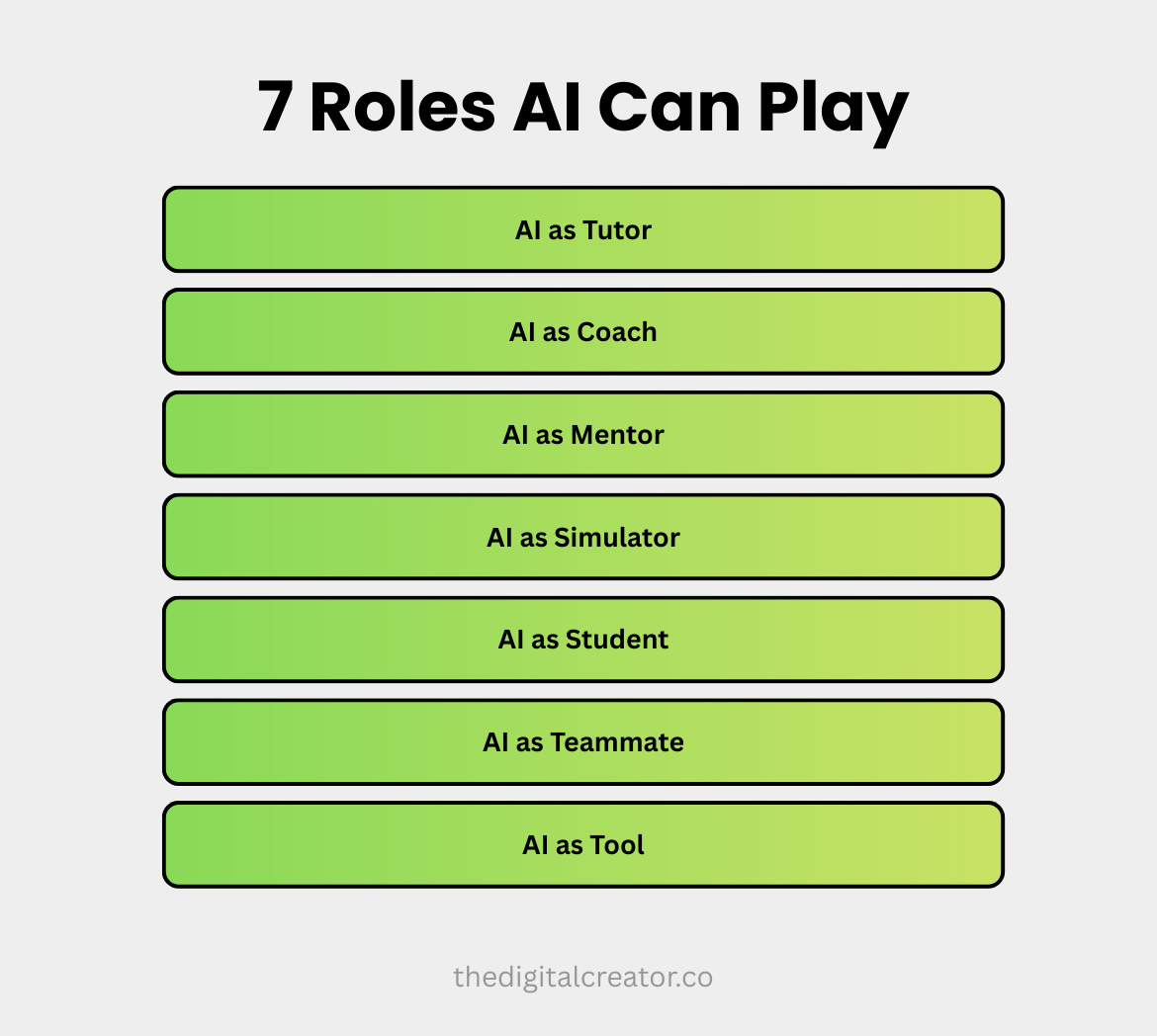
Each role serves a different purpose. Some build genuine expertise. Others just make you feel productive while your skills stagnate.
Let me break down all seven…with real examples for creators learning business and creative skills.
By the end of this, you’ll know exactly how to use AI to actually learn (not just get quick answers).
Role 1: AI as Tutor
What it does: Provides direct instruction, explains concepts, and adapts difficulty based on your level.
How creators should use it:
Let’s say you’re learning copywriting and need to understand the AIDA framework (Attention, Interest, Desire, Action).
Instead of reading a generic blog post, you ask:
“I’m a complete beginner in copywriting. Explain the AIDA framework to me. Then give me 3 progressively harder exercises to practice applying it…starting with a single sentence, then a paragraph, then a short email.”
The AI explains the concept, then generates practice exercises that increase in difficulty as you improve.
Real example from my journey:
When I was learning how to structure email sequences, I used Claude to explain the psychological principles behind effective email marketing. Then I had it generate increasingly complex scenarios…from a 3-email welcome sequence to a 9-email product launch sequence.
Each exercise built on the last. By the end, I understood why certain structures work, not just what to write.
The key: You’re using AI to teach you the fundamentals with adaptive difficulty…something a static course can’t do.
Role 2: AI as Coach
What it does: Prompts reflection and metacognition through structured questions. Helps you think about your thinking.
How creators should use it:
This is one of the most powerful roles…but the most underused.
Instead of asking AI to give you a marketing strategy, you ask it to help you think through your marketing strategy.
Example prompt:
“I’m trying to build a marketing strategy for my digital product. Don’t give me the strategy yet. Instead, ask me 5 probing questions that will help me clarify my target audience, their pain points, and the transformation my product delivers.”
AI responds with questions like:
“What’s the specific problem your target audience is trying to solve right now?”
“When they think about this problem at 2 AM, what emotion comes up?”
“What have they already tried that didn’t work?”
You answer these. Your brain engages deeply. By the time you’ve worked through the questions, you’ve created the strategy…AI just guided your thinking.
The Socratic method (learning through guided questions) is one of the most effective teaching techniques ever developed.
AI as coach replicates this. You’re not getting answers handed to you. You’re being forced to think critically and arrive at insights yourself.
This is how genuine expertise is built.
Role 3: AI as Mentor
What it does: Gives formative feedback on your works-in-progress.
How creators should use it:
You’ve written your first landing page for your digital product. Instead of publishing it immediately or asking for generic feedback, you use AI as a mentor:
“I’ve written this landing page copy. Review it like a senior copywriter with 10 years of experience would. Point out what’s working, what’s weak, and specifically why. Focus on structure, clarity of value proposition, and emotional resonance.”
AI gives you detailed, specific critique…not just “this is good” or “fix this,” but why certain elements work or don’t work.
Real creator example:
When I was building my AI Digital Product Builder course, I used Claude to review every module outline before I created content. I’d paste my structure and ask:
“Does this flow logically? Where might a beginner get confused? What’s missing that would make this more actionable?”
The feedback helped me see blind spots I couldn’t see myself. And because I was getting feedback during the process…not after publishing…I could iterate fast.
You’re doing the work. AI is reviewing it.
Your brain stays engaged, but you’re getting expert-level feedback at every stage.
Role 4: AI as Simulator
What it does: Creates realistic practice scenarios so you can rehearse before the real thing.
How creators should use it:
This is especially powerful for skills that involve human interaction…sales, client communication, pitching.
Example:
“I’m about to have a sales call with a potential client for my freelance copywriting services. Simulate that conversation. Play the role of a skeptical small business owner who’s been burned by freelancers before. I’ll respond to your questions and objections in real-time.”
AI becomes your practice partner. You rehearse handling objections, explaining your value, and asking for the sale…without the pressure of a real call.
After the simulation, you ask:
“How did I do? Where was I unclear? Where did I sound defensive? What could I have said differently?”
The key: Repetition without consequences. You can fail 20 times with AI and learn from every mistake…before you ever face a real person.
Role 5: AI as Student
What it does: You teach the concept to AI, and it identifies gaps in your explanation.
This is the most powerful role for deep learning.
There’s a proven technique called the Feynman Technique…named after Nobel Prize-winning physicist Richard Feynman.
The idea: If you can’t explain something in simple terms, you don’t really understand it.
AI makes this technique scalable.
How creators should use it:
You’ve just learned about content repurposing strategies. Now you test your understanding:
“I’m going to explain the core principles of content repurposing to you. Don’t help me or fill in gaps…just listen. After I’m done, tell me where my explanation was unclear, incomplete, or wrong.”
You explain the concept in your own words.
AI responds:
“Your explanation covered the ‘what’ and ‘how,’ but you didn’t explain why certain content formats work better for repurposing than others. You also didn’t address how to maintain brand voice consistency across different platforms.”
Now you know exactly what you don’t understand yet.
This forces you to engage at the deepest level. And research shows that teaching others (or in this case, an AI) is one of the most effective ways to solidify your own knowledge.
The key: You’re not consuming information. You’re actively reconstructing it in your own words…which is where real learning happens.
Role 6: AI as Teammate
What it does: Brainstorming collaborator…helps generate ideas and explore possibilities.
How creators should use it:
This is useful for creativity and ideation, but less effective for skill-building.
Example:
“I’m brainstorming content ideas for my newsletter about productivity for remote workers. Give me 20 angles I haven’t thought of.”
AI generates a list. You pick the ones that resonate. It’s helpful…but your brain isn’t learning a transferable skill here.
When to use this role: When you’re stuck creatively or need fresh perspectives quickly.
When NOT to rely on this role: If you’re trying to actually learn ideation frameworks and creative thinking strategies. In that case, use AI as Tutor or Coach instead.
Role 7: AI as Tool
What it does: Task executor…does the work for you.
How creators use it:
“Write me a week’s worth of social media posts.” “Create a landing page for my course.” “Draft 5 email sequences for my product launch.”
AI generates output. You copy, paste, and publish.
This is the most common way people use AI. And it’s the worst for learning.
Your brain never engages. You’re not building skills…you’re renting AI’s skills.
When this role is useful: After you’ve already mastered the skill and need to scale output. For example, once I deeply understood email marketing principles, I started using AI to draft variations faster. But I still review, edit, and refine everything based on my own judgment.
When this role is dangerous: When you use it instead of learning the skill yourself.
How to Apply This Today
Pick one skill you want to learn this month.
Then decide which AI role will help you most right now:
Starting from zero? → Use AI as Tutor to learn fundamentals
Understand the basics but need to go deeper? → Use AI as Coach to guide your thinking
Created something but not sure if it’s good? → Use AI as Mentor for feedback
Need to practice before the real thing? → Use AI as Simulator
Want to test if you really understand it? → Use AI as Student
Save Teammate and Tool for after you’ve built the foundation.
In the next section, I’ll give you the complete 5-phase framework that combines these roles into a step-by-step learning system…one that takes you from complete beginner to monetizable skill in 12 weeks or less.
And I’ll show you the exact prompts I use at each phase.
The 5-Phase AI Learning Framework
Okay, now we get to the practical part.
Everything we’ve covered so far…the science, the roles, the theory…it all comes down to this:
A repeatable framework you can use to learn any creative or business skill with AI.
I’ve used this exact process to learn email marketing, SEO, product creation, and automation. And I’ve watched dozens of creators use variations of it to go from zero knowledge to paid clients in 8-12 weeks.
This isn’t about speed for speed’s sake. It’s about compressing the learning curve without sacrificing depth.
Here’s the framework…broken into 5 phases, with specific timelines, AI roles, and prompts you can copy-paste.
Phase 1: Map the Territory (Week 1-2)
Goal: Generate a structured learning roadmap and understand the foundational concepts.
AI Roles to Use: Tutor + Coach
Why this phase matters:
Most people start learning by randomly consuming content…YouTube videos, blog posts, courses…with no clear sequence or progression.
That’s how you end up with a scattered understanding and no idea what to focus on next.
Instead, use AI to create a personalized curriculum in minutes.
Prompt to use:
I'm a complete beginner in [skill]. Map out the 10 most important foundational concepts I need to learn first, in order, with specific exercises for each.

For each concept:
- Explain why it matters
- Give me one focused exercise to practice it
- Tell me how I'll know I've mastered it

Start with concept #1.
Real example:
When I decided to learn cold email outreach for partnerships, I used this exact prompt. Claude gave me a roadmap starting with:
Understanding email deliverability fundamentals
Writing subject lines that get opened
Crafting body copy that drives responses
Building follow-up sequences
Analyzing and optimizing performance
Each concept built on the previous one. No guessing. No overwhelm.
The Critical Practice: The Feynman Technique
After AI explains a concept, don’t just move on. Use AI as Student to test your understanding:
I'm going to explain [concept] back to you in my own words. Don't help me or fill in gaps—just listen. After I'm done, tell me where my explanation seems thin, unclear, or incomplete.This forces your brain to reconstruct the information…which is where real learning happens.
What you’ll have by the end of Week 2:
✅ A clear, sequenced learning path
✅ A working understanding of the 3-5 core concepts
✅ Confidence that you know what to focus on next
Phase 2: Build Understanding Through Active Practice (Week 3-6)
Goal: Apply what you’ve learned through deliberate, hands-on practice.
AI Roles to Use: Simulator + Mentor
Why this phase matters:
Knowledge without application is useless. You need to practice the skill in realistic scenarios…and get feedback fast.
The Non-Negotiable Rule:
Always attempt the work yourself before consulting AI.
Research consistently shows that the cognitive struggle of trying something independently…even failing…creates stronger neural pathways than receiving a polished answer.
Prompt structure for this phase:
Create a realistic scenario where I need to [apply the skill]. Give me the brief but not the solution.

After I share my work, critique it like a [senior professional in the field] would. Point out:
- What's working and why
- What's weak and why
- What I should improve next
- One specific technique I should study
Real example from my journey:
When I was learning to write landing page copy, I used this prompt:

The Practice Loop:
Get a scenario from AI
Attempt the work yourself (no AI help)
Submit for critique
Implement the feedback
Repeat with a slightly harder scenario
Do this at least 10 times during weeks 3-6.
Phase 3: Apply Skills to Real Projects (Week 7-10)
Goal: Bridge the gap between practice and real-world application.
AI Roles to Use: Mentor + Coach (sparingly)
This is where learning and earning begin to overlap.
AI practice scenarios are useful…but nothing replaces feedback from real clients, real audiences, and real market validation.
What “real projects” means:
A small freelance gig on Upwork or Fiverr
A blog where you publish your work publicly
A free project for a friend’s business
A digital product prototype (even if it’s simple)
The pattern among successful AI-learner-entrepreneurs:
They don’t wait until they’re “ready.” They ship something real while still learning.
Real examples:
Nico learned to code with AI and shipped his first app while still learning. That app taught him more than any tutorial could.
Sweta Bose started writing blog posts for a pet store client while still developing her copywriting skills. Real client feedback accelerated her learning faster than any course.
How to use AI during this phase:
AI shifts from teacher to review partner.
You’re working on real projects now. Use AI to:
Before you start:
I'm about to [work on real project]. What are the 3 most common mistakes beginners make with this type of project? Help me avoid them.After you complete a draft:
I just completed [real project]. Review it and tell me:
- Does this achieve the goal?
- Where would a professional do this differently?
- What's the one thing I should improve before submitting?
The key difference: You’re not asking AI to do the work. You’re asking AI to help you refine work you’ve already done.
What you’ll have by the end of Week 10:
✅ 2-3 real projects completed (paid or unpaid)
✅ Testimonials or feedback from real people
✅ A portfolio you can show potential clients
✅ Proof that you can deliver results—not just practice
Phase 4: Deepen Expertise Through Deliberate Practice (Week 11-14)
Goal: Move from “competent” to “confident” by challenging your assumptions and filling knowledge gaps.
AI Roles to Use: Coach + Student (debate partner mode)
By now, you can do the skill. But you might not fully understand why certain approaches work or when to break the rules.
This phase is about developing judgment—the kind that separates decent work from exceptional work.
Prompt for this phase:
I just completed [work]. I'm going to explain my strategic decisions and reasoning. Your job is to challenge my assumptions and help me see blind spots. Play devil's advocate.

After I explain, ask me:
- "Why did you choose this approach over alternatives?"
- "What assumption are you making about the audience?"
- "Where might this fail?"
- "What would a senior practitioner do differently?"
Real example:
When I was refining my email marketing skills, I’d write a launch sequence and then explain to Claude why I structured it that way…why email 1 focused on story, why email 3 introduced urgency, why I waited until email 5 to present the offer.
Claude would challenge me: “What if your audience doesn’t respond to urgency? What would you do then?”
I’d have to think. And that thinking deepened my understanding beyond just following formulas.
The Advanced Technique: Interleaving
Instead of practicing one skill in isolation, mix different sub-skills in a single session.
For example, if you’re learning content marketing:
Write a Twitter thread (short-form)
Immediately switch to a newsletter (long-form)
Then write an email subject line (persuasion)
This forces your brain to make connections between skills…which is how expertise develops.
What you’ll have by the end of Week 14:
✅ Deep understanding of why things work, not just what works
✅ Ability to adapt skills to different contexts
✅ Confidence to break rules when appropriate
✅ The start of your own frameworks and systems
Phase 5: Achieve Independence and Scale (Week 15+)
Goal: Prove you can perform without AI. Then use AI as a force multiplier to scale output.
AI Roles to Use: Tool (finally)
Why this phase matters:
This is where you test whether you’ve genuinely learned or just developed AI dependency.
The “Lights Off” Test:
Take a project and complete it with AI completely unavailable.
No ChatGPT. No Claude. No AI tools at all.
Can you still deliver quality work?
If yes → You’ve built genuine expertise.
Congratulations. AI is now a productivity tool, not a crutch.
If no → Go back to Phase 2 and repeat the practice loop.
You’re not ready yet.
Once you pass the test:
Now…and only now…should you use AI primarily as a tool for scaling.
Use it to:
Generate first drafts faster (which you then refine)
Create variations of proven content
Automate repetitive tasks
Handle volume while your expertise ensures quality
This is where successful solopreneurs like Justin Welsh operate:
Strategy and creative vision are entirely human. AI handles execution and scale.
What you’ll have by Week 15+:
✅ Genuine, marketable skills
✅ A portfolio of real work
✅ Confidence to charge professional rates
✅ A system for scaling output without sacrificing quality
✅ The foundation of a real business
This isn’t fast. But it’s faster than traditional learning.
And unlike shortcuts that create the illusion of competence, this builds real skills that translate to real income.
The pattern I’ve seen over and over:
Months 1-3: Learn the skill, practice daily, take on low-risk projects
Months 4-6: Build portfolio, charge introductory rates, refine through client work
Months 7-12: Raise rates, add passive income streams, systematize
By month 12, creators following this framework are consistently making $3K-$10K/month.
Not from faking it. From genuinely knowing what they’re doing.
In the next section, I’ll show you real people who followed this exact path…and what they built in 6-12 months.
Real People Who Did This (And What They Built)
Let me show you what’s actually possible.
Not theory. Not hypotheticals.
Real people who used AI to learn skills and turned those skills into income.
These aren’t outliers or exceptions. They’re following the same pattern…and I’m going to show you exactly what that pattern looks like.
Before we dive in, here’s what you need to know:
None of these people were “experts” before they started.
They didn’t have fancy degrees or 10 years of experience.
They had a goal, a learning method, and the willingness to ship before they felt ready.
And here’s the pattern they all followed:
Learn fast → Ship fast → Iterate based on real market feedback
Not “learn everything first, then launch perfectly.”
That approach keeps you stuck forever.
Let’s look at how this actually plays out.
Case Study 1: Nico – From Zero Coding Skills to $5K/Month in 12 Months
Background: College dropout with no technical background
What he learned: Coding, using AI as his primary learning tool
Timeline: 2 months to first working app
The Journey:
In July 2022, Nico decided to learn coding. He didn’t enroll in a bootcamp. He didn’t spend months watching tutorials.
He used ChatGPT and Claude as his tutors…and more importantly, he started building real apps immediately.
Month 1-2: Learned basic programming concepts while building simple utility tools
Month 3-14: Shipped 17 apps in one year
Yes, seventeen.
Most didn’t succeed. But that’s the point…he was learning by doing, and each failure taught him something new.
The Breakthrough:
One of those 17 apps? He sold it for $65,000.
Another app, Talknotes (an AI voice note tool), grew to $5,000/month in recurring revenue with over 10,000 users.
What made this work:
Nico didn’t wait until he was “ready.” He shipped messy, imperfect apps while still learning. Real users gave him feedback AI never could. That feedback loop accelerated his learning faster than any course would have.
The lesson:
You don’t need to master the skill before monetizing it. You need to be good enough to solve a real problem…then let the market teach you the rest.
Case Study 2: Joe – From Writer to $1M Book Publishing Business
Background: Writer with no publishing experience
What he learned: Self-publishing, book marketing, and automated content creation with AI
Timeline: Months to first sales, under 1 year to $1M valuation
The Journey:
Joe used ChatGPT’s iterative prompting to develop book outlines, flesh out chapters, and refine drafts.
But here’s what’s remarkable: the speed.
He wrote and published 40 titles within months…a pace impossible without AI assistance.
The Process:
Used AI to generate and refine book outlines
Wrote drafts with AI as a writing partner (not ghost writer)
Self-published on Amazon KDP
Ran targeted Pinterest ads to drive traffic
Built professional landing pages to convert browsers into buyers
The Result:
Within a year, Joe sold 50% of his publishing brand at a $1 million valuation.
What made this work:
Joe didn’t use AI to replace his creativity. He used it to accelerate output and remove bottlenecks. The strategy, positioning, and marketing decisions? All him.
He also mastered a skill most creators ignore: paid traffic. He learned to run ads profitably, which multiplied his reach.
The lesson:
Speed matters…but only when combined with strategy. Joe didn’t just publish fast. He published strategically and marketed intelligently.
Case Study 3: Sweta Bose – $5K/Month from 8 Income Streams
Background: No formal training in any of her income streams
What she learned: Multiple content creation and marketing skills using ChatGPT
Timeline: Built to $5K/month over 6-9 months
The Income Breakdown:
Sweta didn’t build one big business. She built a portfolio of services, all powered by skills she learned with AI:
Blog writing: $1,200/month
Email outreach campaigns: $1,000/month
Product descriptions: $800/month
Social media calendars: $600/month
Video scripts: $400/month
AI micro-tools: $400/month
SEO packages: $300/month
Translation services: $250/month
Total: $5,000/month
The Process:
Started on Upwork and Fiverr with zero clients. Used AI to:
Learn each skill through the 5-phase framework
Create portfolio samples quickly
Deliver client work faster (while maintaining quality)
Eventually shift clients to monthly retainers for recurring revenue
What made this work:
Sweta didn’t try to master one skill to perfection. She learned multiple complementary skills to “good enough” level, then stacked them.
This diversification also protected her income—if one stream dried up, she had seven others.
The lesson:
You don’t need to go deep on one skill immediately. You can go wide, serve clients across multiple needs, and build a resilient income stack.
Case Study 4: The SaaS Developer – From Idea to $300K Acquisition in 3 Months
Background: Developer with basic coding knowledge
What he learned: SaaS development, AI-assisted coding, copywriting, and user onboarding…all with AI
Timeline: 3 months from idea to acquisition
The Journey:
This developer wanted to build a SaaS tool for cold email outreach. He used ChatGPT to write 80% of the code, plus all the marketing copy and onboarding flows.
Week 1: Built the MVP
Week 2: Shared it in an indie developer Discord community
Week 4: A semi-viral tweet drove signups
Month 2: Reached $6,000 in monthly recurring revenue
Month 3: Signed a term sheet for a $300,000 acquisition
No pitch deck. No venture capital.
Just product-market fit validated through rapid iteration.
What made this work:
Speed and focus. Instead of building the “perfect” product, he built something minimal but useful, got it in front of users immediately, and iterated based on real feedback.
AI accelerated every step…coding, copywriting, user flows…but the strategic decisions about what to build and who to build it for? All human.
The lesson:
The market rewards speed + focus. Build fast, ship fast, and let users tell you what to improve.
The Common Pattern Across All Success Stories
Look at what these creators have in common:
✅ They didn’t wait to be “ready”
They shipped imperfect work and learned from real market feedback.
✅ They used AI to accelerate, not replace, their thinking
AI handled execution speed. They handled strategy and judgment.
✅ They focused on solving real problems
Not “cool ideas”…actual pain points people would pay to fix.
✅ They iterated based on data, not feelings
When something didn’t work, they pivoted fast.
✅ They monetized early
They didn’t wait for “the perfect product.” They started earning while still learning.
What About the Failures?
Here’s what the research doesn’t show but I know from experience:
For every success story, there are 10 people who started and quit.
Why did they quit?
They used AI as a crutch instead of a learning partner (Roles 6-7 only)
They never shipped anything real (stayed in “learning mode” forever)
They gave up after the first client said no (didn’t iterate)
They tried to monetize before building genuine competence (skipped Phases 1-4)
The people who succeed? They follow the framework. They pass the “Lights Off” test. They ship imperfect work. They persist through early rejection.
That’s the difference.
Your Next Step
These stories aren’t meant to inspire you into inaction (”Wow, that’s amazing, I could never do that”).
They’re meant to show you what’s possible when you follow a proven process.
Nico, Joe, Sweta, and the SaaS developer didn’t have anything you don’t have. They just had a method…and the courage to ship before they felt ready.
In the next section, I’ll show you the 5 specific business models that pair best with AI-learned skills…so you know exactly what type of business to build once you’ve developed your expertise.
And I’ll give you realistic revenue expectations for each model.
The 5 Business Models That Pair Best with AI-Learned Skills
You’ve learned a skill with AI. Now what?
Most creators hit a wall here.
They’ve got the capability…but no clear path to monetization.
So they keep “learning” (procrastinating) or jump into random tactics without a real business model.
Here’s the truth: Not all business models are equally suited to AI-learned skills.
Some require deep expertise and years of credibility.
Others reward speed and systematization…which is exactly what AI-assisted learning gives you.
I’m going to show you the 5 models that work best, ranked from lowest barrier to entry to highest leverage.
For each one, I’ll give you:
What it is and how it works
Real revenue expectations (not hype)
Pros and cons
How to get started this month
Let’s go.
Model 1: Freelancing – The Fastest Path to Your First Dollar
What it is:
You offer services based on the skills you’ve learned. Clients pay you to do the work.
Why it pairs perfectly with AI-learned skills:
Fiverr reported a 1,400% increase in demand for AI-related services. Clients aren’t checking if you have a degree…they care if you can solve their problem.
With AI-accelerated learning, you can go from zero to “good enough to get paid” in 8-12 weeks.
The Playbook:
Learn a high-demand skill (copywriting, social media management, email marketing, web design, SEO)
Create 3-5 portfolio samples using the Phase 2 practice exercises (even if they’re not for real clients yet)
Start offering services on Upwork, Fiverr, or LinkedIn at competitive rates
Build portfolio through real client work (testimonials are gold)
Raise rates every 3-5 clients
Transition best clients to monthly retainers for predictable recurring revenue
Pros:
✅ Lowest barrier to entry…start earning within weeks
✅ Cash flow while you’re still learning
✅ Real client feedback accelerates skill development
✅ No upfront investment needed
Cons:
❌ Trading time for money (initially)
❌ Client management can be draining
❌ Income stops when you stop working (until you build retainers)
Who this works best for:
People who need cash flow now. Those who learn best by doing real work. Anyone building confidence through client validation.
Model 2: Digital Products – The Highest Leverage Play
What it is:
You create something once…a course, ebook, template, toolkit, or system…and sell it repeatedly at near-100% profit margins.
Why it pairs perfectly with AI-learned skills:
One course creator used ChatGPT for scripting, ElevenLabs for narration, and Canva for design to generate $150,000 in course sales in under six months…with no team.
AI dramatically lowers the barrier to creating professional digital products. What used to take months now takes weeks.
The Playbook:
Validate your idea before building (don’t skip this—ask 20 people if they’d pay for it)
Create your MVP product (minimum viable product—it doesn’t need to be perfect)
Launch with a simple landing page (I use Gumroad—setup takes 1 hour)
Drive traffic through content (social posts, newsletter, community)
Collect testimonials and iterate based on real buyer feedback
Build evergreen funnels so it sells while you sleep
Pros:
✅ Create once, sell infinitely
✅ No client management
✅ True passive income potential
✅ Scales without your time
Cons:
❌ Requires upfront time investment
❌ Needs audience or traffic source
❌ Can take 3-6 months to gain momentum
❌ Market validation is critical (or you waste months)
Who this works best for:
Creators who have (or are building) an audience. Those who love teaching and systematizing. Anyone who wants true location independence.
Real example from my journey:
My AI SEO PLaybook? Built entirely using the principles I’m sharing with you today.
I validated it with a lead magnet first. Got 100+ email signups. Then I created the course using AI to help structure modules, draft content, and refine copy.
Result: 900+ students are learning from this.
That product still generates income every month while I sleep.
How to start this month:
Not next quarter. This month.
Pick ONE problem your audience has that you’ve solved
Create a simple lead magnet (free guide, checklist, template) to validate interest
Promote it for 2 weeks and see if people actually download it
If 50+ people download it, create the paid product
Use AI to help structure and create content (but YOUR expertise and examples make it valuable)
Launch with a simple 5-7 day email sequence
And if you want the complete blueprint for this process…from validation to launch…that’s exactly what I teach in my AI Digital Product Builder course.
It’s the exact system I used to build and sell my own digital products. Every module. Every template. Every prompt.
Model 3: Content Businesses – Turn Your Expertise Into Audience
What it is:
Blogs, newsletters, YouTube channels, podcasts…content platforms that build audience and monetize through multiple streams (sponsorships, affiliates, your own products).
Why it pairs perfectly with AI-learned skills:
AI’s ability to maintain consistent production schedules is unmatched. Faceless YouTube channels using AI-automated content production (scripts, voiceovers, thumbnails, editing) report earning $10,000/month in ad revenue.
Newsletter businesses monetize through sponsorships, affiliate marketing, and digital product sales.
The Playbook:
Pick ONE platform to start (don’t spread yourself thin)
Publish consistently (AI helps you maintain pace without burnout)
Build email list from day one (your most valuable asset)
Monetize in layers:
Layer 1: Affiliate links to tools you actually use
Layer 2: Sponsorships (once you hit 5K+ subscribers/followers)
Layer 3: Your own digital products (highest margin)
Pros:
✅ Builds a lasting asset (your audience)
✅ Multiple monetization options
✅ Compounds over time
✅ Positions you as an authority
Cons:
❌ Slowest to generate income
❌ Requires consistent output (months/years)
❌ Audience building is hard work
❌ Can feel like “creating for free” initially
Who this works best for:
Long-term thinkers. People who enjoy creating content. Those building personal brands. Anyone who wants to own their distribution.
Real example from my journey:
The Digital Creator newsletter…the one you’re reading right now…is this model in action.
Now 18,000+ subscribers.
Monetized through:
My own digital products
Premium memberships ($150/year)
Strategic partnerships
And here’s the beautiful part: every newsletter I write drives traffic to my products. It’s a self-reinforcing system.
How to start this month:
Choose your platform (I recommend starting with X/Twitter + Newsletter)
Commit to publishing 2x/week minimum for 90 days
Use AI to help you maintain pace (ideation, drafting, editing…but your voice and insights are what matter)
Collect emails from day one (use a free lead magnet)
Document your learning journey (you’re already ahead of 95% of your audience)
For the complete playbook on building a newsletter business with AI…including my exact content system, automation setup, and monetization strategy…check out my Premium Membership.
You’ll get access to the Substack SEO/AEO Implementation Toolkit, my content distribution system, and all my premium courses at 45% off.
Or you can…
Model 4: Micro-SaaS and App Businesses – Build Once, Earn Forever
What it is:
Small software tools or apps that solve specific problems. Usually subscription-based ($5-$50/month per user).
Why it pairs perfectly with AI-learned skills:
AI coding assistance has made app development accessible to non-developers. One entrepreneur built two complete utility websites with ChatGPT in a single hour and sold both within a day on TinyAcquisitions.
The Playbook:
Identify a specific friction point in your target market
Build MVP using no-code tools or AI-assisted coding (Bubble, Webflow, or code with ChatGPT/Claude)
Launch in relevant communities (ProductHunt, Reddit, Twitter)
Iterate based on user feedback (fast cycles)
Focus on retention (monthly recurring revenue compounds)
Pros:
✅ High scalability (software scales infinitely)
✅ Recurring revenue (monthly subscriptions)
✅ Can be sold for 3-5x annual revenue
✅ True passive income potential
Cons:
❌ Higher technical barrier (even with AI)
❌ Requires ongoing maintenance
❌ Competitive market
❌ Finding product-market fit is hard
Who this works best for:
Technical learners. Problem-solvers. Those with patience to iterate. Anyone wanting to build a sellable asset.
Real example:
Remember the SaaS developer from the last section? Built a cold email tool with 80% of code written by ChatGPT, reached $6K MRR in 2 months, and sold for $300K.
How to start this quarter:
Spend 2 weeks talking to your target market (what tools do they wish existed?)
Build the simplest possible version that solves ONE problem really well
Launch to 10-20 beta users (free or deeply discounted)
Iterate based on their feedback (not your assumptions)
If 5+ people say “I’d pay for this”, build v2 and start charging
Model 5: AI-Augmented Agency Work – Deliver Agency Quality, Keep Solo Margins
What it is:
Positioning yourself as a high-end service provider who uses AI to deliver 3-5x more output than traditional agencies…while maintaining quality and keeping costs low.
Why it pairs perfectly with AI-learned skills:
One freelance designer using AI delivers three times more client projects than before…income doubled while workload halved.
You’re not competing on price.
You’re competing on speed + quality + value.
The Playbook:
Master ONE high-value service (brand strategy, content systems, marketing automation)
Use AI to handle execution at scale (your expertise ensures quality)
Position yourself as strategic partner, not order-taker
Charge premium rates ($5K-$20K per project or $3K-$10K/month retainers)
Keep client load small (3-5 clients max—focus on results, not volume)
Pros:
✅ Premium pricing (charge what you’re worth)
✅ Fewer clients, more impact
✅ AI lets you punch above your weight
✅ Can evolve into productized service
Cons:
❌ Requires strong positioning and sales skills
❌ Longer sales cycles
❌ Still trading time for money (but at higher rates)
❌ Need proven results to command premium pricing
Who this works best for:
Experienced freelancers ready to level up. Strategic thinkers. Those who want fewer clients but higher revenue. Anyone building toward a productized service model.
How to start:
This isn’t for complete beginners. You need 6-12 months of experience first (Models 1-2).
Once you’re there:
Identify your highest-leverage skill (what gets clients the best results?)
Package it as a productized service (fixed scope, fixed price)
Use AI to systematize delivery (templates, workflows, automation)
Focus on outcomes, not hours (charge based on value delivered)
Build case studies that prove ROI
Which Model Should You Choose?
If you need cash flow now: Start with Freelancing (Model 1)
If you’re building for long-term leverage: Focus on Digital Products (Model 2)
If you love creating content: Build a Content Business (Model 3)
If you’re technical and patient: Explore Micro-SaaS (Model 4)
If you’re experienced and strategic: Level up to Agency Work (Model 5)
The smart play? Start with Model 1, add Model 2 by month 6, and let Model 3 amplify both.
That’s exactly what I did…and what I teach inside my courses.
Your Next Move
Let me bring this all together.
We’ve covered a lot…the science, the framework, the success stories, the business models.
But here’s what matters most:
The path from AI-assisted learning to profitable online business is real. It’s documented. And it’s accelerating.
The global AI education market reached $7.57 billion in 2025 and is projected to exceed $112 billion by 2034.
PwC’s research finds that AI-exposed roles command an average 56% wage premium.
The opportunity isn’t coming. It’s here.
But Success Requires a Specific Formula
Not everyone who learns with AI succeeds. In fact, most don’t.
The difference between those who build real businesses and those who develop the “illusion of competence” comes down to this:
AI for speed and scale + Human judgment for strategy and relationships + Focused niche expertise
The winners aren’t using AI to replace their thinking. They’re using it to amplify their capabilities while building genuine skills.
And they follow a sequence that matters more than any specific tool or technique:
They write first, build first, think firs…then use AI to critique, refine, and scale.
That order is everything.
The Resources to Get You There Faster
You don’t have to figure this out alone.
I’ve spent the last two years building systems, frameworks, and courses specifically for creators who want to learn with AI and build lean, profitable businesses.
If you want the complete roadmap for building a digital product from scratch:
This is my flagship course. It takes you from skill discovery to your first digital sale in 7 weeks. Every module includes AI prompts, templates, and my exact process for validation, creation, and launch.
If you want to master content creation and audience growth:
→ Viral X Thread Blueprint ($149)
The exact system I used to grow from 3K to 75K followers on X in 5 months. Includes AI-powered content frameworks, hooks, and distribution strategies.
→ AI SEO Playbook ($49)
Learn how to use AI to dominate search rankings and drive consistent organic traffic to your offers.
If you want everything, plus ongoing support:
→ Premium Membership ($39/month or $150/year)
Get all three courses above at 45% off, plus:
5 Premium Claude Skills (AI agents for specific tasks)
Complete AI Agents Collection
Substack SEO/AEO Implementation Toolkit
Exclusive community access
All future courses and updates
This is the best value if you’re serious about building a sustainable creator business with AI.
One Final Thought
The entrepreneurs who win in the next decade won’t be those who use AI 100% or those who reject it completely.
They’ll be the ones who understand how to use AI to build genuine expertise faster…then apply that expertise to solve real problems for real people.
They won’t do it alone. They’ll do it alongside others who understand the challenges and opportunities of this moment.
That’s exactly why I built The Digital Creator community and newsletter. To help creators like you turn skills into income, content into business, and ideas into assets.
You’ve got the roadmap now. The science. The framework. The examples. The business models.
The only question left is: Will you start?
Because the market rewards action, not intention.
Start with a real problem. Learn the minimum skills needed to solve it. Ship something imperfect quickly.
And let the market teach you what AI cannot.
Your next level is waiting.
—Sharyph
P.S. — Get Started Today (Free)
Not ready to invest yet? I get it.
Start with my free lead magnet: The Lean AI-Powered Business Playbook for Creators
It’s the exact blueprint I give to every creator who wants to build a simple, profitable online business using AI…without the overwhelm.
Inside, you’ll get:
The 3-step framework for turning any skill into income
My AI prompt library for creators (50+ prompts)
The content system I use to stay consistent without burnout
Email templates that convert browsers into buyers
Until next time,
Sharyph | Founder of The Digital Creator
Super insightful
Thanks for this! I really like this lights off test.