

TL;DR: AI made building cheap. It didn’t make getting seen cheap. A month ago I launched Traffiklist, a launch board that shows makers verified clicks instead of upvotes.
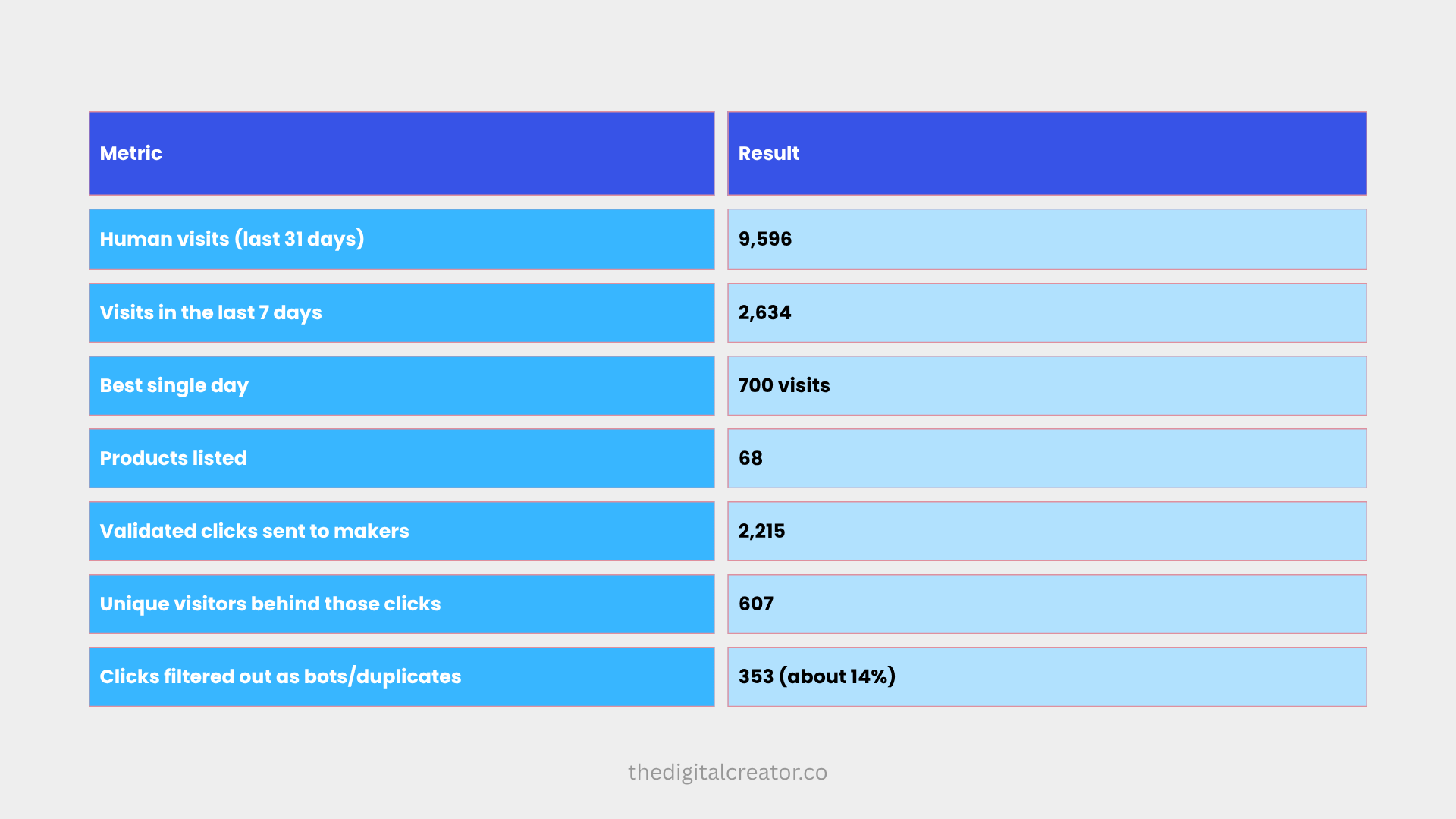
In 31 days it sent 2,215 validated clicks to 68 products, and I had to throw out a big chunk of my own traffic numbers to get there.
This issue covers why I built it, the bot problem I almost ignored, the full receipts, and what I’m building next.
Welcome to The Digital Creator, helping creators accelerate with AI by showing you how to start, create, grow, and scale faster.
Building a product used to be the hard part. Now it’s the easy part.
People are shipping thousands of AI-built products a day. Most of them are forgotten within a week.
Not because they’re bad.
Because nobody saw them.
I’ve watched this happen from the sidelines for months. Then I decided to stop watching and build something about it.
Regular readers know me for writing about growth, marketing, and how to build a content system that converts. I’m not known for shipping software. So putting my name on a platform, in public, with real numbers attached, is new for me.
If you’ve been following the monetization series, you know the pattern I keep coming back to: attention without a next step doesn’t turn into anything. This issue is the same idea one layer up.
A product without distribution doesn’t turn into anything either.
This one is part build log, part honest confession, and part invitation.
Let’s get into it. 👇
First: Where Are You Right Now?
Your starting point decides which part you’ll get the most from.
🟡 Stage 1: You have an idea, no product.
You’re still deciding what to build. → Start at Part 1, then jump to the closing section.
🟠 Stage 2: You built something, and nobody’s seeing it.
The product exists, the traffic doesn’t. → Start at Part 3.
🔴 Stage 3: You launched, but you’re not sure the numbers are real.
Your analytics look great and your sales don’t. → Start at Part 3.
Outline:
Part 1: The Problem I Couldn’t Stop Seeing
Part 2: What I Built (and How)
Part 3: The Number I Had to Throw Out
Part 4: The Receipts
Part 5: The Part That Scared Me
Part 6: What’s Next
Part 7: What I’d Tell You If You’re Thinking About Building
Part 1: The Problem I Couldn’t Stop Seeing
Everything bottlenecks at distribution.
An AI-assisted founder can go from idea to working product in a weekend. Then comes the part nobody has automated: getting that product in front of the people who actually need it.
That’s where most projects die. Not at the build. At the silence after the build.
Marketing a single idea is hard right now. There’s more being made than anyone can look at. And the usual advice is to “post more” and “build in public,” which only works if someone is watching.
I kept thinking about the maker who spends three weeks on a product and gets 11 visits on launch day. Most of those visits are bots. They don’t know that.
That’s the gap I wanted to close. Not just launching products.
Getting them in front of people who need them, and getting their first real feedback.
Part 2: What I Built (and How)
Most launch boards run on upvotes. Upvotes are easy to game, and they tell a maker nothing about whether a real person ever visited their site.
So I built Traffiklist, where the main thing a maker gets is a receipt: a public page showing how many validated clicks their product received.
Listing is free. Every maker gets:
→ A permanent product page
→ Click tracking
→ A public receipt of real clicks
→ A do-follow backlink once the product earns 3 upvotes


How I built it
I didn’t start with code. I started with Claude, using it for deep research on the idea: whether it was feasible, who else was building in this space, and how long the full project would realistically take.
Once I had a roadmap I trusted, I built it with Claude Code.
That order matters. Research first, roadmap second, build third. I wasn’t guessing at a direction. I was following a plan I’d stress-tested before writing a line.
Part 3: The Number I Had to Throw Out
The first thing I wanted to see after launch was visits. I used Cloudflare to track them.
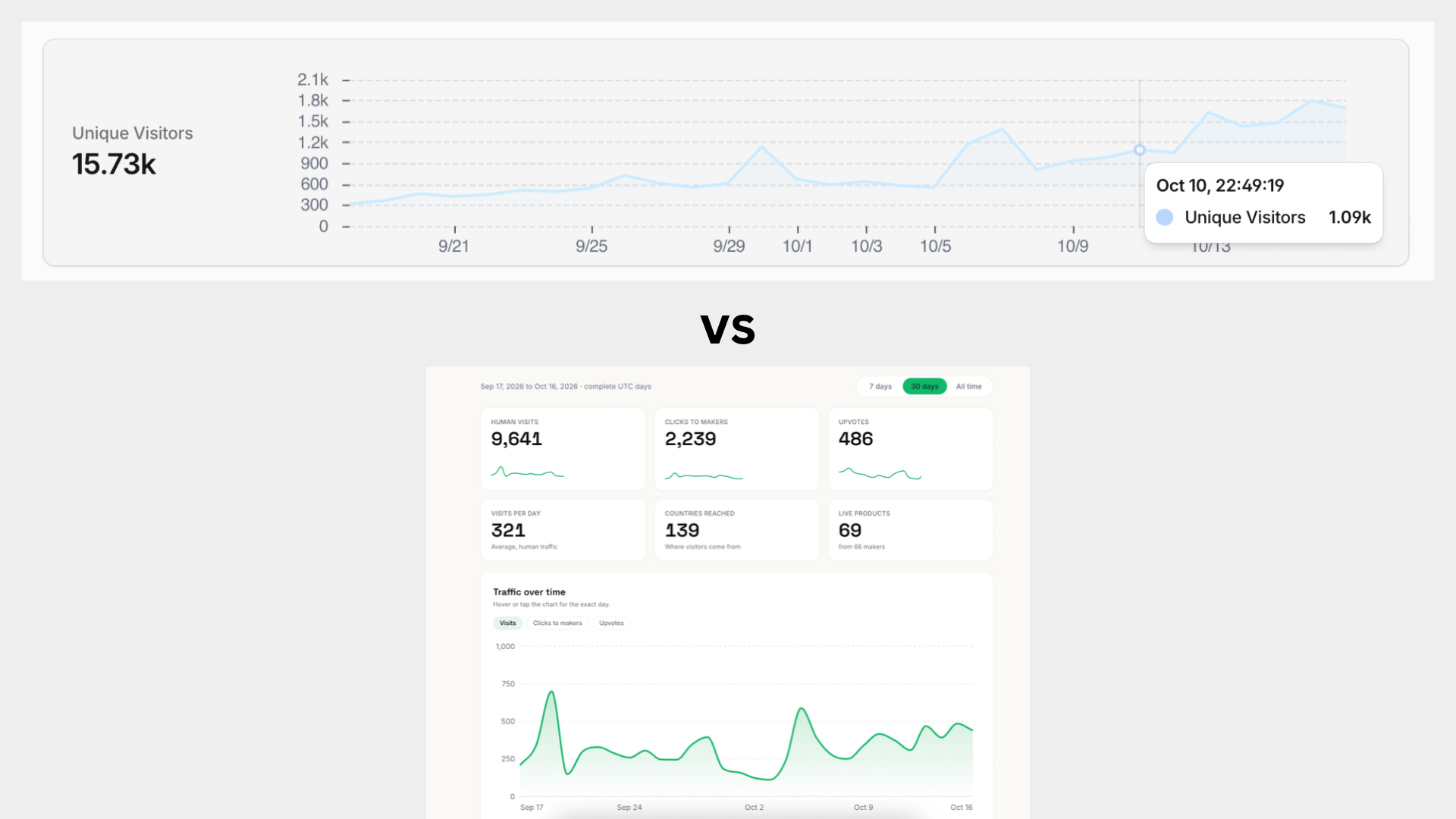
The numbers were high. Really high.
Then I found out they weren’t people.
A large share of those visits were bots, scripts, and prefetches. Automated traffic that looks great on a dashboard and does nothing for a maker.
Raw Cloudflare number you saw vs. the filtered human number
I had two options:
Leave the inflated number up. It looks impressive, and nobody checks.
Filter it out, as much as I could, and show the smaller real number.
I filtered it.
The platform is for builders, and builders want real numbers. If a launch platform can’t be trusted on its own traffic, it can’t be trusted on anyone else’s.
So every receipt on Traffiklist now shows the filtered clicks too. Anything that looks like a bot, a script, a prefetch, or a duplicate never counts.
You can read exactly how it works on the methodology page.
One rule I now apply everywhere: if a platform shows you a huge visit number, ask how much of it is real. That includes mine.
Part 4: The Receipts
Here’s what 31 days actually looks like, with the bots already removed.
No ad budget. No paid votes.
→ The average listing got about 33 clicks.
→ The top listings got close to 3x that.
The top three:
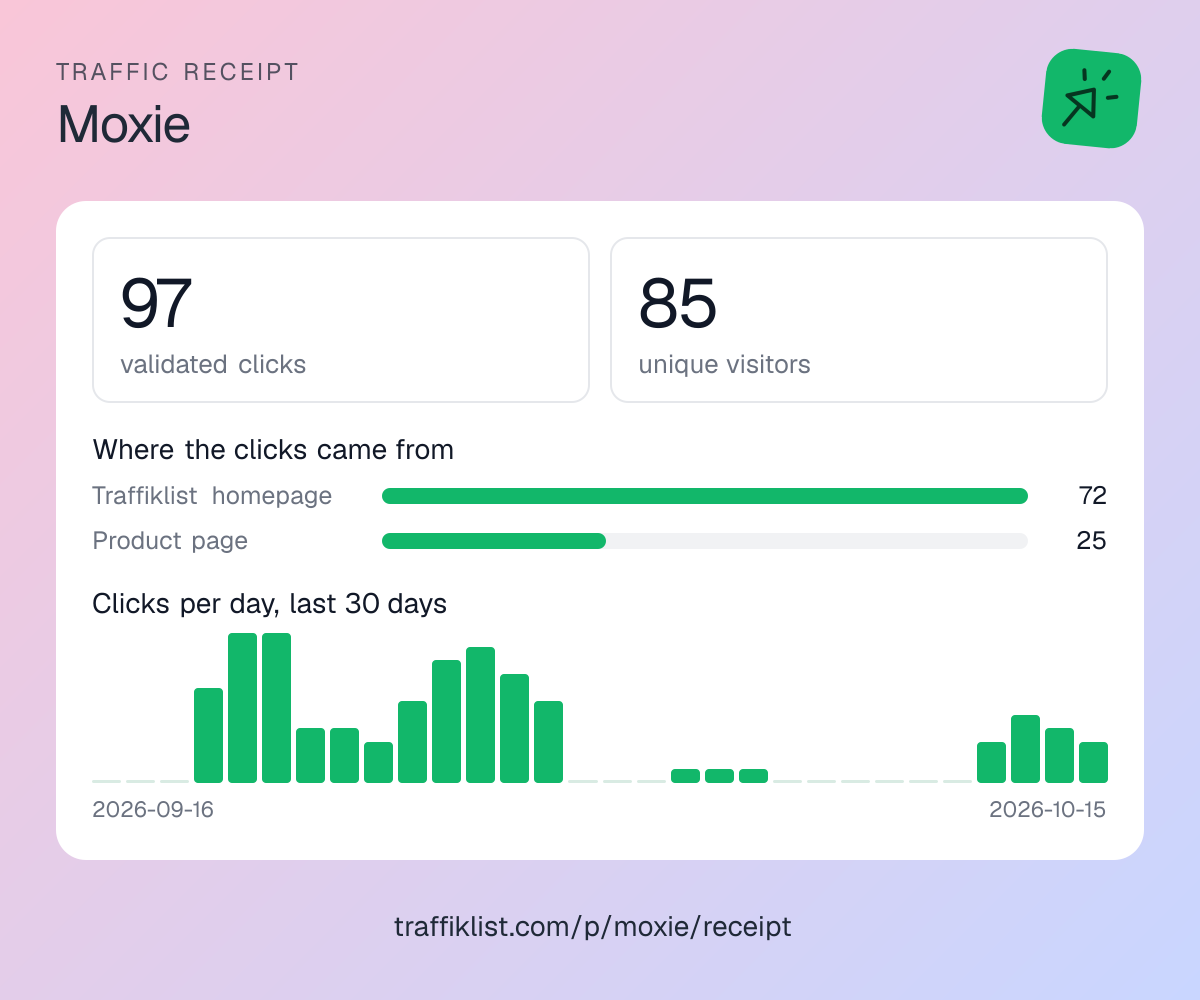
→ Moxie: 97 clicks, 85 unique visitors in 27 days
→ VibeCodingList: 76 clicks, 63 unique in just 11 days
→ makerio.io: 69 clicks, 64 unique visitors in 27 days
And where the clicks came from:
→ 67% from the homepage board
→ 23% from product pages
→ 9% from the newsletter
I’ll be honest about what these numbers are. They aren’t “millions of visitors.”
They’re 2,215 clicks, from 607 real people, sent to 68 products.
But look at that source split. Two-thirds of the clicks came from simply being on the board. That tells me the board itself is the product.
The first job is getting makers in front of people who are already looking.
My gut says the numbers matter less than what they show: when a platform is honest about its traffic, makers trust it more.
Part 5: The Part That Scared Me
Here’s the one I almost didn’t write.
Launching platforms is a crowded space. A lot of makers are building them. New ones appear and disappear every month, and people are rightly skeptical of any new one.
So the questions that kept me up were these:
→ What if this goes badly, and it has my name on it?
→ What if people don’t trust a new platform?
→ What if nobody shows up?
The hardest part wasn’t the code. It was sharing it publicly. I hadn’t talked much about this project. People know me as someone who writes about growth and content, not as a developer.
I had no idea how my own audience would react.
I’m still not sure. That’s why I’m telling you here, before I know how it lands.
I shared it anyway. Not because I felt ready. Because building in private and hoping is the one strategy I’d already warned everyone else against.
You never feel ready. A public page makes you find out.
Part 6: What’s Next
Listing a product is step one. The question I keep asking is: once a builder launches, what do they need next?
My answer is feedback from real people.
So the next phase is a way for builders to give each other feedback. Makers who give feedback unlock more features and earn points they can use for their own growth.
I’ll also give personal feedback on individual products.
After that comes the bigger goal, the one that’s been the point from the start: helping with distribution over the long run.
Product content strategy, founder-led content, and SEO, all inside one platform.
By then Traffiklist will hold a lot of data about each product and each maker.
That’s what makes it realistic to build content strategies for products, and to automate them.
I don’t have all of this figured out. I’m building it in stages and learning at each one. That’s the honest version.
Part 7: What I’d Tell You If You’re Thinking About Building
I’m a month in, so I’m not going to pretend I have a framework. But three things already feel true:
1. Build from the itch. I didn’t build Traffiklist because of a market report. I built it because a problem I kept noticing bothered me enough to act on. Your best project is probably the thing you keep complaining about.
2. Measure honestly, even when it hurts. A smaller number you can defend beats a bigger one you can’t. People can tell the difference sooner than you think.
3. Ship before you feel ready. Fear is a bad reason to stay quiet. The reaction is almost never as bad as the version in your head.
And a bigger one underneath all three: building projects is the best way to learn and grow. I’ve learned more about distribution, trust, and my own audience in 30 days of building than I did in months of writing about them.
The Bottom Line
AI made it possible to build almost anything. It didn’t make being seen any easier.
The creators who stand out from here won’t be the ones who build the most. They’ll be the ones who build something real, get it in front of people, and show honest numbers.
So go with your curiosity. Build something you can use yourself, and something you can promote.
If you’ve shipped something, you’re welcome to list it on Traffiklist for free. You’ll get a permanent page and a public receipt of real clicks.
And if you don’t have a product yet, start with the idea. AI Offer Crafter reads what you’ve already published and finds the offer your audience has been asking for. Build that, then come back and launch it.
One question for you:
What’s the one thing you keep wishing existed? Hit reply and tell me. That might be your next product, and I read every reply.
See you in the next one, Sharyph