

89% of B2B buyers now use AI for research before making a purchase decision.
Let that sink in.
Your potential customers aren’t visiting your website anymore. They’re asking ChatGPT. They’re consulting Perplexity. They’re trusting Claude to do their research for them.
And here’s the uncomfortable truth: If you’re not in the AI answer, you’re not in the consideration set.
Last month, a $50M ARR SaaS company discovered that Perplexity was pulling their pricing from a blog post written in 2019—showing a price point 3x lower than current. For six months, thousands of prospects got completely wrong information about their product.
They had no idea it was happening.
Another company? They’re getting 10,000 visitors per month from ChatGPT. High-quality, ready-to-buy traffic. But until they started tracking it properly, they thought it was just “direct” traffic in Google Analytics.
Here’s what changed: These companies stopped guessing and started measuring. They implemented a proven framework for AI search optimization (also called AEO or GEO). And the results?
4x growth in 90 days (Runpod)
226% lift in citations in 12 weeks (Strapi)
78% AI search surge (BairesDev)
This isn’t theory. It’s a playbook built on tracking 100M+ actual AI prompts and working with 500+ brands who are dominating AI search right now.
In this guide, we’re breaking down the exact 6 tactical steps these companies use—complete with product demos showing you how to execute each one. No fluff. No corporate speak. Just the framework that drives measurable results.
Quick note before we dive into the tactics:
Throughout this article, you’ll see demos and screenshots from Scrunch…the AI search optimization platform we built to execute this framework. It tracks your brand presence across ChatGPT, Perplexity, Claude, and other AI platforms, and automates most of the heavy lifting.
If you want to follow along with your own brand, they have a 7-day free trial (no credit card needed).
Alright—let’s get into it.
Tactical Step 1: See How You Stack Up Against Competitors
You can’t improve what you don’t measure.
That’s Marketing 101. But when it comes to AI search, most brands are flying completely blind. They have no idea if ChatGPT mentions them, how often they appear in Perplexity results, or whether Claude recommends their competitors instead.
Here’s the problem:
The same prompt produces wildly different answers across different AI platforms.
Ask ChatGPT “What are the best project management tools?” and you might get mentioned.
Ask Perplexity the exact same question?
Your top competitor appears instead.
Ask Claude? Neither of you show up—it’s pulling from a completely different set of sources.
This is why competitive benchmarking is your starting point.
You need to see the complete picture:
Where are you winning? (Double down on these prompts)
Where are competitors dominating? (Opportunity to close the gap)
Where is nobody showing up? (Blue ocean territory)
What You’ll Discover
When you start tracking your competitive presence, you’ll uncover insights like:
Your mention rate across AI platforms (industry average: 20-30% before optimization)
How often you’re positioned at the top vs. bottom of AI responses
Whether AI platforms cite your website or third-party sources
Which competitors appear more frequently than you (and for which prompts)
Sentiment analysis—how AI describes your brand vs. competitors
The Metrics That Actually Matter
Forget page rankings and SERP positions. In AI search, you’re tracking:
Mention Rate: What percentage of tracked prompts include your brand?
(Target: 40%+)Position: Are you mentioned first, middle, or buried at the end?
(Top 3 mentions get the attention)Share of Voice: Your mentions vs. competitor mentions
(Track the trend)Citation Type: Is AI citing your website (good) or third-party sources only?
(Aim for 60/40 split)Sentiment: Positive, neutral, or negative framing in AI responses
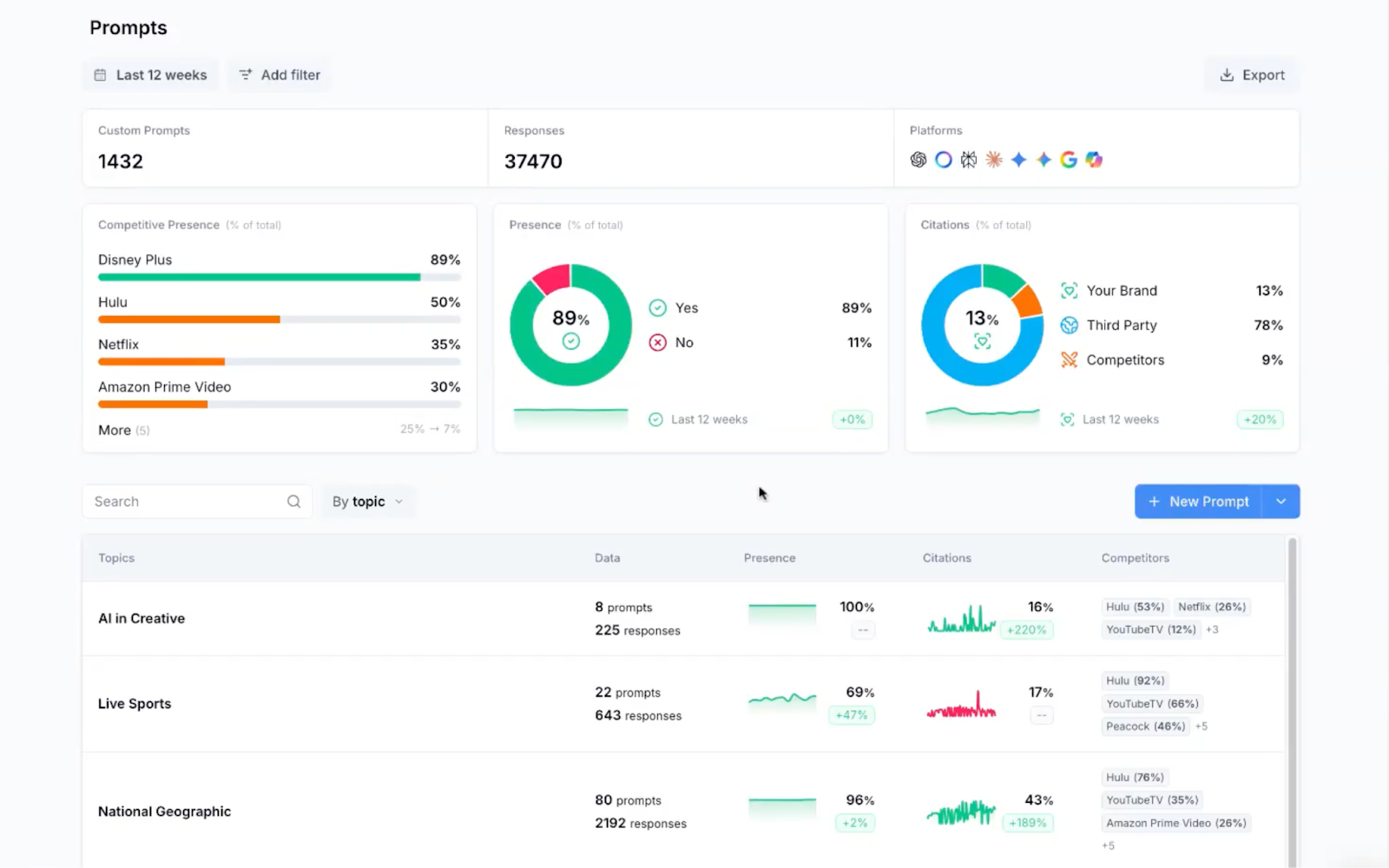
Here’s what this looks like in action:
Instead of manually checking each AI platform, Scrunch monitors everything automatically and shows you exactly how you stack up against competitors.
Tactical Step 2: Find Hidden Competitors You Didn’t Know About
Here’s something that surprises every brand when they start tracking AI search:
Competitors you’ve never considered are stealing your share of voice.
A fitness bike company discovered motorcycle brands appearing in their AI search results.
A B2B SaaS tool found consumer apps competing for the same prompts.
An enterprise software company realized a completely different industry was being recommended alongside them.
Why does this happen?
AI platforms blend categories differently than Google does.
Traditional search relies on keywords and structured taxonomies. AI search uses natural language understanding and contextual relevance.
When someone asks “best bike for commuting,” an AI might pull from fitness cycling, electric bikes, motorcycle commuting, and bike-sharing services—all in one answer.
Your carefully defined competitive set? AI doesn’t care. It’s pulling from a much wider universe of solutions.
The Opportunity (and Threat)
The Threat: You’re losing visibility to competitors you’re not even monitoring. While you’re optimizing against your known rivals, a completely different player is capturing mind share in AI responses.
The Opportunity: Spot these emerging competitors early. Understand why AI groups you together. Adapt your strategy before they establish dominance.
Real Example: The Bike Company Story
A premium cycling brand was tracking performance against their usual suspects—Trek, Specialized, Cannondale. They felt confident in their AI presence.
Then they ran a broader analysis and discovered Yamaha showing up for prompts like “best bike for fitness and commuting.” Yamaha makes motorcycles, not fitness bikes.
Why was this happening? The prompts were ambiguous. “Bike” could mean bicycle or motorcycle. AI platforms were hedging their bets and including both categories.
The fix? They adjusted their content to emphasize “cycling,” “fitness bikes,” and “pedal-powered” more explicitly. Their mention rate for relevant prompts jumped 40% in three weeks.
What You’ll Discover
Hidden competitor analysis reveals:
Long-tail competitors from adjacent categories
Consumer solutions competing with your B2B product
Regional players you didn’t know were national
New entrants gaining traction in AI search
Category confusion (like the bike example)
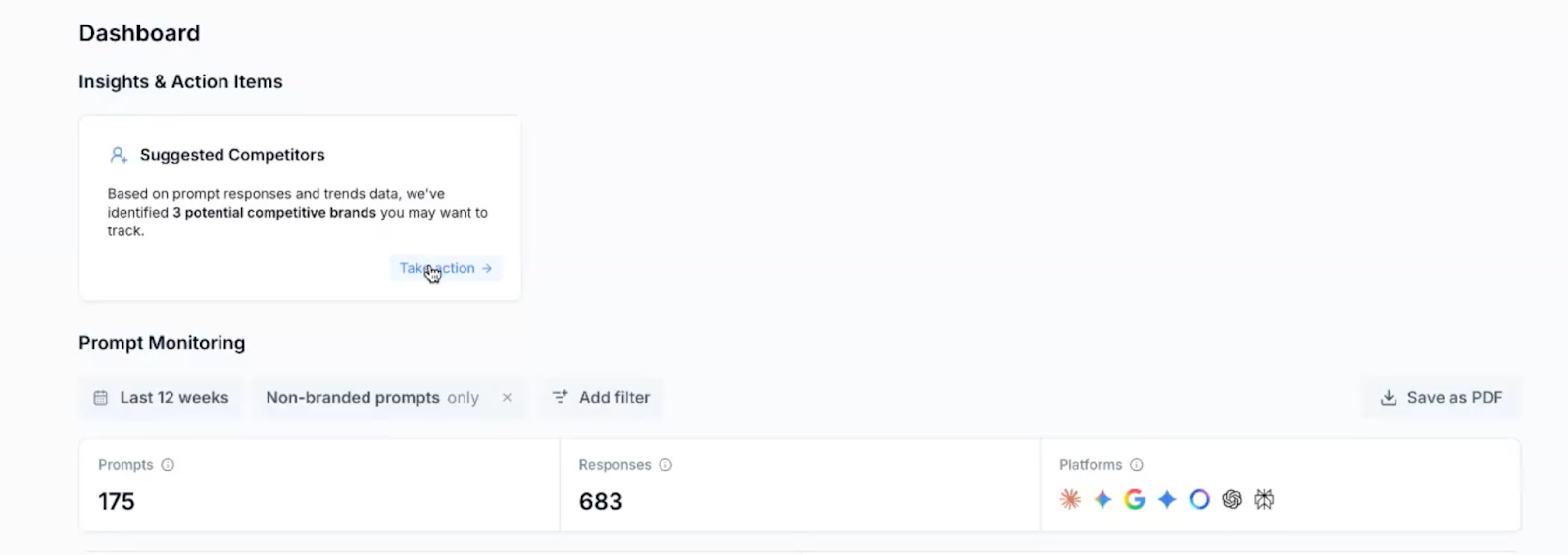
Here’s how Scrunch automatically finds these hidden competitors for you:
Scrunch’s Suggested Competitors feature continuously scans all your tracked prompts and identifies brands that appear frequently but aren’t on your monitoring list. It automatically flags them so you can decide whether to track them or dismiss them as irrelevant. Takes one click to start monitoring a new competitor.
Pro tip: Don’t just look at direct competitors. Pay attention to replacement behaviors. If AI suggests using a combination of Tool A + Tool B instead of your all-in-one solution, those are competitors…even if they’re in different categories.
Tactical Step 3: Discover Which Topics Are Trending (100M+ Prompt Dataset)
Most brands are optimizing for the wrong prompts.
They’re guessing at what their audience asks AI. They’re converting old SEO keywords into prompts and hoping for the best. They’re tracking 50-100 prompts based on intuition, not data.
Meanwhile, their audience is asking completely different questions across AI platforms—questions these brands never thought to track.
Here’s the reality: AI search behavior is different from Google search behavior.
On Google, people type short, keyword-heavy queries: “best CRM” or “project management software pricing.”
In AI platforms, they ask full questions: “What’s the best CRM for a 50-person sales team that integrates with HubSpot and has good mobile apps?” They have conversations. They ask follow-ups. They get specific.
If you’re not tracking what people are actually asking, you’re optimizing in the dark.
The 100M+ Prompt Advantage
This is where scale matters.
Scrunch has tracked over 100 million real AI prompts across every major platform—ChatGPT, Perplexity, Claude, Gemini, Meta AI, and more. These aren’t keyword proxies. These are actual questions real people asked AI platforms.
This dataset gets grouped into topics, categorized by industry (using NAICS classification codes), and tracked for volume trends week over week.
So instead of guessing which prompts to track, you can see:
Which topics are surging in AI search volume right now
How your brand performs across those trending topics
What specific prompts people are asking within each topic
Whether you should invest content resources in a topic or not
Why Topic Trends Matter
Example: Let’s say you’re a streaming service like Disney+.
You might assume the hot topics are “family entertainment” and “Marvel shows.” But when you look at the data, you discover:
“Theme park experience planning” is trending up 40% month-over-month
“Nostalgia content for millennials” surged after a viral TikTok trend
“Ad-free streaming options” spiked after competitors announced price changes
Now you know where to focus your content strategy and which prompts to prioritize for tracking.
Without this data? You’d be optimizing for topics that peaked 6 months ago while missing emerging opportunities.
What You’ll Discover
AI Search Trends reveals:
Volume trends: Is this topic growing or declining?
Prompt samples: See actual questions people ask within each topic
Your brand performance: Current mention rate across that topic’s prompts
Category insights: What’s trending in your industry vs. adjacent industries
Seasonal patterns: Which topics spike at specific times of year
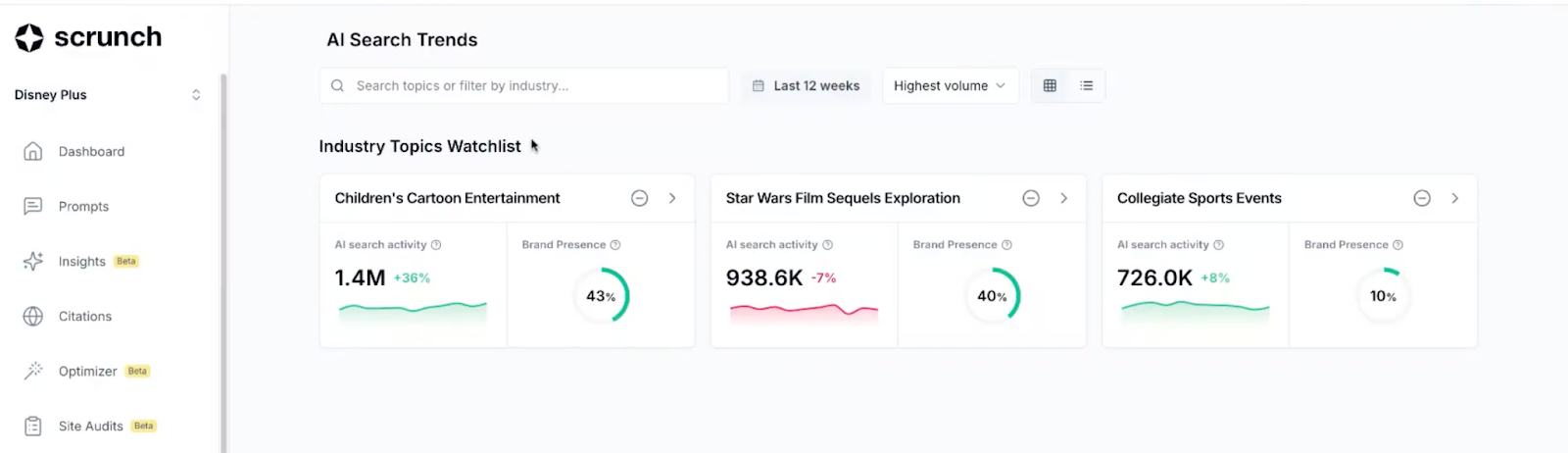
Here’s how to use AI Search Trends to find high-impact topics:
Scrunch’s AI Search Trends feature gives you access to this massive prompt dataset, organized by topic and industry. You can search for relevant categories, see trending topics, review sample prompts, and add entire topic sets to your tracking with one click. It’s like having a crystal ball for what your audience is asking AI.
Tactical Step 4: Build Your Prompt Tracking Strategy
You’ve seen where you stand competitively (Step 1). You’ve discovered hidden competitors (Step 2). You’ve identified trending topics (Step 3).
Now comes the foundation: building your prompt tracking list.
Winners track prompts strategically. They focus on high-intent, non-branded prompts at the evaluation stage. They prioritize prompts where competitors are winning and they’re losing. They expand systematically based on data.
Everyone else tracks randomly. They grab a few branded searches, throw in some generic keywords, maybe add a couple they thought of in a meeting. Three months later, they wonder why AI optimization isn’t working.
The Four Ways to Build Your Prompt List
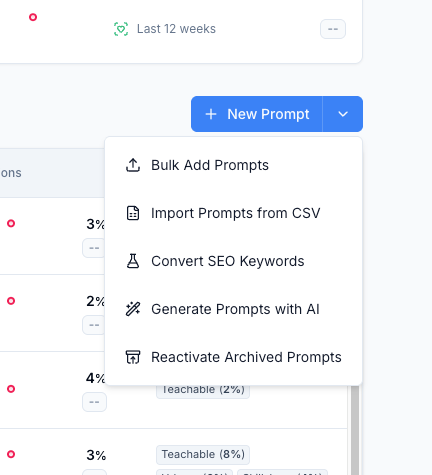
You don’t need to start from scratch. There are four proven methods to build a strong prompt tracking foundation—and you can use any combination of them:
Method 1: AI-Generated Prompts (Fastest to start)
Let AI generate prompts based on your personas, topics, and funnel stages. Takes 5 minutes. Great for quick setup.
Method 2: Bulk Custom Prompts (Most tailored)
Paste in a list of prompts you’ve collected from customer research, sales calls, or support tickets. Real questions your audience asks.
Method 3: SEO Keyword Conversion (Best for SEO teams)
Import your existing SEO keywords and convert them into natural language prompts. Bridges your current SEO strategy with AI search.
Method 4: CSV Import (Most advanced)
Upload a spreadsheet with hundreds of prompts, specify which AI platforms to track for each one, assign topics and stages. Maximum control.
Start with 50-100 core prompts. You can always expand later. Quality over quantity matters here—50 well-chosen prompts beat 500 random ones.
Tactical Step 5: Uncover the Citations AI Platforms Love
Here’s something most brands miss when optimizing for AI search:
Third-party citations matter more than your own content.
Let me explain.
When AI platforms answer questions, they’re building credibility through citations. They’re not just saying “Company X is great”—they’re saying “According to TechCrunch, NerdWallet, and G2, Company X is great.”
A single high-authority citation can appear in hundreds of AI responses.
Think about it: If Perplexity cites a NerdWallet article that mentions your brand, that citation gets pulled into every relevant prompt where NerdWallet is considered authoritative. One placement = recurring visibility.
But here’s the kicker: Most brands have no idea which sites AI platforms actually cite in their category.
They’re creating content in a vacuum. They’re hoping AI will magically find and cite them. Meanwhile, there’s a clear pattern of which domains AI platforms trust and reference repeatedly.
The Citation Strategy That Works
The brands winning at AI search aren’t just optimizing their own content. They’re getting strategic about third-party placements:
Identify the domains AI platforms cite most in your category
Find articles that mention competitors but not you
Prioritize based on citation frequency (how often AI pulls from that source)
Get featured through outreach or better content
This represents your quickest wins. One outreach email to the right editor can result in your brand appearing in dozens of AI responses overnight.
Your Action Item
Export your top 20 cited domains. Identify 5 where you can get featured.
Export top 20-30 cited domains in your category
Focus on domains that appear in 5+ prompts
Prioritize evaluation-stage citations (higher intent)
Click through to the specific URLs being cited
Document which competitors are mentioned
Note what format performs (comparison, guide, review, case study)
Identify articles that should include you but don’t
✅ Citation frequency (10+ mentions = high priority)
✅ Competitors mentioned (if they mention 3+ competitors, you should be there)
✅ Content freshness (recently updated = editor is engaged)
✅ Editorial responsiveness (check if they accept updates)
Tactical Step 6: Track AI Bots Visiting Your Site (The New Customer Journey)
Here’s a reality check that changes everything:
Your potential customers are visiting your website. You just can’t see them.
They’re not showing up in Google Analytics as a person from Seattle browsing your pricing page. They’re showing up as a bot—an AI agent sent by ChatGPT, Perplexity, or Claude to gather information on behalf of a human.
Humans have outsourced browsing to AI.
Think about your own behavior. When was the last time you visited 5 different websites to compare solutions? Probably not recently. Now you ask ChatGPT: “Compare the top 3 CRM tools for a 50-person sales team.” ChatGPT sends agents to visit those websites for you, pulls the information, and summarizes it in 30 seconds.
You never clicked through. But those AI agents? They definitely visited those sites.
This is the new customer journey. And if you’re not tracking it, you’re blind to a massive portion of your research traffic.
The Three Types of AI Bots You Need to Understand
Not all AI bot traffic is created equal. There are three distinct types, and each one tells you something different about your AI search performance:
1. Retrieval Bots (Most Critical)
These are AI agents visiting your site right now to answer a specific human’s question.
Someone just asked ChatGPT: “What’s the pricing for [Your Company]?” ChatGPT sends a retrieval bot to your pricing page, grabs the information, and responds to the user—all within 3-5 seconds.
This is essentially a site visitor. Someone is actively researching you. They’re in your funnel. If your pricing page is outdated, poorly formatted, or blocked by access controls, the AI can’t help them. You just lost a potential customer.
What to track:
Which pages retrieval bots access most, when they visit, whether they successfully get information.
2. Training Bots
These crawl your site periodically to collect data for training future AI models.
Think of it like Google’s crawler, but for AI training. Today’s crawl becomes tomorrow’s AI knowledge. If training bots can’t access your site, future versions of these AI platforms won’t have updated information about you.
Why this matters:
Long-term visibility. If AI models aren’t training on your latest content, they’ll keep citing outdated information or skip you entirely.
What to track:
Frequency of training bot visits, which content they access, any access issues.
3. Indexer Bots
These build AI platforms’ own web indexes—separate from Google’s or Bing’s.
AI platforms don’t want to rely on traditional search engines. They’re building their own understanding of which websites contain authoritative information on which topics.
Why this matters:
Being in these AI indexes determines whether you even get considered for citation. If you’re not indexed, you don’t exist to the AI.
What to track:
Index coverage, which pages are in the index, crawl frequency.
What Most Brands Miss
Here’s the invisible problem:
You might be getting hundreds or thousands of AI bot visits per day and have no idea. Traditional analytics tools lump them into “bot traffic” and filter them out. You’re optimizing for human visitors while AI agents—representing real humans doing research—are bouncing off your site or finding outdated information.
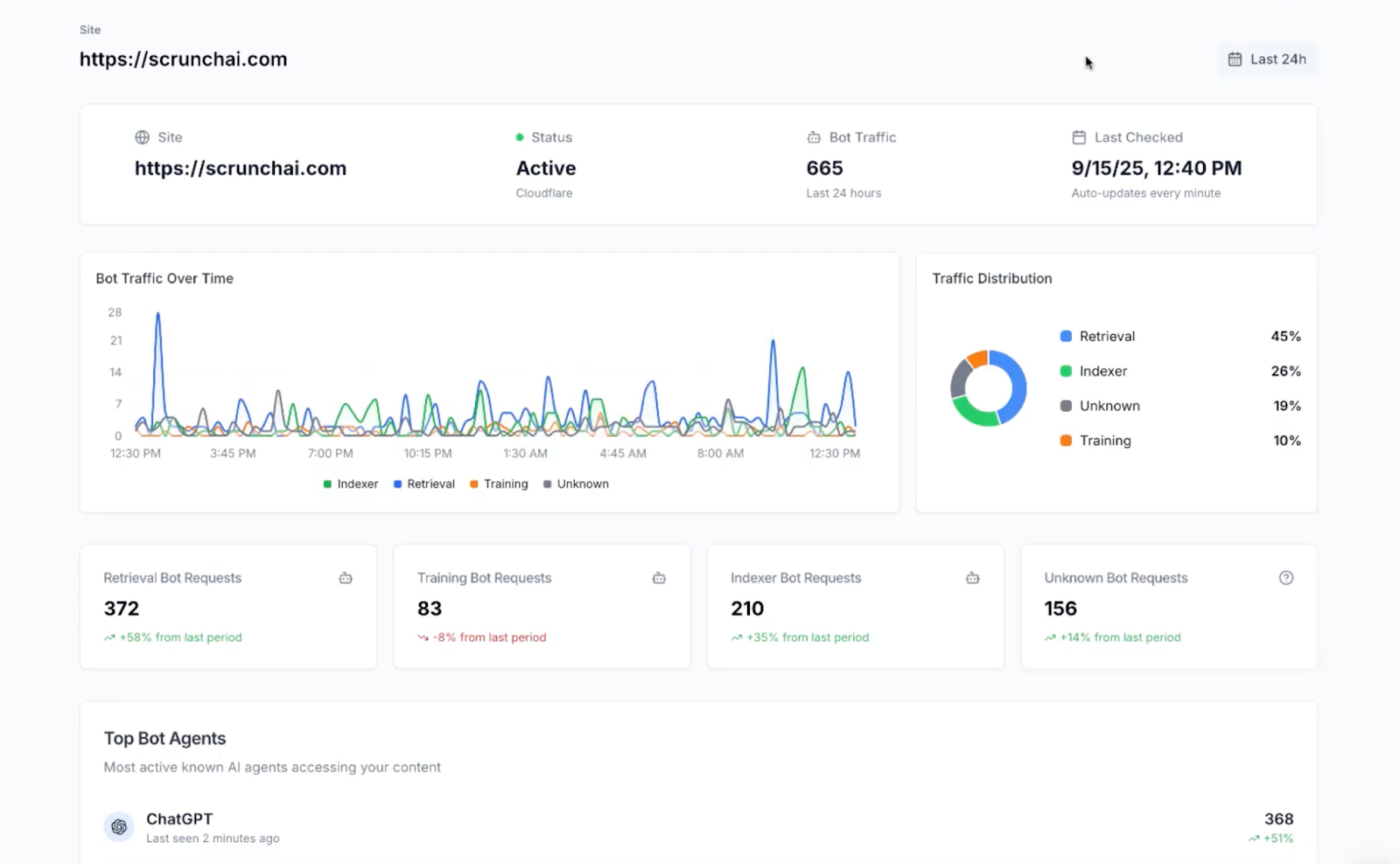
Here’s what AI bot tracking looks like in action:
Scrunch’s Agent Traffic dashboard (powered by partnerships with CDN providers like Akamai) gives you real-time visibility into every AI bot visiting your site. You can see which platforms are crawling you, what content they’re accessing, and even watch retrieval bots hit your site live as people ask questions. It’s like Google Analytics, but for AI agents.
Your Next Steps
You’ve seen the framework. You’ve seen the results. Now it’s time to implement.
Resources to Help You Execute
Get Started with Scrunch:
🚀 Try Scrunch Free for 7 Days
No credit card required. Full platform access. See exactly how your brand shows up across AI platforms.
→ Start your free trial
📊 Book a Personalized Demo
See how Scrunch works for your specific industry and use case. Get implementation guidance from the team.
→ Schedule a demo
💰 View Pricing & Plans
Transparent pricing. No surprises. Plans for every stage from startup to enterprise.
→ See pricing options
Free Tools & Resources:
✅ Download the Complete AI Search Checklist
97-point checklist covering everything from technical setup to content optimization.
→ Get the checklist
📋 Free Prompt Tracking Template
Spreadsheet template for manual tracking if you’re not ready for a platform yet.
→ Download template
🎯 AI Prompt Generator
Generate relevant prompts for your industry in seconds. Free tool, no signup required.
→ Try the generator
The Window Is Open (But Closing)
Here’s what you need to understand:
Right now, AI search optimization is like SEO in 2004.
Early adopters are establishing dominance while most brands are still figuring out if it matters.
In 2004, if you ranked #1 for your category keywords, you owned that category for years.
The brands who invested early built moats that competitors couldn’t break through.
The same is happening in AI search.
The brands establishing AI visibility now—getting cited in high-authority sources, optimizing for AI bots, dominating key prompts—are building advantages that compound.
In 12 months:
Category leaders will be cemented in AI platforms’ “memory”
Citation sources will be saturated (harder to get placement)
AI bot optimization will be table stakes (not a differentiator)
Late movers will be playing expensive catch-up
In 24 months:
AI search will be a mature channel (like SEO is today)
First-movers will have years of citation history and authority
New entrants will face the same challenges as SEO: established players are entrenched
The question isn’t “Should I optimize for AI search?”
The question is: “Do I want to be early or late?”
Early means lower competition, easier wins, compounding advantages, category leadership.
Late means fighting for scraps, premium costs, uphill battles, playing catch-up indefinitely.
Thank you for reading “6 Tactical Steps to Win AI Search.”
Now go execute. Your competitors are.
If AI can’t find the right answer about you, your deal might already be lost.
This is very helpful. Thanks for putting this together! 🙋🏻♀️ Time to level up the game.