

Most creators don’t have a content problem.
They have a systems problem…and it’s burning them out.
Here’s what I see constantly: a creator sitting down every week, staring at a blank screen, grinding out a blog post from scratch, spending 6-8 hours on something Google may or may not reward… and then doing it all again next week.
No process. No leverage. Just willpower on a loop.
52% of creators report burnout directly from their content careers. Not from running a business. From producing content.
I was there too. And the turning point wasn’t working harder or finding a better writing app.
It was building a machine.
Over the past year, I’ve built an AI-powered SEO content system using Claude that handles everything from the first keyword to a published, optimized post…with my voice intact, my expertise layered in, and Google’s quality standards met.
What used to take 8 hours now takes under 2. What used to require daily decisions now runs on a repeatable architecture I set up once.
That’s what this issue is about.
By the time you finish reading, you’ll have the exact framework to build your own…to produce SEO content that compounds, and do all of it without adding more hours to your week.
This is not theory. Let’s get into it.
Why SEO Still Matters (And Why AI Changes the Game)
Let me say something most AI newsletters won’t.
SEO is not dead. It is not dying. And for creators building long-term digital businesses, it is still one of the highest-leverage channels you can invest in…because it compounds.
A post you publish today can send you traffic, subscribers, and sales 18 months from now. A tweet from last Tuesday? Gone.
That’s the core difference between content and assets. And right now, AI has made it possible for a solo creator to build SEO assets at a pace that used to require a full content team.
Here’s what the data looks like: companies publishing content weekly see 3.5× more conversions than those publishing monthly.
The differentiator is no longer quality alone… it’s scale plus quality. Big brands have had the scale advantage for years. AI just handed it to you.
The window is open. But it won’t stay open forever.
58% of US small businesses are already using generative AI for content…up from 40% just a year ago. The creators building systematic AI content workflows right now are locking in a compounding advantage. The ones waiting for the “right time” will spend next year trying to catch up.
There is one thing worth addressing head-on before we go further.
“Won’t Google penalize AI content?”
No. And I want to be precise here, because this fear is keeping a lot of creators from moving.
Google’s official position, reaffirmed as recently as December 2025, is this:
“Appropriate use of AI or automation is not against our guidelines.”
What Google penalizes is low-value, mass-produced content with no original insight, no human expertise, and nothing that serves the reader beyond what’s already ranking.
That’s not a new standard…it’s the same standard that killed lazy human-written content for years.
The framework Google uses is E-E-A-T:
Experience, Expertise, Authoritativeness, Trustworthiness.
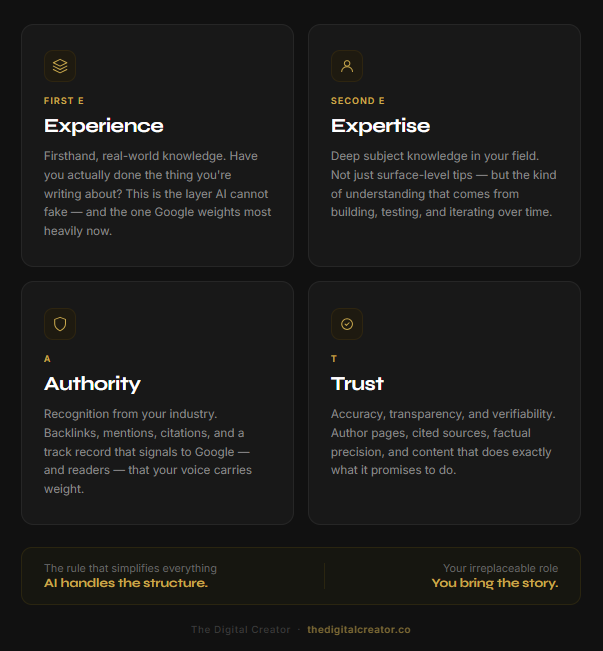
The first “E” — Experience — carries more weight now than ever.
Firsthand knowledge. Real results. Proof you’ve actually done what you’re writing about.
Here’s how I think about it: AI handles the structure. You bring the story.
My experience building an 18,000-subscriber newsletter, and selling 1,000+ digital products without spending a dollar on ads…that’s not something Claude can fabricate. That’s the layer Google rewards. That’s the moat.
The goal of this system isn’t to replace your voice. It’s to give your voice more surface area.
The Architecture - Two Tools, One Machine
Before you write a single word of SEO content with Claude, you need to understand one distinction. Get this right and everything else in this system clicks. Get it wrong and you’ll spend months wondering why Claude keeps going off-brand.
Here it is:
Claude Projects are your knowledge base. Claude Skills are your procedure layer.
Most creators discover Projects first and stop there. They upload a few documents, set some custom instructions, and call it a day. That works…but it’s only half the machine.
Let me break down both.
Claude Projects: Give Claude a Brain
A Project is a self-contained workspace inside Claude. Every conversation inside that Project has access to the same persistent context…your uploaded documents, your custom instructions, your brand materials…without you having to re-explain anything every session.
Think of it as hiring a writer who never forgets your brief.
Inside your SEO content Project, you’d upload:
Your brand voice guide
Your audience persona
Your best-performing posts as writing samples
Your product and offer details
Your internal linking reference
Every time you open that Project, Claude already knows who you are, who you’re writing for, and what your content should sound like. The 200,000-token context window…roughly 500 pages of reference material…means you’re not cramming. You’re building a proper knowledge base.
✅ Projects are available on all paid Claude plans.
✅ Free users get up to 5 Projects.
✅ When your knowledge base grows large, Claude automatically enables RAG mode — expanding its memory up to 10×.
Claude Skills: Give Claude a Procedure
A Skill is a reusable instruction package stored as a .md file. Where a Project holds what Claude knows, a Skill defines how Claude should act on a specific, repeatable task.
The SEO Blog Writer Skill I use tells Claude exactly how to:
structure a post
keyword placement rules,
heading hierarchy,
meta description format,
internal linking ratios,
where the CTA goes,
what phrases to avoid,
what my voice sounds like under pressure…etc
It activates automatically when I start an SEO writing task. I don’t prompt it. It just fires.
Here’s the analogy that makes this click:
Projects = your creative brief. Skills = your SOP.
A brief tells the writer what the brand is. An SOP tells the writer how to execute the work. You need both.
Why This Beats ChatGPT Custom GPTs
This is a question I get a lot…and the answer matters for your decision.
ChatGPT Custom GPTs have an 8,000-character instruction limit.
Claude Projects give you a 200,000-token context window.
That’s not a marginal difference. That means Claude can hold your complete brand voice guide, multiple writing samples, your full product catalog, and your SEO ruleset in memory simultaneously…without compression or trade-offs.
Beyond the context advantage, Claude’s instruction-following for structured content is tighter.
When I tell it to keep paragraphs under 4 sentences, place the primary keyword in the first 100 words, and never use certain phrases…it holds those rules across a 2,000-word draft. That consistency is what makes a content machine reliable.
One more thing worth saying plainly: Claude produces more natural prose. Less formulaic. Less obviously AI.
That matters when your goal is content that sounds like you…not like a template someone ran through a robot.
The Two-Layer Setup
Here is how the architecture sits in practice:
[ Claude Project ]
Brand voice samples
Audience persona
Product + offer details
Best-performing posts (3–5)
Internal linking reference

        ↓ feeds into ↓

[ Claude Skill — SEO Blog Writer ]
Keyword placement rules
Post structure template
Meta title + description specs
CTA placement logic
Voice constraints + banned phrases
The Project is built once and updated occasionally.
The Skill runs every time you produce a post.
Together, they turn a keyword into a brand-consistent, SEO-optimized draft in under 30 minutes…with your expertise added on top.
That’s the foundation. Now let’s build it.
How to Build Your Brand .md File - The Foundation
You now understand the architecture.
Claude Projects as the knowledge base. Claude Skills as the procedure layer. The two-tool setup that makes everything else in this system work.
That is the what.
What comes next…is the how.
Here is exactly what paid subscribers are reading right now:
→ The 7-Component Brand .md File (Built Step by Step) The exact framework I use to make Claude sound like me…not a polished, forgettable version of everyone else’s This is the single most important document in the entire system.
→ The Full 7-Step Production Workflow From keyword to published post…with exact time estimates at each step. How I go from a blank screen to a Google-ready draft in under 2 hours. Where the human layer goes. What the SEO review checklist looks like.
→ The Publishing Pipeline: Two Ways to Push Live Without Friction How to use Claude Cowork and the Chrome extension to publish directly to WordPress…no manual CMS work. And for those running code-based blogs on Vercel: how a Git push triggers an automatic deploy in under 60 seconds. Both workflows, step by step, with the exact instructions that make them reliable.
This is not a summary of concepts.
This is the source file…the step-by-step build of a system
Unlock the full issue and every issue like it.
Become a Paid Subscriber — $39/month or $150/year
Paid membership also includes:
✅ 5 Premium Claude Skills (more adding..)
✅ Substack SEO/AEO Implementation Toolkit
Every week, paid subscribers get the full playbook — not the concept, the build.
The brand .md file is the single most important document in your entire content machine. It is the instruction layer that makes Claude sound like you…not like a polished, forgettable version of everyone else’s AI content.
Here’s what goes inside it. Seven components. Build all seven.