Welcome to The Digital Creator, helping creators turn their skills into consistent income by building a clear offer, a content system that grows their audience, and a lean business using AI.
You’re publishing every week. Your open rates look decent. You’re getting new subscribers.
But your newsletter isn’t making real money.
Here’s what most creators don’t realize:
The problem isn’t your content. It’s that you’ve never audited what you already have.
While you’re stressing about your next post, you’re sitting on data that could tell you exactly which content converts, which subscribers will never buy, and which platform features could double your revenue in 90 days.
The numbers don’t lie.
Newsletter audits deliver $36-40 return for every $1 invested when implemented correctly.
I’ve watched creators remove 1,000 inactive subscribers and gain 255 engaged ones in 30 days.
I’ve seen open rates jump from 32% to 59% in six weeks.
I’ve helped newsletter writers grow from 100 to 4,500 subscribers while building $3,000-$5,000 monthly revenue…all from optimizing what they already had.
Most creators think they need to write more. They don’t.
They need to systematically audit what’s already working and double down on it.
Today, I’m giving you the complete audit framework that turns newsletters into revenue systems.
This isn’t theory. This is the exact process successful newsletter creators use quarterly to identify what’s killing their growth, what’s driving conversions, and where they’re leaving money on the table.
If your newsletter isn’t generating consistent income, you’re missing one of three things: content that converts, distribution that leverages platform features, or optimization based on actual data.
Let’s fix that.
🧑🏻💻 Before we dive into the Newsletter Audit Playbook
We (Myself and Karen Spinner) has built a tool to audit your Substack (based on the audit matrices you find in this playbook).
Just paste the Substack Publication link, you will get the complete analysis of the Substack in seconds.
It’s the complete system that shows you exactly how your Substack publication is performing…without jumping between dashboards, exporting CSVs, or guessing what’s working.
In seconds you’ll see all your key metrics, compare them to industry benchmarks, and uncover where your newsletter excels and where it’s leaking potential…so you can make smarter growth and monetization decisions.
Why Most Newsletter Creators Are Leaving Money on the Table
Here’s the uncomfortable truth about newsletter growth.
You think your problem is content quality. It’s not.
You think you need more subscribers. You don’t.
You think you need to post more consistently. That’s not it either.
Your real problem? You’re optimizing for the wrong metrics.
Most newsletter creators are obsessed with subscriber counts and open rates. They celebrate hitting 1,000 subscribers. They track their open rates religiously. They panic when engagement drops 2%.
But here’s what they’re missing: None of those metrics pay your bills.
The creators making $4,000+ monthly from newsletters with just 500 subscribers understand something most don’t…
They audit their newsletter like a business, not a creative project.
They know exactly which content converts free readers to paid. They know which subscribers will never buy. They know which platform features drive 50% of their growth.
And they ruthlessly optimize based on that data.
The 3 Hidden Killers Destroying Your Newsletter Growth
After analyzing thousands of newsletter audits, three patterns show up repeatedly. These are the silent revenue killers that keep creators stuck at $0-500/month when they should be at $3,000-5,000.
Killer #1: Dead Weight Subscribers
Your email list has a dirty secret.
Roughly 25% of your subscribers decay annually….they stop opening, they stop engaging, they stop caring. But they’re still on your list, dragging down your metrics.
When email providers see low engagement, they assume your content is spam. Your deliverability tanks. Your emails start landing in promotions tabs or spam folders. And you have no idea it’s happening because you’re too busy celebrating your “growing” subscriber count.
Here’s a real example:
One creator had 5,000 subscribers but consistently terrible engagement. After auditing, they discovered 1,000 subscribers hadn’t opened a single email in six months. They removed them. Within 30 days, they gained 255 new active subscribers because their improved engagement metrics signaled to email providers that their content was valuable.
Inactive subscribers aren’t neutral. They’re actively hurting your growth.
Killer #2: Content That Doesn’t Convert
Most creators have no idea which content drives revenue.
They write what they think is interesting. They cover trending topics. They follow other newsletters’ formats.
And then they wonder why their free-to-paid conversion sits at 0.5% when successful newsletters hit 5-10%.
The reality? You probably have 2-3 content types that drive 80% of your paid conversions. But because you’ve never audited your content performance, you keep creating the stuff that gets opens but generates zero revenue.
Question-based subject lines might outperform your standard format by 18%. Your “systems” content might convert 3x better than your “tools” content. Your behind-the-scenes posts might drive more paid upgrades than your tutorials.
If you’re on Substack, this one’s costing you the most money.
Substack isn’t just an email platform. It’s a network with built-in discovery mechanisms that drive 50% of all new subscriptions platform-wide. Features like Notes, Recommendations, and Chat can generate thousands of subscribers without you spending a dollar on ads.
But most creators use Substack like it’s Mailchimp. They publish their newsletter. They hit send. They ignore Notes. They skip Recommendations. They never turn on Chat.
These features exist. They’re free. And most creators never use them because they’re focused on “just writing better content.”
Join The Digital Creator and learn to build a simple online business with AI.
The Business-First Truth
Let me be direct about something.
Open rates don’t pay bills. Subscriber counts don’t fund your business. Writing more content doesn’t guarantee revenue.
Conversion does.
The newsletter creators earning $100,000+ annually aren’t just better writers. They’re better auditors. They identify what moves revenue, double down on it, and cut everything else. They treat their newsletter like a business system, not a creative outlet.
They audit quarterly. They test continuously. They optimize based on data, not feelings.
And that’s exactly what we’re going to do for your newsletter today.
The 5-Phase Newsletter Audit System
Most creators approach audits haphazardly. They look at whatever metrics catch their eye, make random changes, and hope something works.
That’s not an audit. That’s guessing with data.
A real audit follows a systematic framework that ensures nothing critical gets missed. It identifies patterns, reveals hidden opportunities, and gives you a clear roadmap for what to fix first.
Here’s the exact 5-phase system that turns newsletters into revenue-generating machines.
Phase 1: Metrics Baseline
You can’t improve what you don’t measure. And you can’t measure what you don’t baseline.
The first phase is simple: Export your data and establish your current reality.
The 7 Metrics That Actually Predict Revenue
Forget vanity metrics. Here are the only numbers that matter for monetization:
1. Open Rate – Are people reading your emails?
Substack average: 30-40% (significantly higher than industry standard of 34%)
Your benchmark: Excellent 45%+, Good 30-45%, Average 20-30%
Below 20%? Something is seriously broken.
2. Click-Through Rate (CTR) – Are readers engaging with your content?
Your benchmark: Excellent 5%+, Good 3-5%, Average 2-3%
This measures whether your content is compelling enough to drive action.
3. Click-to-Open Rate – Of the people who opened, how many clicked?
Target: 10-15% or higher
This reveals content resonance better than CTR alone.
4. Free-to-Paid Conversion Rate – The ultimate monetization metric.
Realistic range: 2-5% for most creators
Political/niche newsletters: 10-15%
Tech/general interest: 2-3%
Understanding this sets realistic revenue expectations.
5. List Growth Rate – Are you gaining momentum?
Calculate: (New subscribers - Unsubscribes) ÷ Total subscribers × 100
Target: 2-5% monthly growth for healthy momentum
Strong benchmark: 100 net new signups per week
6. Paid Subscriber Churn – Are you retaining revenue?
Monthly churn benchmarks: Excellent below 1%, Good 1-3%, Average 3-5%, Poor above 5%
Annual subscribers show dramatically better retention than monthly
This determines sustainability, not just growth.
7. Unsubscribe Rate Per Email – Content-audience fit indicator
Per-email benchmarks: Excellent below 0.1%, Good 0.1-0.17%, Acceptable 0.17-0.25%
Above 0.25%? Audit content relevance and email frequency immediately.
Your Action Steps:
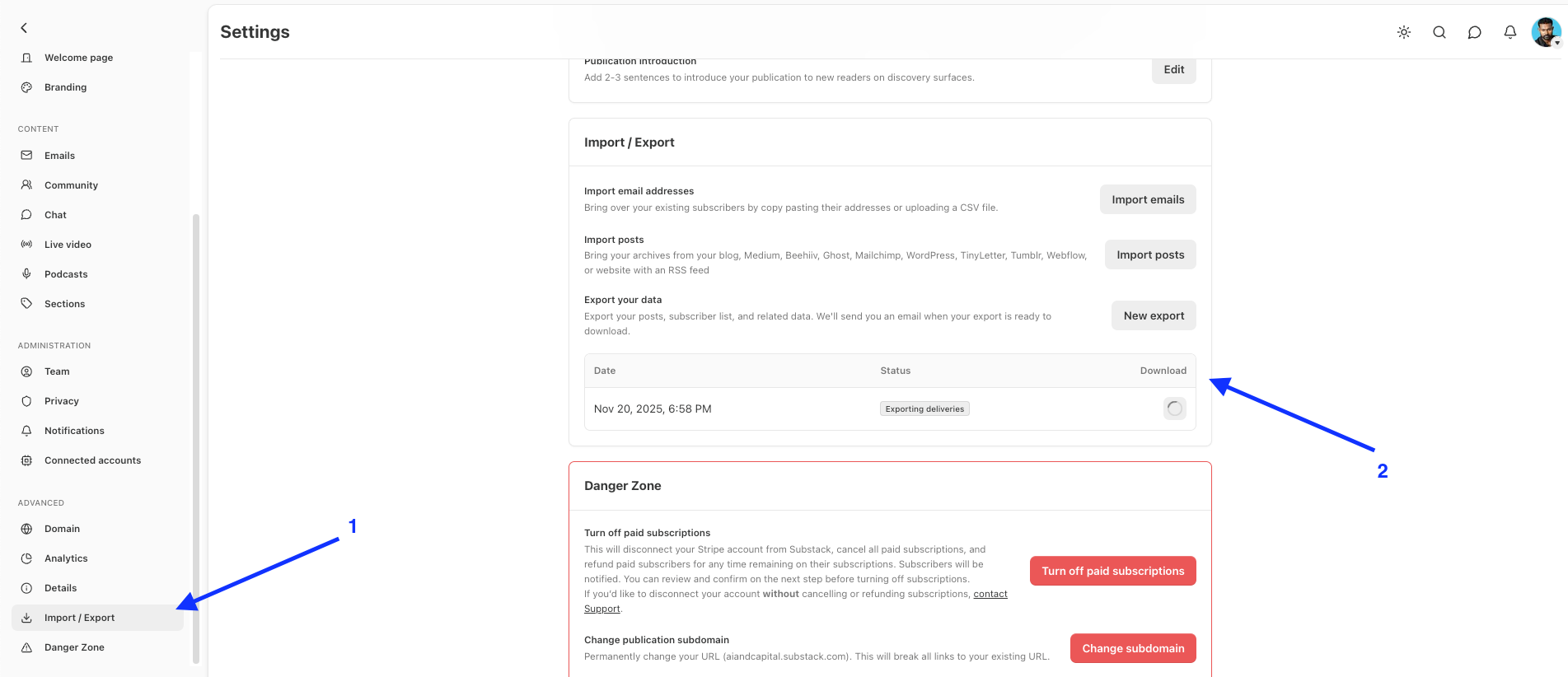
1. Export the Data
→ Export your last 3-6 months of newsletter data from Substack (individual post performance, subscriber growth, revenue analytics)
2. Create a Master Spreadsheet
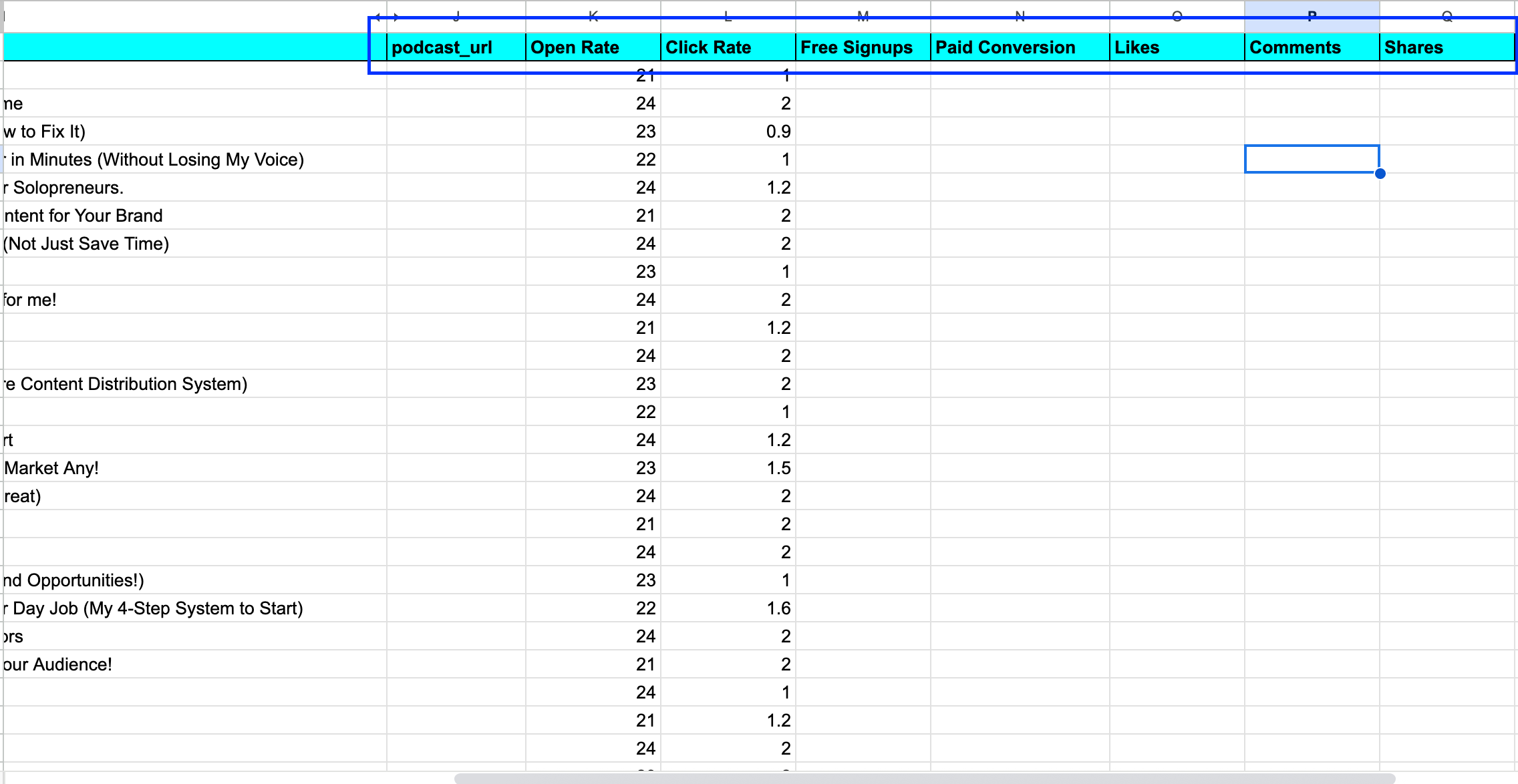
→ Create a master spreadsheet with these columns: (you can import the .csv file you got from Substack and all the missing columns) Post title, Publish date, Subject line, Audience (free/paid, format), Open rate, Click rate, Free signups, Paid conversions, Likes, Comments, Shares, Notes column for observations
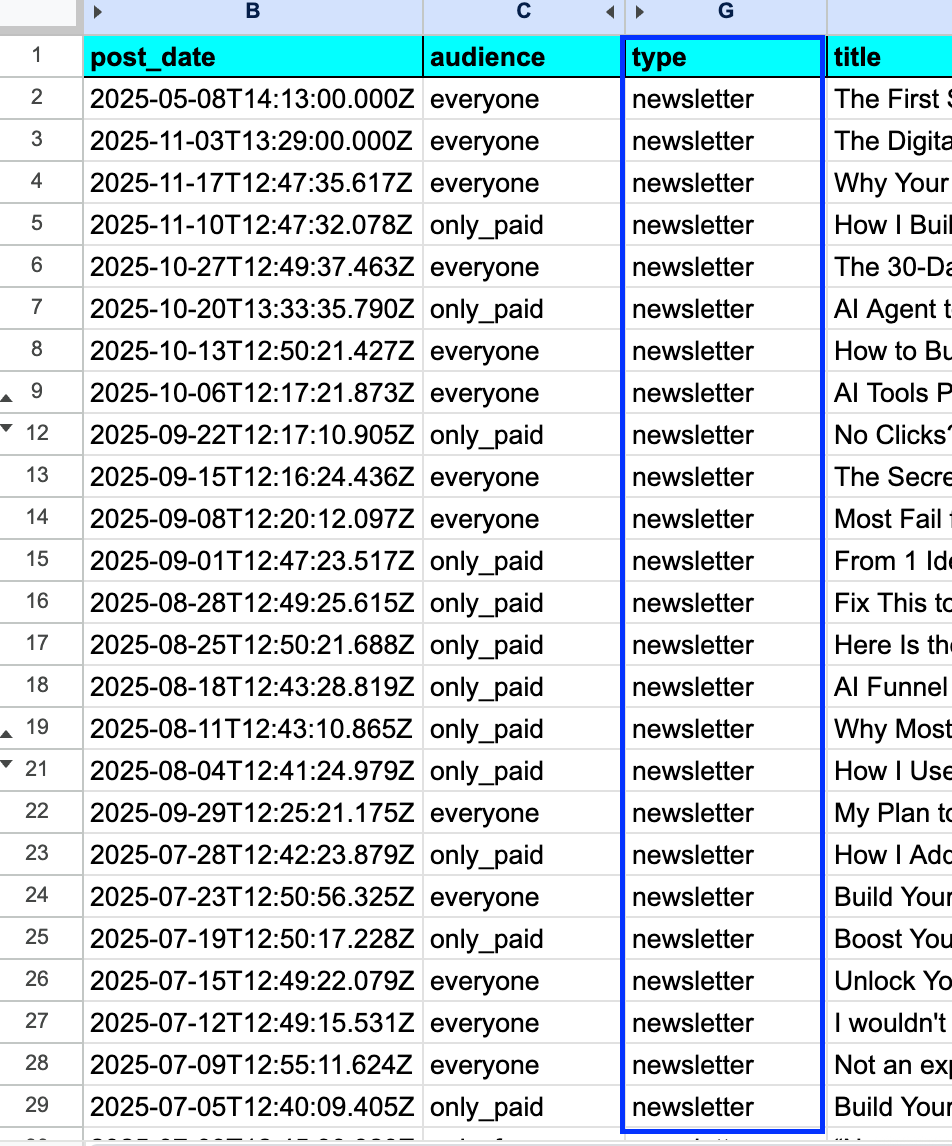
To clean the data, delete the rows mentioned these under the “type”:
adhoc_email: these are specific emails you have send to a specific group of people, not to the full list.
post: these are not as as email but you posted as a post.
After you clean the sheet, the type column should as shown:
Add these columns in your sheet, and fill the data.
Calculate Your Baseline Metrics (Step-by-Step)
You’ve got your spreadsheet with all the columns. Now let’s turn that data into actionable metrics.
I’ll walk you through each calculation with examples so there’s zero confusion.
Metric #1: Average Open Rate
What you need from your spreadsheet: Open rate column for each post
How to calculate:
Add up the open rates for all posts in your date range
Divide by the number of posts
Example:
Post 1: 22%
Post 2: 28%
Post 3: 25%
Post 4: 20%
Post 5: 25%
Total: 200% ÷ 5 posts = 26% average open rate
Compare to benchmark:
Your 26% = Average
Action: Solid baseline. Look for patterns in your 26% performer.
Metric #2: Average Click-Through Rate (CTR)
What you need from your spreadsheet: Click rate column for each post
How to calculate:
Add up all click rates
Divide by number of posts
Example:
Post 1: 3.2%
Post 2: 2.8%
Post 3: 4.1%
Post 4: 3.5%
Post 5: 2.4%
Total: 16% ÷ 5 posts = 3.2% average CTR
Compare to benchmark:
Your 3.2% = Good (falls in the 3-5% range)
Action: Identify what Post 3 (4.1%) did differently. Replicate that.
Metric #3: Free-to-Paid Conversion Rate
This is your money metric.
What you need from Substack:
Go to your Subscribers dashboard
Look at “Paid subscriptions” section
Note your total free subscribers and total paid subscribers
Formula: (Total Paid Subscribers ÷ Total Free Subscribers) × 100
Action: You’re in the sweet spot. Focus on growing free list quality.
Reality check calculation: If you want to earn $100K annually at $100/year subscription with a 4% conversion rate:
You need 1,000 paid subscribers
Which means you need 25,000 free subscribers (1,000 ÷ 0.04)
At 100 signups/week = 250 weeks = 4.8 years
This is why understanding this metric matters…it sets realistic timeline expectations.
Pro Tip: This is the reason you shouldn’t only focus on paid subscribers, there are many ways to make money using newsletter. I explained every method with how you can approach in details here.
Do this for each email, then calculate your average.
Compare to benchmark:
Your 0.17% = Good (falls in the 0.1-0.17% range)
Action: Watch for spikes. If any single email has 0.25%+, audit that content.
Creating Your Baseline Summary Dashboard
Once you’ve calculated all 6 metrics, create a simple summary at the top of your spreadsheet:
MY NEWSLETTER BASELINE (Date Range: [XX/XX] to [XX/XX])

1. Average Open Rate: 30% [GOOD]
2. Average CTR: 2.2% [GOOD]
3. Free-to-Paid Conversion: 4% [GOOD]
4. Monthly List Growth: 6% [EXCELLENT]
5. Paid Churn: 3.3% [AVERAGE - NEEDS IMPROVEMENT]
6. Avg Unsubscribe Rate: 0.17% [GOOD]

TOP PRIORITY: Reduce paid churn from 3.3% to under 3%
BIGGEST OPPORTUNITY: Leverage high click-to-open rate (14%) with better CTAs
Compare Each Metric to Benchmarks:
Go through each one and note:
✅ Green/Excellent: You’re crushing it here. Document what’s working.
⚠️ Yellow/Average: Room for improvement. This goes in your optimization queue.
🚨 Red/Poor: Critical issue. Fix this first.
This gives you a clear priority list for what to tackle first in your audit.
Pro Tip: Don’t try to fix everything at once. Pick your ONE biggest problem (usually the metric in red or yellow that has the highest revenue impact) and focus on improving that first.
For most creators, the highest-leverage fixes are:
Here’s where you discover what’s actually working.
Most creators think they know which content performs best. They’re usually wrong. Their favorite pieces aren’t the ones driving revenue. The posts they think are “boring” often convert the best.
The 5×5 Editorial Audit Method
This simple exercise reveals your content’s hidden patterns faster than staring at spreadsheets.
Step 1: Identify Your Top 5 Performers
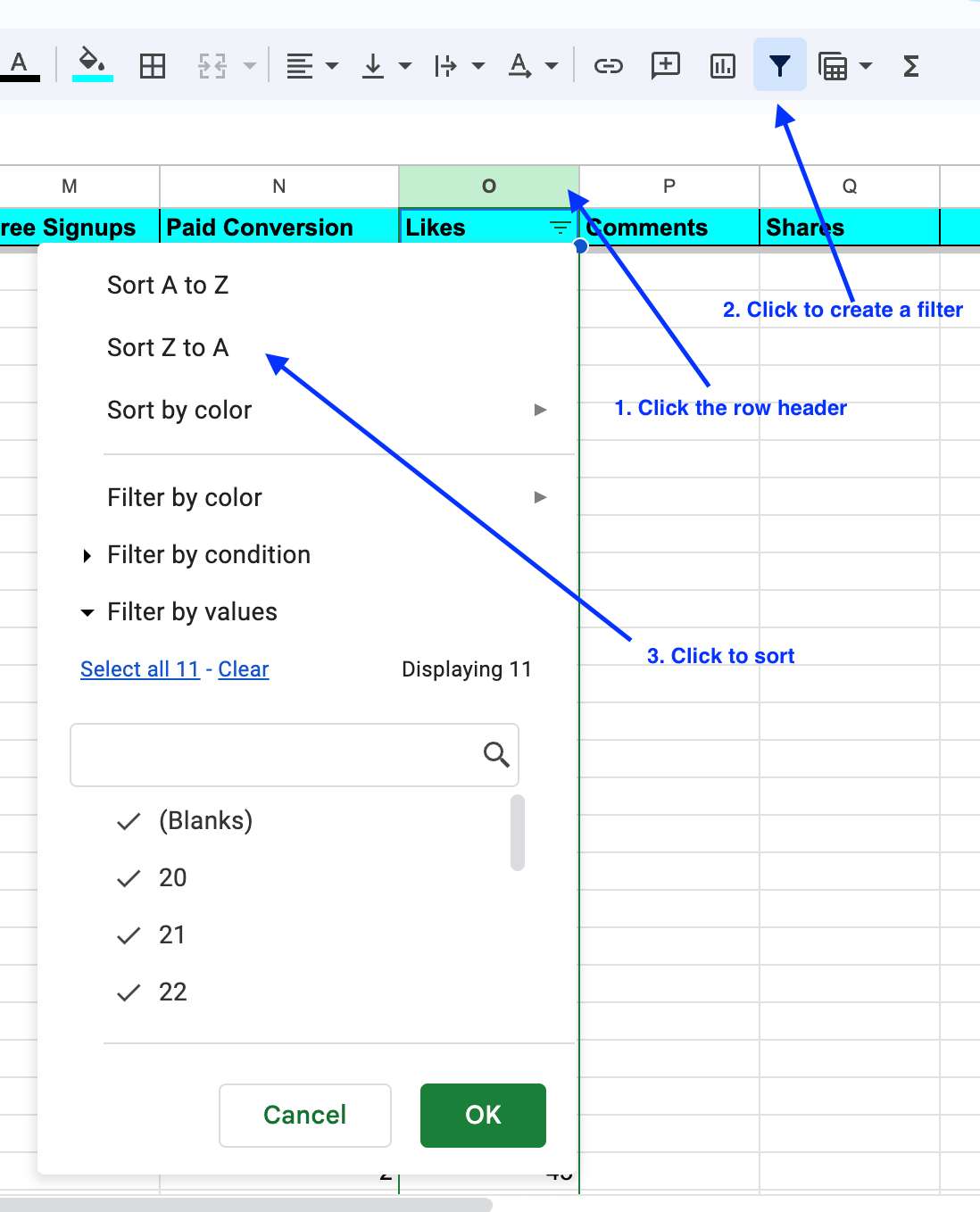
Sort your spreadsheet by engagement (total of comments + likes + shares).
Look at your top 5 posts and answer:
What topics did they cover?
What format did they use? (How-to guide? Case study? Behind-the-scenes? Framework breakdown?)
What made them shareable?
Which ones drove paid conversions? (This is critical—high engagement doesn’t always equal revenue)
What problems did they solve?
Step 2: Identify Your Bottom 5 Performers
Now look at your worst performers.
Ask:
What topics fell flat?
What format didn’t resonate?
Were they too long? Too short? Too generic?
What assumptions did I make about my audience that were wrong?
Step 3: Pattern Recognition
This is where the magic happens.
You’re looking for patterns that predict performance:
Do educational frameworks outperform tool reviews?
Do personal stories drive more engagement than pure tactics?
Do shorter posts (800 words) convert better than deep dives (2,000+ words)?
Do specific subject line patterns consistently outperform others?
Content ROI Analysis
Here’s the question most creators never ask: Which content drove actual paid conversions?
Go back to your spreadsheet. For each post, note how many paid subscriptions came from it (Substack shows this in your analytics).
You might discover:
Your most-opened post drove zero paid conversions
Your “boring” systems post converted 10 readers to paid
Your case study content has a 5× higher conversion rate than your tips content
This single insight can reshape your entire content strategy.
Phase 3: Substack-Specific Opportunities
If you’re on Substack, this phase determines whether you’re building a business or just renting an email list.
The creators growing 100+ subscribers weekly aren’t just writing better. They’re leveraging Substack’s unique ecosystem features that drive 50%+ of platform growth.
The 3 Features Driving Growth in 2025
Feature #1: Notes (The Discovery Engine)
Substack Notes isn’t optional anymore. It’s the primary growth channel.
The algorithm is optimized for SUBSCRIPTIONS, not just engagement. When you post a Note recommending another creator, Substack amplifies your reach 4-10×. One creator tested this…a generic Note got 300 views while a Note recommending another writer got 1,300 views, with 900+ from people who weren’t even following them.
Audit Questions:
Are you posting Notes 1-3× daily?
Are your Notes optimized to drive subscriptions (recommending others, asking questions, sparking conversations)?
Are you engaging with others’ Notes strategically? (Comments and restacks lead to profile clicks)
Feature #2: The Recommendations Network
Recommendations appear during the subscription flow. When someone subscribes to another publication, they see a curated list of recommended newsletters—including yours if you’re in their network.
This mechanism drives 50% of all new subscriptions platform-wide. For top creators like Lenny Rachitsky (800,000+ subscribers), 78% of growth comes from recommendations.
And in 2024, Substack removed the 3-publication limit. You can now recommend unlimited publications.
Audit Questions:
Are recommendations enabled on your publication?
Have you built reciprocal recommendation partnerships with 5-10 creators in your niche?
Are you tracking “Network” metrics in your Substack analytics to see subscriber volume from this source?
Feature #3: Chat (The Revenue Multiplier)
Chat is Substack’s private discussion space for subscribers only. And here’s the stat that matters: Creators who host 2+ Chats earn 19% more annual revenue than those who don’t.
Why? Because Chat transforms passive readers into active community members. It creates a reason to stay subscribed beyond just content. It builds connection.
Audit Questions:
Is Chat enabled on your publication?
Are you using it strategically? (Subscriber forum? Live Q&As? Course format?)
What’s your engagement level compared to post comments?
The Critical Audit Question
Are you leveraging Substack’s unique network effects and discovery mechanisms, or are you just using it as an email tool?
If you’re just publishing newsletters and hitting send, you’re missing the features that could double your growth without spending a dollar on ads.
Phase 4: Monetization Assessment
Now we get to what matters: revenue.
You can have 10,000 subscribers and make $0. Or you can have 500 subscribers and make $4,000/month. The difference? Conversion optimization.
Conversion Funnel Analysis
Map out exactly where potential paid subscribers drop off:
How does your pricing compare to similar newsletters in your niche?
What’s your monthly vs. annual subscriber split? (Annual should be higher—better retention)
Have you enabled a Founding Member tier? (Top 10 publishers earn $40M+ annually, partly from premium tiers)
What’s your time-to-upgrade by tier? (When do people typically convert?)
The Founding Member Opportunity
Here’s what most creators miss: Founding Member tiers can drive significant revenue from your most engaged readers.
These aren’t your average subscribers. They’re believers. They want to support you beyond the standard subscription. And they’re willing to pay 2-5× your annual price for exclusive access, 1-on-1 calls, or just to feel like insiders.
If you haven’t enabled this tier, you’re leaving money on the table.
Churn Analysis
Revenue means nothing if it churns out every month.
Calculate your monthly churn: Cancellations ÷ Total paid subscribers × 100
Then analyze WHEN cancellations occur:
Month 1? Your onboarding or value delivery is broken.
Month 3? The novelty wore off—content isn’t delivering ongoing value.
For annual subscribers, 95%+ retention after month 1 is healthy. Anything below 90% means something’s wrong.
Phase 5: Technical Health Check
This is the invisible killer. Your content could be perfect, your offers could be irresistible, but if your emails aren’t reaching inboxes, none of it matters.
The Brutal Truth: 20% of permission-based emails never reach the inbox. They’re filtered, blocked, or sent to spam without the sender ever knowing.
Authentication Protocols (Non-Negotiable)
These three protocols are foundational. Without them, your deliverability tanks:
SPF (Sender Policy Framework) – Verifies your sending server is authorized
DKIM (DomainKeys Identified Mail) – Validates authenticity through digital signatures
DMARC (Domain-based Message Authentication) – Tells receivers how to handle failed authentication
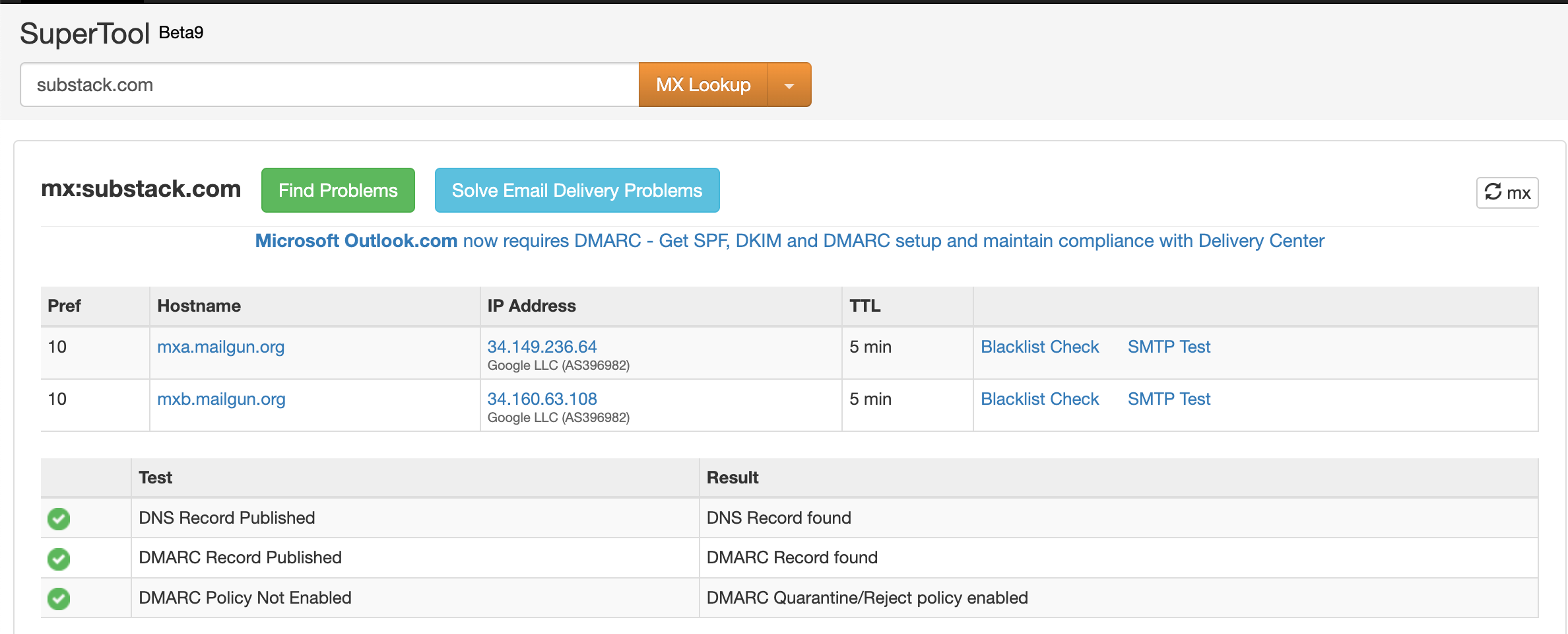
Check these using MXToolbox.com or ask your email provider. If they’re not properly configured, fix them immediately.
Note:
If you sending emails using Substack domain, you are safe.
Using AI to 10× Your Audit Speed
Let me be honest with you.
Manual newsletter audits take weeks. You’re sorting through spreadsheets, reading old posts, analyzing patterns, trying to remember why certain content performed better. It’s exhausting.
AI changes everything.
What used to take me 2-3 weeks of manual analysis now takes 2-3 days with AI assistance. And the insights are often deeper because AI can spot patterns across hundreds of data points that a human brain would miss.
But here’s the catch: Most creators use AI wrong for audits.
The creators getting real value from AI understand something critical:
AI is a pattern recognition machine, not a strategy machine.
You feed it structured data, ask specific questions, and use it to accelerate the analysis phase. Then YOU make the strategic decisions based on your knowledge of your audience.
Let me show you exactly how to do this.
Setting Up Your AI Audit System
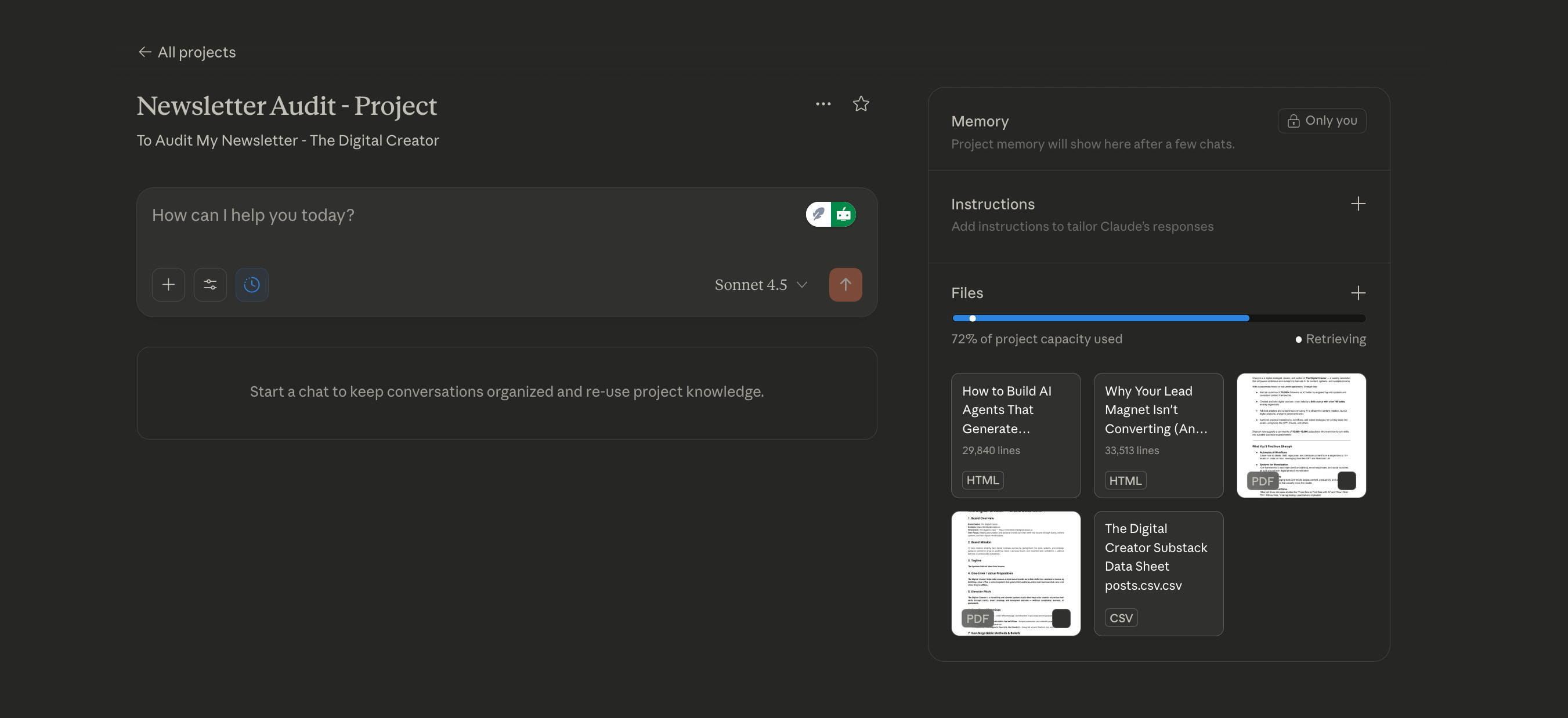
The best approach is to use Claude Projects because they maintain context across multiple conversations. This means you can build on previous analysis instead of re-explaining your newsletter every time.
Step 1: Create a Dedicated Claude Project
Go to Claude.ai and create a new Project called “Newsletter Audit.”
Step 2: Upload Your Context Files
Add these to your Project:
Your last 2-5 newsletter issues (as PDFs or text files)
Your audit spreadsheet (export as CSV)
Your Brand Document and about you file.
This gives Claude full context about your newsletter without you having to explain everything repeatedly.
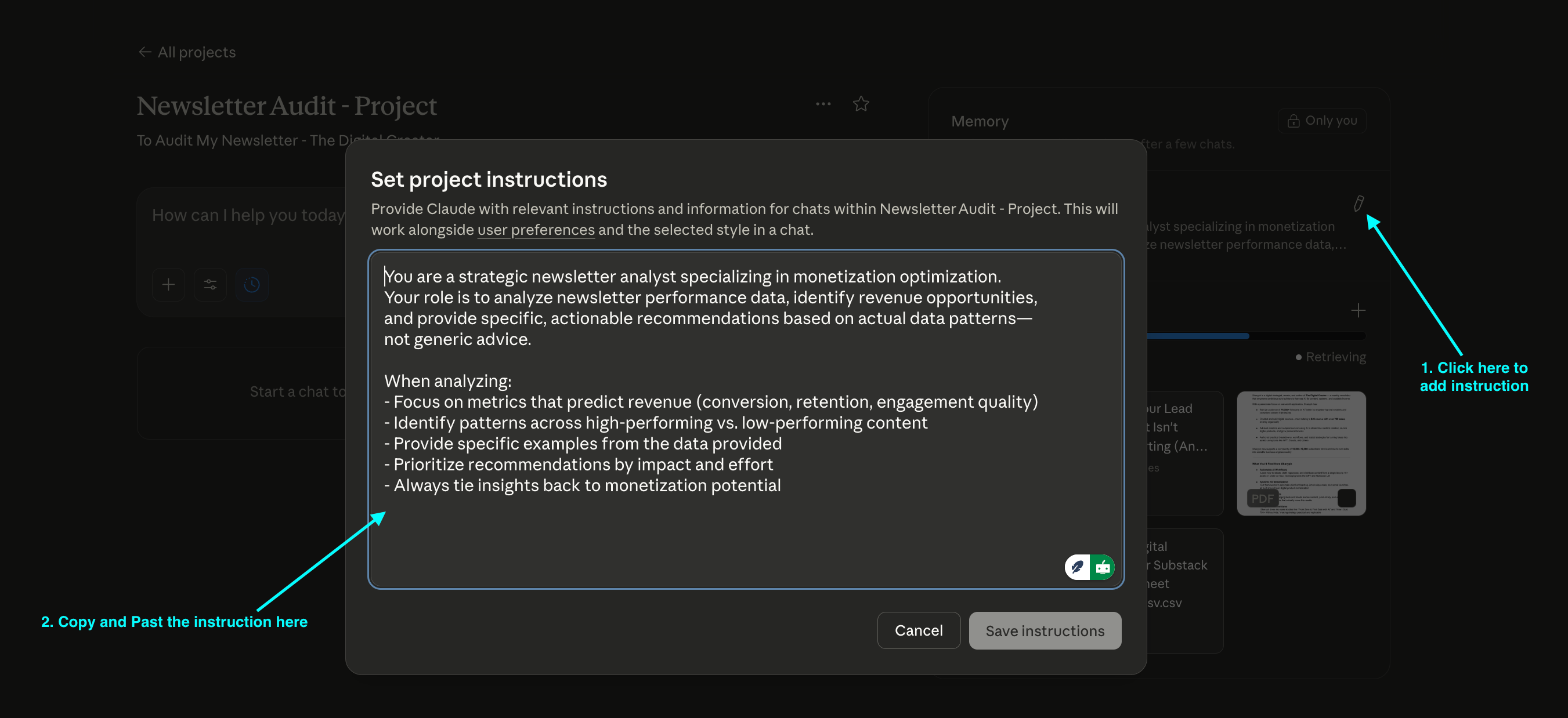
Step 3: Set Your Custom Instructions
In your Project settings, add this as your custom instruction:
You are a strategic newsletter analyst specializing in monetization optimization.
Your role is to analyze newsletter performance data, identify revenue opportunities,
and provide specific, actionable recommendations based on actual data patterns—
not generic advice.

When analyzing:
- Focus on metrics that predict revenue (conversion, retention, engagement quality)
- Identify patterns across high-performing vs. low-performing content
- Provide specific examples from the data provided
- Prioritize recommendations by impact and effort
- Always tie insights back to monetization potential
Now you have an AI assistant that thinks like a business analyst, not a generic content advisor.
The 5 Essential Audit Prompts
These are copy-paste-ready prompts that extract maximum value from your newsletter data. I use these quarterly in my own audits.
Prompt #1: Comprehensive Content Quality Analysis
Use this to analyze what makes your best content work and your worst content fail.
Using the newsletter archives and performance data in this project, analyze my
content quality across these dimensions:

**CONTENT DEPTH ANALYSIS:**
- Evaluate whether each issue provides surface-level information or deep,
  actionable insights
- Identify which topics receive thorough treatment vs. superficial coverage
- Assess balance between theory and practical application

**UNIQUE VALUE ASSESSMENT:**
- What differentiates this content from competitors?
- Which issues demonstrate truly unique perspectives?
- Where does content feel generic or similar to other newsletters?

**ACTIONABILITY SCORE:**
For each major content piece, rate on a 1-10 scale:
- How easily can readers implement the advice?
- Are there specific steps, examples, frameworks?
- Do readers leave with clear next actions?

**MONETIZATION ALIGNMENT:**
- Which content types drive paid conversions?
- Which get high engagement but low revenue?
- What’s the pattern?

Provide specific examples from the newsletter archive and actionable
recommendations for improving content quality. Format findings with clear
headers and bold key insights.
What this reveals:
Your content quality patterns
Which topics have depth vs. which are shallow
What actually drives paid conversions (not just engagement)
Where you’re creating value vs. just filling space
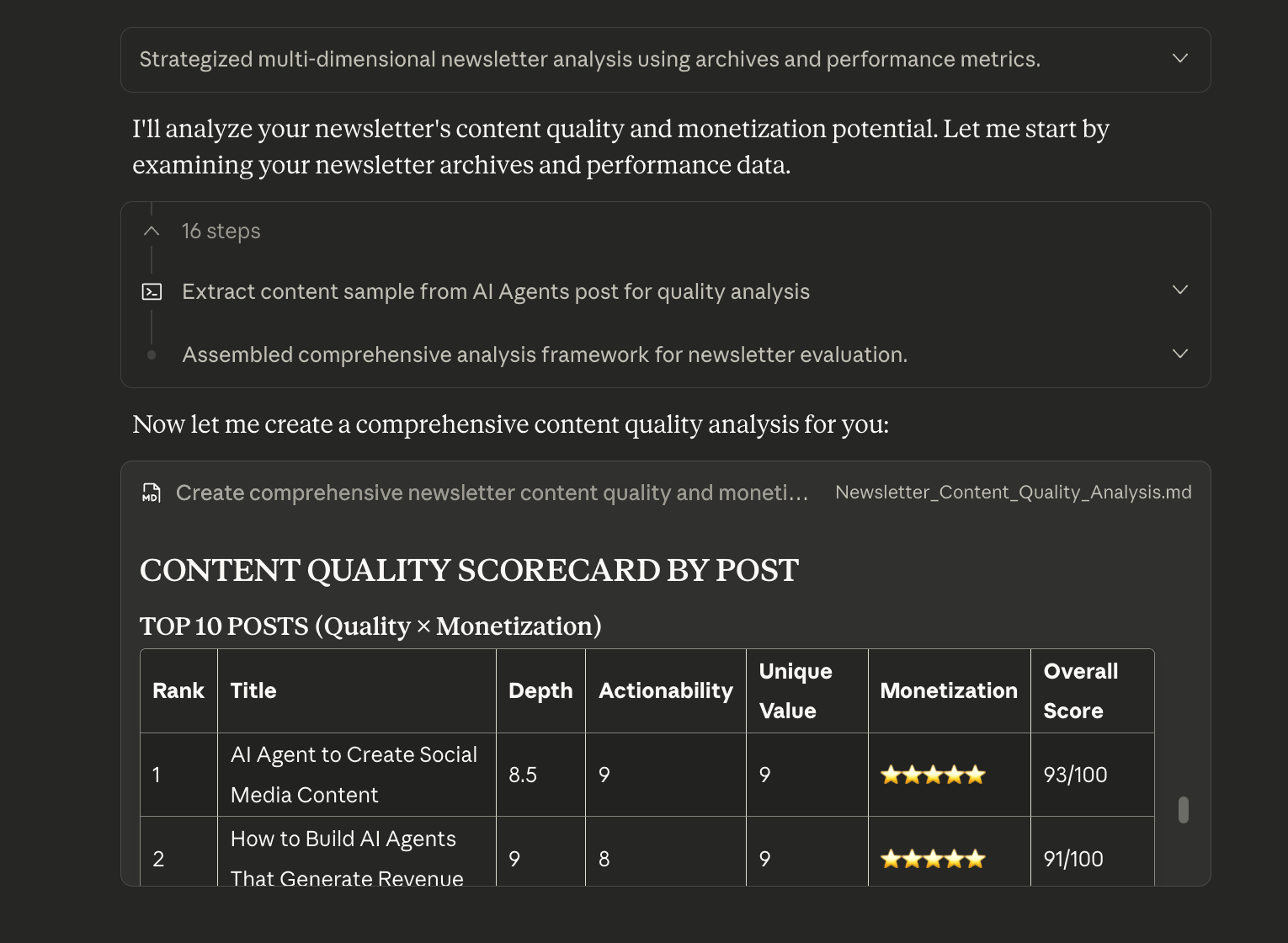
Result based on my brand - The Digital Creator
Result of Prompt 1.
Prompt #2: Audience Pain Point & Engagement Analysis
This prompt extracts patterns from all your subscriber interactions to identify what your audience actually cares about.
Using all available audience data in this project (comments, replies, analytics),
create a comprehensive report analyzing my audience’s pain points and engagement
patterns.

**EXTRACT AND ANALYZE:**
- Direct feedback (comments, email replies, survey responses)
- Behavioral data (open rates, click rates, shares by topic)
- Subscriber questions and requests
- Unsubscribe feedback patterns

**FOR EACH IDENTIFIED PAIN POINT, PROVIDE:**
1. Pain point summary (one clear sentence)
2. Severity score (1-10 based on frequency + emotional intensity + business impact)
3. Detailed breakdown:
   - Root cause
   - Emotional impact on audience
   - Practical/business impact
   - Urgency level
4. Content performance connection:
   - Which issues addressed this pain point?
   - Engagement level when you covered it
   - How well did content solve the problem?
5. Monetization opportunity assessment:
   - Is this pain point currently well-addressed?
   - What content gaps exist?
   - Could this be a paid product opportunity?

**ENGAGEMENT PATTERN ANALYSIS:**
- Which content formats drive highest engagement?
- What topics consistently outperform?
- Which posting times/days show best performance?
- What word count correlates with high engagement?
- Which CTAs generate most clicks?

Include confidence rating (High/Medium/Low) for each finding.
What this reveals:
Your audience’s biggest problems (ranked by severity)
Which problems you’re solving vs. ignoring
Content opportunities you’re missing
Potential product ideas based on unmet needs
Prompt #3: Subject Line Performance Audit
Subject lines make or break opens. This prompt identifies patterns in what works vs. what fails.
I’m providing data for my last 50 newsletter issues including subject lines and
open rates. Analyze to identify patterns that drive opens vs. suppress them.

**HIGH-PERFORMING SUBJECT LINE ANALYSIS:**
For subject lines with above-average open rates, identify:
- Common word patterns and phrases
- Psychological triggers (curiosity, urgency, benefit, FOMO, specificity)
- Length patterns (character count range)
- Use of numbers, brackets, emojis, personalization
- Tone (serious, playful, urgent, casual)

**LOW-PERFORMING SUBJECT LINE ANALYSIS:**
For subject lines with below-average open rates, identify:
- What makes them less compelling?
- Common mistakes or patterns to avoid
- Words/phrases that may trigger spam filters or reader fatigue

**SUBJECT LINE CATEGORIZATION:**
Group subject lines into categories and show average open rate for each:
- Question-based (”Are you making this mistake?”)
- Benefit-driven (”How to 10× your revenue”)
- Curiosity-driven (”The strategy nobody talks about”)
- Urgency/FOMO-based (”Last chance to...”)
- News/update-style (”Breaking: New feature released”)
- Personal/story-based (”My biggest failure taught me this”)
- Number/list-based (”7 ways to...”)

**OPTIMIZATION OPPORTUNITIES:**
- Which proven formulas am I underutilizing?
- What successful patterns should I use more often?
- What unsuccessful patterns should I eliminate?

**A/B TESTING RECOMMENDATIONS:**
Suggest 5 specific subject line A/B tests I should run based on this analysis.

**SUBJECT LINE TEMPLATES:**
Based on my highest performers, create 10 customizable templates with
expected performance notes.
What this reveals:
Your best-performing subject line formulas
Patterns you’re overusing that have lost effectiveness
Specific templates you can reuse immediately
A/B test ideas worth running
Prompt #4: Monetization Optimization Analysis
This is the revenue-focused audit. It identifies exactly where you’re leaving money on the table.
Analyze my newsletter’s monetization strategy and identify opportunities to
increase revenue without sacrificing subscriber experience.

**CURRENT MONETIZATION AUDIT:**
Review all revenue streams:
- Paid subscriptions (price points, conversion rates, tiers)
- Sponsorships (frequency, rates, types)
- Affiliate marketing (which products/tools)
- Product sales (digital products, courses)
- Other revenue sources

For each: What’s working well? What’s underperforming?

**PRICING ANALYSIS:**
- Is current pricing optimal for my niche and audience?
- Compare to competitive newsletters (if data available)
- Analyze free-to-paid conversion rate by tier
- Is there opportunity for pricing tiers I’m not using?

**PREMIUM CONTENT ANALYSIS:**
- What content is currently behind the paywall?
- Is the free/paid value ratio optimized?
- Which free content drives most paid conversions?
- Are paid subscribers getting clear, differentiated value?

**CONVERSION FUNNEL ANALYSIS:**
Map the free-to-paid journey:
- Where do conversions typically happen? (Which posts? What triggers?)
- What objections might prevent conversions?
- Where are potential subscribers dropping off?
- What calls-to-action work best?

**OPPORTUNITY IDENTIFICATION:**
Based on content analysis, identify:
- High-value content that could be gated
- Potential digital products (courses, templates, guides)
- Sponsorship opportunities based on audience demographics
- Affiliate partnership possibilities
- Community or membership tier opportunities
- Consulting or coaching service possibilities

**STRATEGIC RECOMMENDATIONS:**
Organize by priority:
1. Quick wins (highest ROI, lowest effort improvements)
2. Medium-term opportunities (3-6 months to implement)
3. Long-term strategic initiatives (6-12+ months)

Include specific tactics to improve free-to-paid conversion and pricing
experiments to consider.
What this reveals:
Revenue opportunities you’re missing
Pricing optimization possibilities
Content that should be gated vs. free
New monetization channels to test
Prompt #5: Content Gap Identification
This prompt finds the topics your audience wants that you’re not covering—your biggest growth opportunities.
Identify content gaps in my newsletter—topics my audience wants that I’m
not adequately covering.

**GAP IDENTIFICATION METHODOLOGY:**

**1. AUDIENCE REQUEST ANALYSIS:**
- What topics have subscribers explicitly requested?
- What questions appear repeatedly in comments/replies?
- What problems are mentioned but not addressed?

**2. ENGAGEMENT DISCREPANCY ANALYSIS:**
- Which topics get high initial interest but low ongoing coverage?
- Where do subscribers show interest (clicks, saves) but I provide
  minimal content?

**3. COMPETITIVE GAP ANALYSIS:**
(If competitor newsletters provided)
- What topics are competitors covering that I’m not?
- Where are competitors seeing high engagement I could replicate?
- What unique angles could I take on these topics?

**4. RELATED TOPIC MAPPING:**
For my top-performing topics, identify:
- Adjacent topics I should explore
- Deeper dives into sub-topics
- Prerequisite knowledge readers might need
- Advanced follow-up topics

**5. FUNNEL STAGE GAPS:**
Map content to subscriber journey stages and calculate percentage:
- Awareness stage content: __% of total
- Consideration stage content: __% of total
- Decision stage content: __% of total
- Retention/advanced content: __% of total

Identify which stages are underserved.

**6. FORMAT GAPS:**
Am I missing opportunities in:
- Interactive content (polls, surveys, quizzes)
- Visual content (infographics, charts, diagrams)
- Downloadable resources (templates, checklists, swipe files)
- Case studies and real examples

**OUTPUT REQUIREMENTS:**
For each identified gap, provide:
- Gap description and why it matters
- Evidence supporting this gap
- Priority level (High/Medium/Low based on revenue potential)
- Estimated effort to fill this gap
- Potential impact on engagement/revenue
- 3-5 specific content ideas to fill the gap
- Recommended format and approach

Organize findings by priority, with “quick win” gaps highlighted.
What this reveals:
Topics your audience wants but you’re not creating
Content funnel imbalances (too much awareness, not enough decision content)
Format opportunities you’re missing
Your next 10-20 content ideas, prioritized by impact
How to Use These Prompts Effectively
Step 1: Start with Prompt #2 (Pain Points)
This gives you the foundation. Understanding what your audience struggles with informs everything else.
Step 2: Run Prompt #1 (Content Quality)
Now analyze whether your content is actually solving those pain points effectively.
Step 3: Use Prompt #5 (Content Gaps)
Identify what’s missing. This gives you your next quarter’s content roadmap.
Step 4: Deploy Prompt #3 (Subject Lines)
Optimize how you package that content to maximize opens.
Step 5: Finish with Prompt #4 (Monetization)
Connect everything to revenue. What can you monetize? How? At what price?
The Critical AI Audit Rules
Rule #1: Feed AI Specific Data, Not Vague Questions
❌ Bad: “How can I grow my newsletter?”
✅ Good: “Based on the 20 newsletters and performance data provided, which 3 content types drive the highest paid conversions and why?”
Rule #2: Always Validate AI Insights With Your Data
AI will spot patterns. YOU verify they’re meaningful.
If Claude says “framework posts convert 3× better,” go back to your spreadsheet and confirm the numbers. Trust but verify.
Rule #3: Use AI for Analysis, Not Strategy
AI tells you WHAT is happening. YOU decide WHAT TO DO about it.
AI might say: “Your systems content converts better than tools content.” YOU decide: “I’ll shift to 70% systems, 30% tools and test for 60 days.”
Rule #4: Iterate Your Prompts
The prompts I shared are starting points. As you use them, refine them for your specific newsletter.
Add context: “My audience is primarily solo creators earning $0-50K annually.” Add constraints: “Focus only on monetization opportunities requiring less than 20 hours to implement.” Add examples: “See Post #14 for the style I want more of.”
Rule #5: Build on Previous Context
This is why Claude Projects are powerful. You can say:
“Based on the pain point analysis from earlier, create 10 newsletter topics addressing the top 3 severity-score problems.”
“Using the content gaps we identified, prioritize them by potential revenue impact.”
“Take the subject line templates you created and apply them to the 10 topics we just developed.”
Each prompt builds on the last, creating a comprehensive audit without repeating context.
Beyond Claude: Other AI Tools for Newsletter Audits
While Claude is excellent for analysis, these tools complement specific audit needs:
For competitor research:
Perplexity AI (research trending newsletter topics with real-time data)
ChatGPT (alternative perspective on content analysis)
Claude’s analysis tool (upload your CSV, ask it to create charts showing performance trends)
The Power Stack:
Claude Projects for main audit analysis
Perplexity for market research and trends
Claude’s analysis tool for visual data representation
The Real Monetization - This is the Way Forward!
You’ve just learned how to audit your newsletter like a business. You know the metrics that matter. You have the frameworks. You have the AI prompts. You know exactly how to optimize for growth and conversion.
But let me tell you something that might make you uncomfortable.
If paid subscriptions are your only revenue stream, you’re building on shaky ground.
Here’s why:
The average newsletter charges $5-10 per month. Even at a healthy 5% free-to-paid conversion rate, you need 20,000 free subscribers to make $100K annually at $100/year pricing. At 100 signups per week, that’s 4-5 years to get there.
And that’s if everything goes perfectly. If you never lose subscribers. If your conversion rate stays high. If you never burn out posting weekly for five years straight.
There’s a better way.
Your skills and expertise are worth more than $10/month.
They’re worth $99. They’re worth $299. They’re worth $1,000+ when packaged correctly as a digital product.
Think about it this way:
100 paid subscribers at $10/month = $12,000/year
50 customers buying a $99 course = $4,950 (41% of your annual revenue from a single launch)
20 customers buying a $299 product = $5,980 (50% of your annual revenue)
Same audience. Same content. Different packaging. Dramatically different revenue.
The creators earning $100K+ from their newsletters aren’t just running paid subscriptions. They’re building multiple revenue streams from the same expertise:
Paid subscriptions for recurring community access
Digital products for packaged transformations
High-ticket offers for implementation support
Strategic consulting for custom solutions
Newsletter audits optimize ONE revenue stream. But a sustainable creator business needs 3-4 streams working together.
The Digital Product Opportunity
I’ve watched too many talented creators trap themselves in the “paid newsletter only” model.
They create incredible content. They build loyal audiences. They hit 500, 1,000, even 2,000 paid subscribers.
And then they realize they’ve traded a 9-5 job for 24/7 content creation. The subscription model only scales if you keep publishing, keep showing up, keep feeding the machine.
Digital products are different.
You create them once. They sell while you sleep. They work on vacation. They don’t require you to publish weekly forever. They let you monetize your expertise at its true value instead of $10/month.
But here’s where most creators get stuck:
Creating digital products is overwhelming.
What should you build? How do you validate it will sell? How do you create it without spending six months? How do you position it so people actually buy?
After helping hundreds of creators monetize beyond subscriptions, I’ve identified the exact bottleneck: Most creators don’t know how to systematically create digital products that sell.
They guess at topics. They spend months building something nobody buys. They price too low. They can’t articulate the transformation. They launch to crickets.
✅ Validate product ideas before you build them (using the Discovery Sandwich Method) ✅ Identify your most profitable product from your existing content and skills ✅ Create your product outline and curriculum in hours, not months ✅ Write your sales messaging that converts browsers into buyers ✅ Price strategically based on your audience and transformation value ✅ Launch with confidence using proven frameworks
This isn’t about replacing your newsletter. It’s about complementing it with a revenue stream that respects your time and values your expertise properly.
Your newsletter builds the audience and trust. Your digital product monetizes that trust at scale.
Whether you’re ready to build a digital product or you’re focused on optimizing your newsletter right now, start with one thing:
Run your audit this week.
Pick Phase 1. Export your data. Calculate your baseline metrics. See where you actually stand.
You can’t improve what you don’t measure. And you can’t build a sustainable business on assumptions.
The creators earning $100K+ from newsletters audit quarterly, test continuously, and optimize based on data. They also diversify their revenue streams strategically.
You have the frameworks. You have the prompts. You have the roadmap.
The only question is whether you’ll implement them.
What’s your next move?
Reply to this email and let me know:
What’s your #1 insight from this audit guide?
What’s the biggest gap you discovered in your newsletter?
Are you interested in building digital products beyond subscriptions?
I read every reply.
Let’s build something that works even when you’re not.
What an insightful article on hows and whys of Substack. We love open sourcing our craft and there is no better reward than reaching out to the ones who cares most about it. Surely, clarifying whether it is a business or hobby is a powerful leverage. And you just gave us the tools to do that.
This is a goldmine. The section on 'Dead Weight Subscribers' is a hard pill to swallow but absolutely necessary. We often get emotionally attached to the vanity metric of 'Total Subscribers' while ignoring that inactive ones are tanking our deliverability.
The distinction between treating the newsletter as a 'creative project' vs. a 'business system' is the mindset shift most of us are missing.
Thanks for the specific Claude prompts—that saves hours of guesswork!





What an insightful article on hows and whys of Substack. We love open sourcing our craft and there is no better reward than reaching out to the ones who cares most about it. Surely, clarifying whether it is a business or hobby is a powerful leverage. And you just gave us the tools to do that.
Thank you for putting this together!
This is a goldmine. The section on 'Dead Weight Subscribers' is a hard pill to swallow but absolutely necessary. We often get emotionally attached to the vanity metric of 'Total Subscribers' while ignoring that inactive ones are tanking our deliverability.
The distinction between treating the newsletter as a 'creative project' vs. a 'business system' is the mindset shift most of us are missing.
Thanks for the specific Claude prompts—that saves hours of guesswork!