

Welcome to The Digital Creator, helping creators build better businesses with better systems.
TL;DR: Stop asking "what should I sell?" Your existing content…newsletters, posts, videos, repeated questions…already contains the problems, expertise, and proof you need. Extract the 10 hidden signals, find the recurring pattern, turn it into a specific transformation, then build the mechanism, package, and proof around it.
Before we get into today’s playbook, I want you to do one thing.
Stop trying to come up with your next offer.
Because here’s what I’ve learned after two years of building in public: you probably already have the raw material for your next product. It’s sitting inside your newsletters. Your posts. Your videos. Your threads. Your frameworks. Your client conversations. Your repeated opinions. Your answers to the same questions you’ve been asked ten times.
You just haven’t organized it yet.
The creator economy grew from $191.55B in 2024 to a projected $234.65B by the end of 2026. And the whole game has shifted. It’s no longer about being a “creator.” It’s about becoming a creator-entrepreneur…someone who owns products, not just an audience.
But most creators are stuck at the starting line. Not because they lack ideas. Because they’re looking in the wrong place for them.
Let me show you where to actually look.
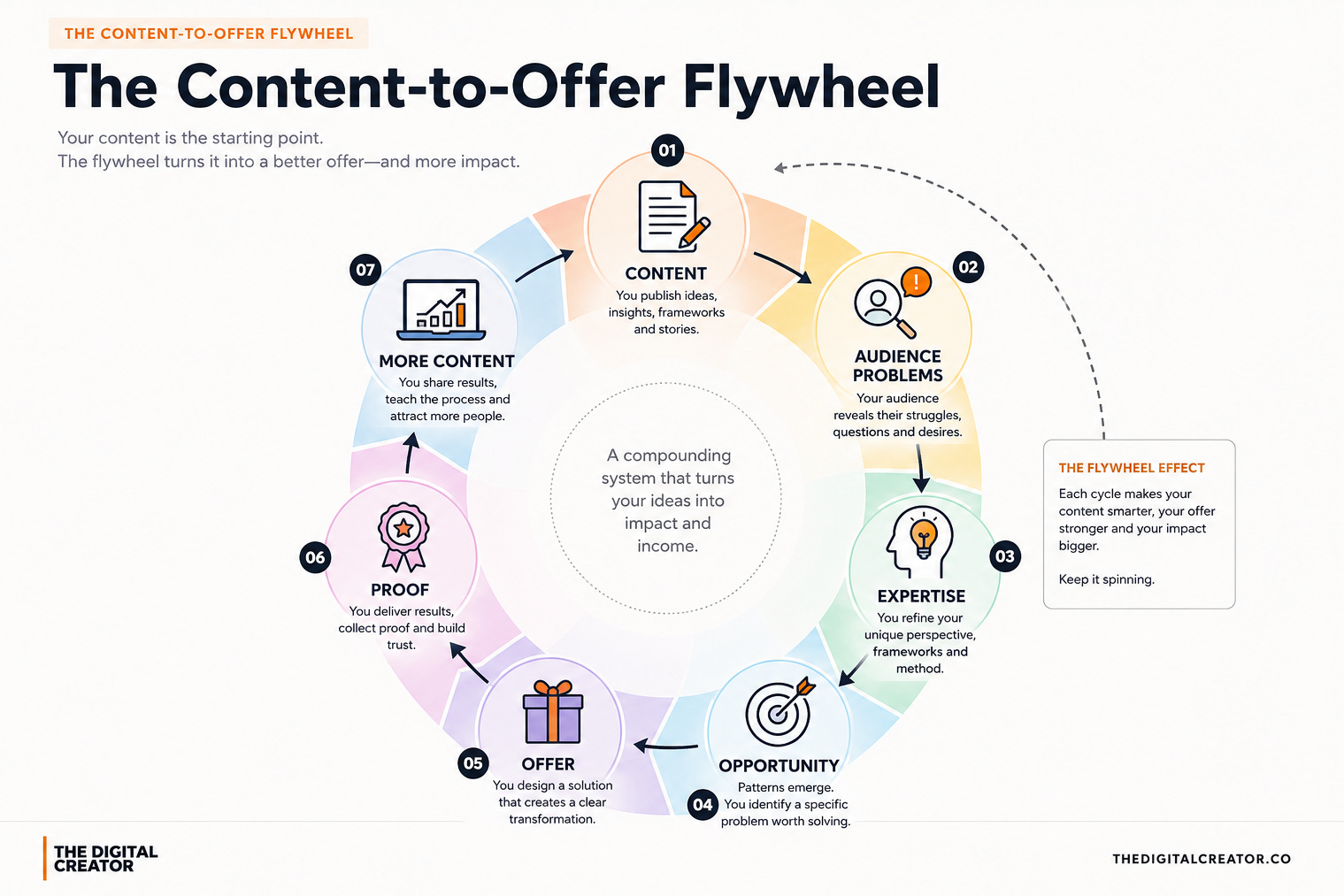
What If Your Next Offer Is Already Hidden in Your Content?
Most creators start offer creation backwards…picking a product format first, then hunting for a problem to fit it. Your published content already contains accumulated market intelligence: proven problems, developed opinions, and topics your audience responds to. The opportunity isn't inventing something new…it's mining what you've already created.
Most creators approach offer creation backwards.
They start with the product.
“Should I make a course?”
“Should I build a SaaS?”
“Should I create a community?”
“Should I sell consulting?”
Then they try to find a problem that fits the product.
That’s backwards.
Read that again.
Your existing content is a much better starting point. Because you’ve already spent months…maybe years…publishing ideas.
You’ve already discovered what you know.
You’ve already explained problems.
You’ve already developed opinions.
You’ve already answered questions.
And if you’ve been paying attention, you’ve already seen which topics people actually respond to.
Here’s the truth:
Your content is not just marketing.
It’s accumulated market intelligence.
The opportunity isn’t to create something new.
It’s to learn how to mine what’s already there.
Why Most Creators Struggle to Create Offers
Three mistakes kill offer creation before it starts: starting with the product instead of the problem, starting with what you know instead of what transforms someone, and copying a competitor's offer instead of using your own evidence. The fix for all three is the same…start with your content, your audience, and your proof.
I’ve made every one of these mistakes myself.
When I started, I had ideas. But no direction. No clear offer. No system. Just noise.
Here are the three mistakes I see on repeat.
❌ Mistake #1: Starting with the product
You decide to create a $99 course.
Then you spend six weeks trying to figure out what the course should teach.
See what happened? The product became the constraint.
Instead: Start with the problem. Then decide what product is the best vehicle for solving it.
❌ Mistake #2: Starting with what you know
This one sounds smarter.
“What am I good at?”
But even this isn’t enough.
The market doesn’t pay you simply because you know something. It pays you when your knowledge produces a valuable transformation.
Knowing how to write isn’t an offer.
Helping a founder turn their expertise into a content system that generates qualified conversations? That might be.
The distinction matters more than you think.
❌ Mistake #3: Copying someone else’s offer
You see someone selling a newsletter course.
It works for them.
So you make a newsletter course.
But you don’t have their audience.
You don’t have their proof.
You don’t have their positioning.
And you don’t necessarily solve the same problem.
👉 The better strategy is to start with your evidence.
Your content. Your expertise. Your audience. Your problems. Your proof.
That’s where the opportunity lives. Not in someone else’s Gumroad page.
What Should You Actually Look For in Your Content?
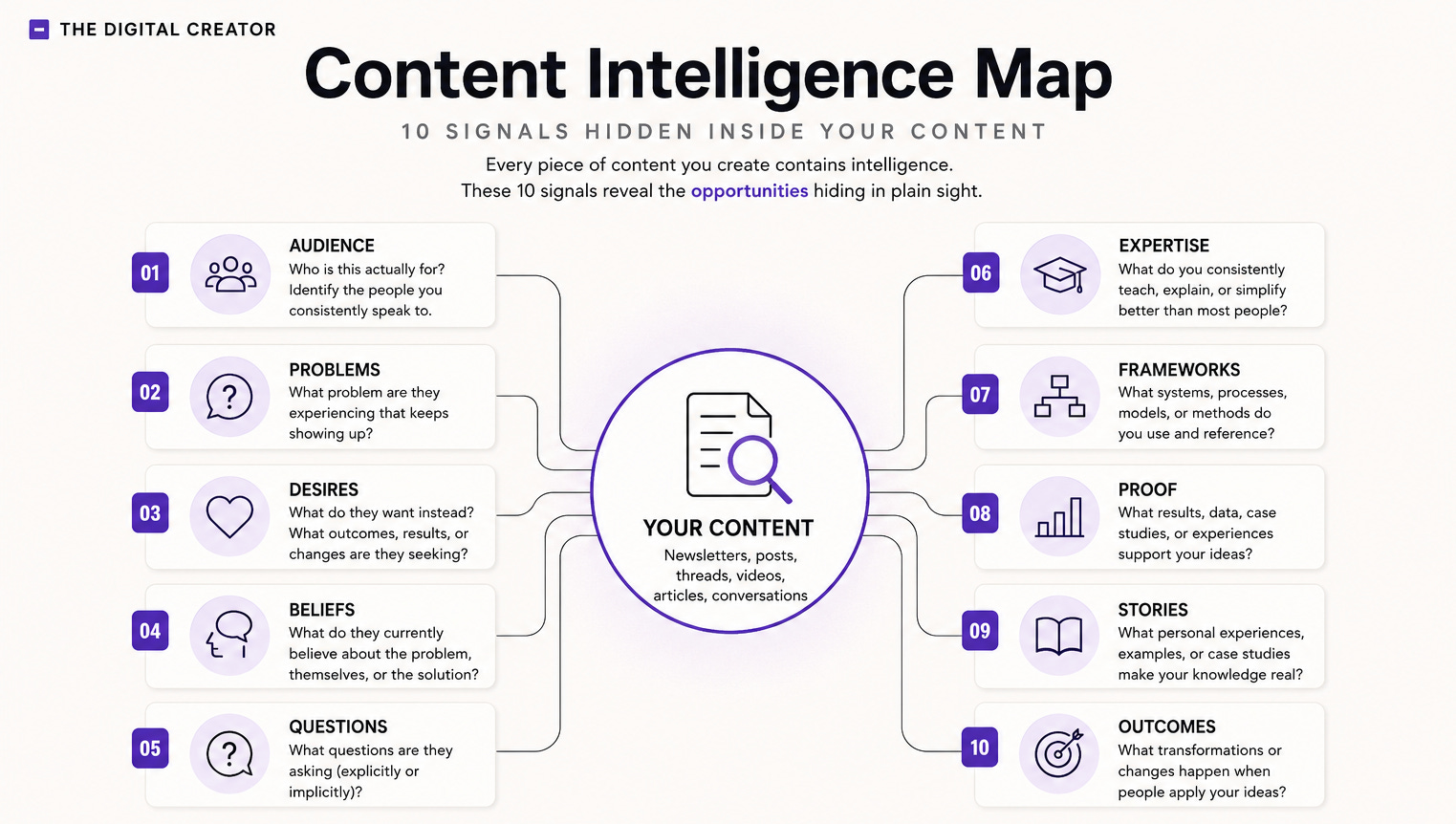
Don’t ask “could I sell this piece?”…extract the intelligence underneath it. Look for 10 signals across your content: audience, problems, desires, beliefs, questions, expertise, frameworks, proof, stories, and outcomes. One post is interesting; twenty posts repeating the same problem is a pattern worth building a business around.
Here’s where most people get it wrong.
They read each piece of content and ask:
“Could I sell this?”
That’s too narrow.
Instead, extract the intelligence underneath the content.
For every piece, look for these 10 signals:
1. Audience → Who is this actually for?
2. Problems → What problem are they experiencing?
3. Desires → What do they want instead?
4. Beliefs → What do they currently believe about the problem?
5. Questions → What are they trying to figure out?
6. Expertise → What do you repeatedly teach better than most people?
7. Frameworks → What systems or processes have you developed?
8. Proof → What results, examples or case studies support your ideas?
9. Stories → What experiences make your knowledge credible?
10. Outcomes → What changes for someone who applies what you teach?
The goal isn’t to find one interesting idea.
It’s to find patterns.
One post about content distribution is interesting.
Twenty pieces about distribution, creator burnout, repurposing and content systems? That’s a signal.
That’s where you start paying attention.
💡 Once you've spotted a pattern worth pursuing, a tool that extracts your offer from content you've already published can turn it into positioning, pricing, and email scripts in minutes instead of doing this pass by hand.
How Do You Turn a Content Pattern Into an Offer?
Follow the chain: content reveals a pattern, the pattern points to a real problem, the problem implies a desired outcome, and the outcome becomes your opportunity. A topic like “content repurposing” isn’t an offer…an offer names a specific person, problem, outcome, and mechanism, not just a subject.
From pattern to problem to opportunity
Here’s the framework I use.
Content → Pattern → Problem → Outcome → Opportunity
Let me walk you through a real example.
Say you’ve published several pieces about content creation.
You notice you keep coming back to one thing: creators struggling to distribute their work.
That’s the pattern.
Now investigate further.
The actual problem isn’t:
“Creators need more content.”
It’s:
“Creators are spending hours creating content but aren’t getting enough mileage from the ideas they’ve already produced.”
Now you have a problem.
The desired outcome becomes:
“Get more reach from the content I’m already creating — without spending hours manually rewriting everything.”
Now you have a transformation.
And that creates an opportunity:
A system that turns one strong content pillar into platform-native distribution assets.
Notice what just happened.
We didn’t invent the business idea.
We extracted it.
That’s the whole shift.
Your Topic Is Not Your Offer
This is one of the most important distinctions in this entire playbook.
“Content repurposing” is a topic.
“AI content creation” is a topic.
“LinkedIn growth” is a topic.
“Email marketing” is a topic.
None of those are offers.
An offer is much more specific. It connects:
A person → with → a painful problem → to → a valuable outcome → through → a believable mechanism.
Here’s the formula I use. Steal it:
For [specific person] who [specific problem], [offer] helps them achieve [specific outcome] through [unique mechanism], without [major sacrifice].
Now compare these two:
❌ “A content repurposing course.”
✅ “A system that helps solo creators turn one strong piece of content into a week’s worth of platform-native distribution — without spending hours manually rewriting it.”
The second one tells you who it’s for. What it solves. What changes. And why it’s different.
The difference isn’t subtle.
One is a topic. One is an offer.
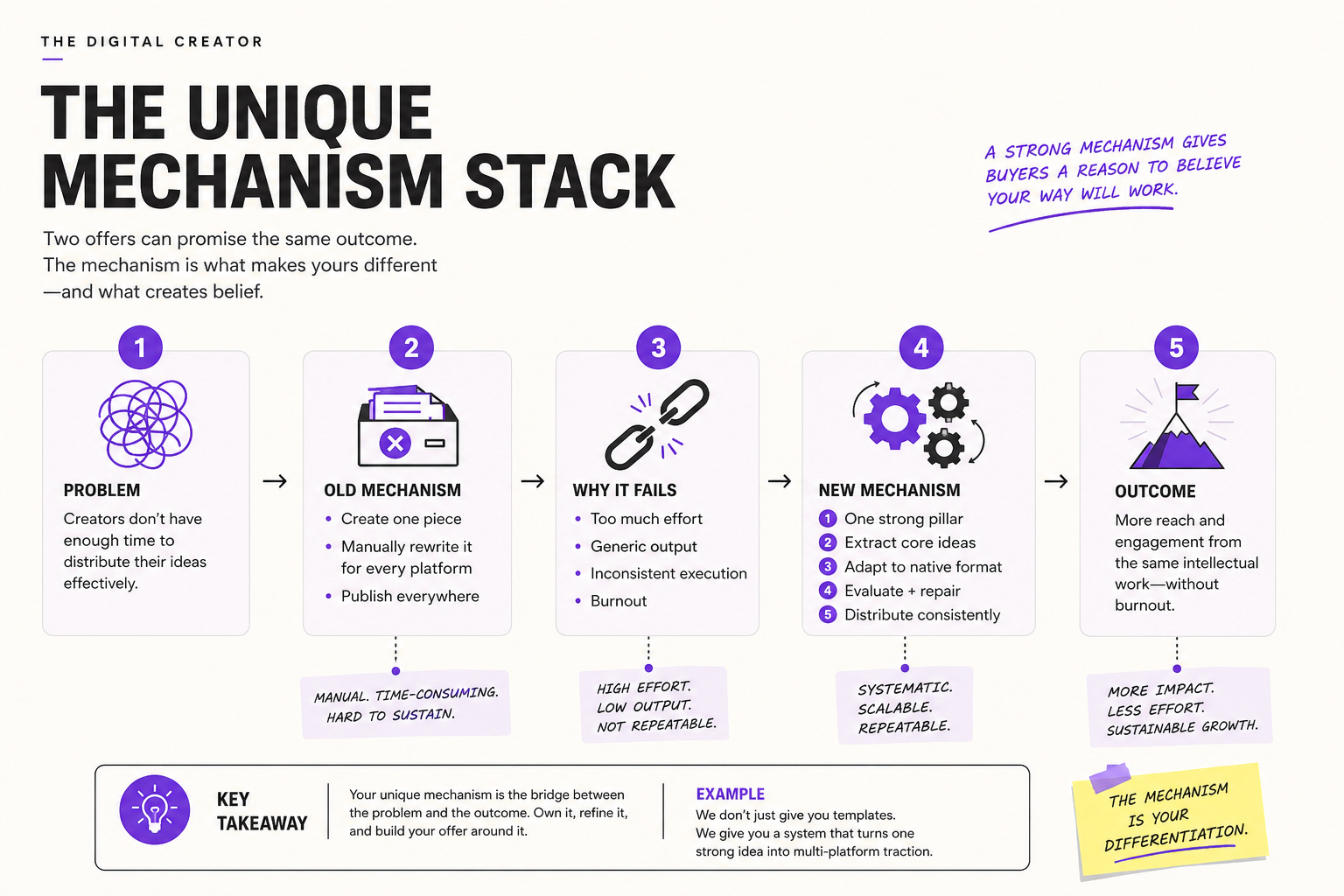
The Mechanism Is Where Your Offer Gets Interesting
Two businesses can promise the same outcome.
But the mechanism can be completely different.
And that matters…because buyers don’t just need to want the outcome.
They need to believe your way of getting there actually works.
Here’s what that looks like:
Problem → Creators don’t have enough time to distribute their ideas.
Old mechanism → Create one piece → manually rewrite it five times → publish everywhere.
Why it fails → Too much effort. Generic output. Inconsistent execution. Burnout.
New mechanism → One strong pillar → extract core ideas → adapt each idea to its native format → evaluate the output → repair the weak pieces → distribute.
Outcome → More distribution from the same intellectual work.
That’s a mechanism.
And a strong mechanism gives your offer a reason to exist.
Without it, you’re just another course competing on price.
How Do You Package and Price the Offer?
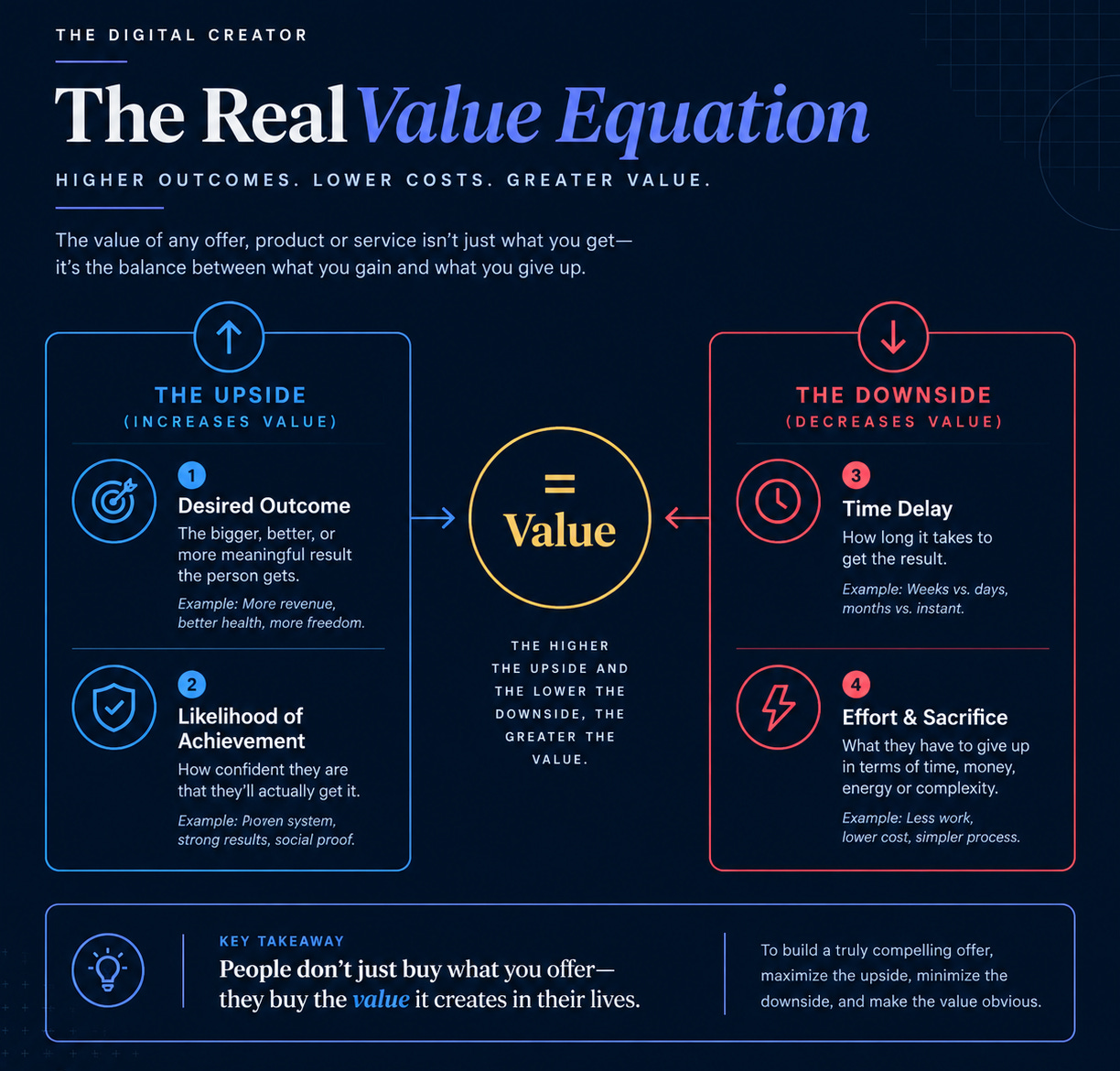
Value goes up when you increase the desired outcome and the buyer’s perceived likelihood of achieving it, and goes down when you decrease time delay and effort. Build the product around the transformation and mechanism, not the module count…templates, support, and community only belong in the offer if they measurably speed up or de-risk that outcome.
How valuable is the transformation?
Here’s another trap.
Creators try to make an offer more valuable by adding more stuff.
More modules. More templates. More bonuses. More PDFs. More prompts. More videos.
But here’s the thing:
More stuff doesn’t automatically mean more value.
A better way to think about value:
↑ Increase:
Desired Outcome
Perceived Likelihood of Achievement
↓ Decrease:
Time Delay
Effort & Sacrifice
The ideal offer helps someone achieve something they really want, makes them believe they can achieve it, gets them there faster, and removes as much unnecessary work as possible.
That’s why a simple service can be worth more than a 40-hour course.
The customer isn’t buying the hours of content.
They’re buying the transformation.
Price on the transformation. Not the time you put in.
How Do You Package the Offer?
Once you know the transformation and the mechanism, you build the product around them…not the other way around.
Start with the core transformation.
Then ask one question:
What does the customer actually need to achieve it?
That might include:
Templates
Software
Training
Checklists
Examples
Community
Support
Implementation
Feedback
Done-for-you work
But every single component needs a job.
Don’t add a bonus because you need something to fill the sales page. Add it because it improves the transformation.
Here’s the stack I use:
Core Transformation
↓
Unique Mechanism
↓
Product / Deliverables
↓
Implementation Support
↓
Risk Reversal
↓
Price
That’s the offer.
Not the number of modules.
💡 If you want a broader map of which specific products fit which stage of a creator business, my digital product playbook walks through the idea-to-income path in more depth.
How Do You Build Proof Before You Have Any?
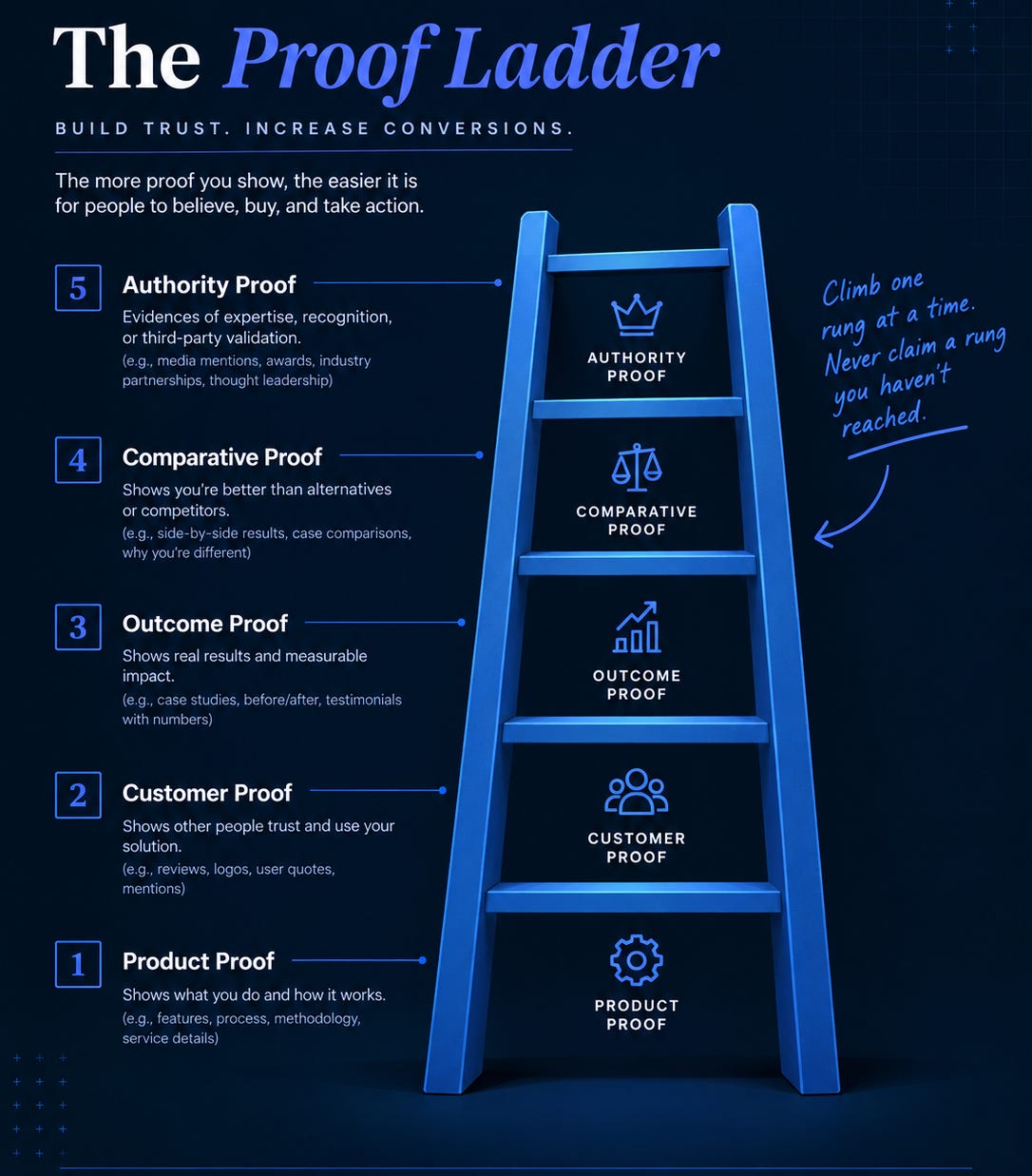
Never let your promise outrun your proof. Climb five levels in order: product proof (it works), customer proof (others used it), outcome proof (it produced results), comparative proof (it beats alternatives), and authority proof (why you). With zero testimonials, offer a discounted “founding buyer” deal for honest feedback…one proof point is enough to start the momentum
This is where I break from a lot of offer frameworks.
They tell you to make a big promise. Then figure out the proof later.
I do the opposite.
Look at your evidence first.
There are five levels of proof:
1. Product proof → Does the thing actually work?
2. Customer proof → Have other people used it?
3. Outcome proof → Did it produce the promised result?
4. Comparative proof → Can you show your approach works better than the obvious alternatives?
5. Authority proof → Why should someone trust you to solve this?
Now here’s the important part.
If you don’t have outcome proof yet…don’t pretend you do.
Reduce the claim. Run a beta. Get users. Document the process. Create product proof. Then build toward stronger claims.
I started with zero testimonials on my first product. Zero.
So I offered a “founding buyer” deal to a handful of people…free or steep discount…in exchange for honest feedback. Even a single line of proof moved the needle. Once the first few came in, momentum picked up.
Your promise should never outrun your proof.
Should You Even Build This?
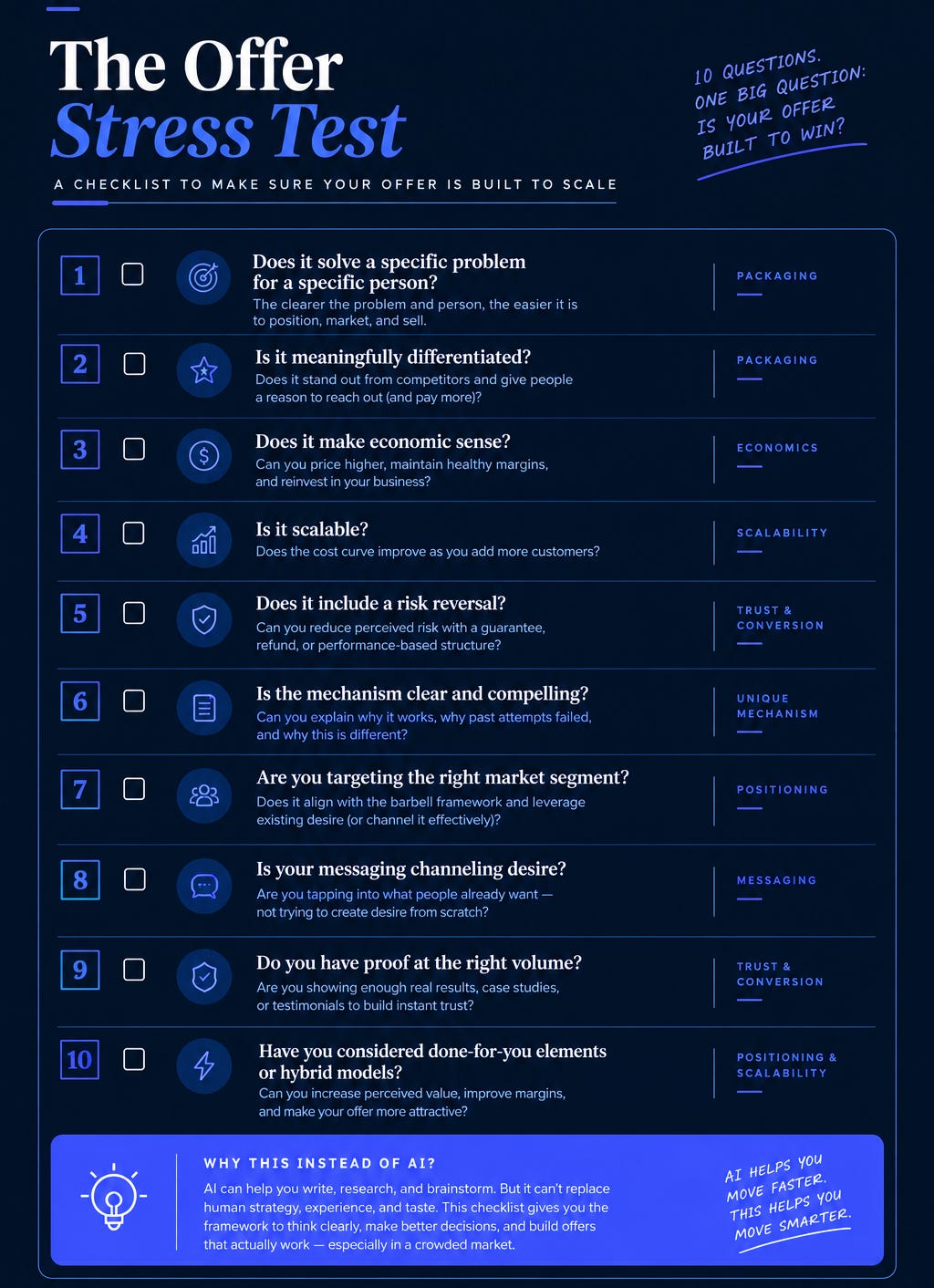
Before building, stress-test the opportunity: is the problem painful, frequent, and already being paid for, and is your mechanism meaningfully different? Then answer the harder 2026 question…why should someone buy this instead of just asking ChatGPT or Claude? If your edge isn’t proprietary data, workflow, or implementation, it’s not a real offer yet.
The offer stress test
This is the step almost everyone skips.
They find an idea. They get excited. They start building.
Three months later, they discover nobody wants it.
Don’t do that.
Before you build, score the opportunity. Run it through these questions:
✅ Is this actually painful?
✅ Does the problem happen frequently?
✅ Is solving it worth money?
✅ Are people already spending money to solve it?
✅ Is there urgency?
✅ Can the outcome be clearly explained?
✅ Is the mechanism meaningfully different?
✅ Why should I be the person solving this?
✅ Do I have enough proof?
✅ Can someone understand the offer in one sentence?
And then the question that matters more every single month:
Why this instead of ChatGPT or Claude?
If your answer is:
“Because my prompts are better.”
That’s probably not enough anymore.
Your real differentiation is more likely to be:
Proprietary data
Workflow
Accumulated context
Specialized knowledge
Integration
Evaluation
Distribution
Implementation
Accountability
A better end-to-end system
That’s what people pay for in the AI era. Not information they can get for free.
💡 Want this scored instead of eyeballed? I built a Claude Skill that scores any offer across five dimensions in about 60 seconds.
When the right answer is “don’t build this”
Now the counterargument. Because if you take this too far, you’ll start seeing a business in everything.
That’s not the goal.
Not every topic deserves an offer.
Sometimes the correct answer is:
Don’t build this.
Maybe the problem isn’t painful enough.
Maybe people don’t have buying power.
Maybe the market’s too crowded.
Maybe you don’t have a real advantage.
Maybe you don’t have enough proof.
Maybe the outcome isn’t measurable.
Or maybe…honestly…you just don’t want to spend the next three years solving this problem.
That’s fine.
The goal isn’t to monetize every idea you’ve ever had.
It’s to find the few opportunities worth building around.
Your content gives you possibilities.
The market decides which ones survive.
💡 Don't have a system yet for any of this?
I put the foundation of this exact approach inside my Lean AI-Powered Business Playbook for Creators — the free lead magnet for people who want the systems-first path without the tool overwhelm. → Grab it here.
Then come back and finish this, because the next part is the whole system.
What’s the Full Content-to-Offer System?
The complete system runs nine steps: ingest your existing content, extract the 10 signals, cluster the recurring patterns, generate multiple opportunities, score them, develop the transformation and mechanism, validate with real buyers before building, launch around the same problem, then learn from every customer interaction…which feeds back into step one.
Here’s the operating system I’d use, start to finish.
01 — Ingest
Start with your existing content.
Newsletters. Posts. Videos. Threads. Articles. Transcripts. Client material.
Everything you’ve already made is raw material.
02 — Extract
Pull out the 10 signals:
Audience. Problems. Desires. Expertise. Beliefs. Frameworks. Stories. Proof. Outcomes.
03 — Cluster
Find the recurring patterns.
What problems keep appearing? What topics keep coming back? What do people repeatedly ask about? What do you repeatedly teach?
04 — Generate
Turn the strongest patterns into several possible opportunities.
Don’t fall in love with the first idea. Create options.
05 — Score
Evaluate each opportunity:
Pain. Demand. Urgency. Differentiation. Credibility. Proof. Monetization. Outcome clarity.
06 — Develop
Take the strongest opportunity and build:
The transformation. The mechanism. The product. The pricing. The risk reversal. The proof strategy.
07 — Validate
Do NOT build the whole thing first.
Test the promise. Talk to buyers. Sell a beta. Create a prototype. Look for real behavior — not polite encouragement.
08 — Launch
Then build your marketing around the same problem and mechanism.
Teach it. Demonstrate it. Show the process. Show the proof. Invite people into the offer.
09 — Learn
Every customer interaction gives you more information.
→ That information improves the product
→ which creates better results
→ which creates better proof
→ which creates better content
→ and the cycle continues.

The Interesting Part Is What Happens Next
Once you understand this system, content creation changes.
You’re no longer publishing just to get views.
You’re collecting intelligence.
A newsletter isn’t just a newsletter → it’s a signal.
A thread isn’t just a thread → it’s a test.
A reader’s question isn’t just a question → it’s potential demand.
A framework that lands isn’t just content → it could be a product.
A problem you keep writing about isn’t just a topic → it could be a business.
That’s the shift:
Your content doesn’t just promote your business. It helps you discover what your business should be.
Read that again.

Frequently Asked Questions
Do I need a large audience before doing this?
No. A smaller audience can actually give you better qualitative signals, because you can talk to people directly and get honest, specific feedback instead of vague reactions. The thing that matters isn’t audience size — it’s the quality of the problem you’re solving and how clearly you can validate it.
What if my content covers a lot of different topics?
That’s exactly why clustering matters more than any single post. Don’t judge individual pieces in isolation — look for recurring patterns across your whole body of work. A scattered archive on the surface usually still circles back to two or three problems you keep addressing from different angles.
What if I don’t have testimonials?
Start with product proof instead of waiting for customer proof. Build a small version, run a beta, and document what happens. Offer a discounted “founding buyer” deal in exchange for honest feedback. Then collect customer and outcome proof as you go — that’s exactly how this approach was built and tested.
What if AI can already solve the problem?
Then your offer has to answer a harder question: why should someone buy your system instead of just asking ChatGPT or Claude directly? That’s where mechanism, accumulated context, workflow, proof, implementation, and specialization become your real edge — information alone stopped being enough to charge for.
How long does it take to turn content into an offer?
Faster than building from scratch, because you’re extracting instead of inventing. Auditing your last 20 pieces for the 10 signals and finding the recurring pattern takes a few hours. Turning that pattern into a validated, priced offer — through scoring, developing, and testing with real buyers — typically takes 1-2 weeks.
Key Takeaways
Audit your last 20 pieces of content for the 10 signals (audience, problem, desire, belief, question, expertise, framework, proof, story, outcome) instead of asking “could I sell this?”
Find the pattern, not the idea: one post about a topic is noise; the same problem surfacing across 15-20+ pieces is a validated signal worth building around.
Name the offer with the formula: for [specific person] who [specific problem], [offer] achieves [specific outcome] through [unique mechanism], without [major sacrifice].
Climb the proof ladder in order…product, customer, outcome, comparative, authority…and start with a discounted “founding buyer” deal if you have zero testimonials.
Validate before building: run the 9-step system (Ingest → Extract → Cluster → Generate → Score → Develop → Validate → Launch → Learn) and get real buyer behavior, not polite encouragement, before you build anything.
The Bigger Idea
You don’t need another business idea.
You need a better way to look at the business intelligence you’ve already accumulated.
Your content contains:
Problems. Desires. Expertise. Beliefs. Frameworks. Proof. Demand signals.
The job is simple to say and hard to skip:
Turn those signals into an opportunity.
Turn the opportunity into a transformation.
Then build the offer around the transformation.
That’s how you stop guessing what to sell.
And start discovering what your audience is already telling you to build.
The One Thing to Do This Week
Take your last 20 pieces of content.
Ask one question: “What problem do I keep talking about?”
Don’t look for an offer yet. Just find the pattern.
That pattern is the beginning of your next product.
Whenever You’re Ready to Build It
I’ve spent the last two years turning my own content into products…validating, packaging, pricing, and selling them with a lean AI-powered system instead of a bloated tool stack.
Everything in this playbook…the extraction, the mechanism, the value equation, the proof ladder, the validation…is exactly what the tool I have created does.
And provide the links of your best posts/newsletters, LinkedIn posts..etc and start from there.
Your content already did the hard part. Let’s turn it into income.
Until next time,
Sharyph | Founder of The Digital Creator
Twenty pieces repeating the same problem is such a clear signal most people ignore.
Just like building tech products. Thanks for this!!🙋🏻♀️
For [specific person] who [specific problem], [offer] helps them achieve [specific outcome] through [unique mechanism], without [major sacrifice].