

👋 I’m Sharyph. This is the first issue of something new.
There’s no shortage of people breaking down how companies make money. Revenue curves, funding rounds, ARR milestones. I read a lot of them.
What almost nobody breaks down is the layer underneath:
How these companies won attention in the first place.
Which channel they started on.
Which format actually broke through.
How often they published, and
What they eventually killed.
That’s the part that decides whether any of the revenue happens, and it’s the part that gets skipped.
So I’m building it.
What this is: I take one company apart through a content lens and answer all the questions you may ask about that company’s growth…especially how they used content to drive their growth, and I will provide real numbers…
What you get: how they built their audience, plus what the company stopped doing, (that means what’s working for them) and what won’t transfer to you if you’re one person without a team or a budget.
Where this is going: With this series, I am creating a filterable database. Filter by channel, by format, by team size, by whether a solo creator can realistically pull it off…each entry linking back to the full issue. So instead of trying to remember which breakdown had the play you need, you just filter for it.
Let’s start with a company that grew a blog to 1.5M monthly visits by publishing less.
📊 The Scoreboard
Primary channel Organic search (blog), then YouTube
Time to first traction ~12 months of failure, then 4 years of compounding
Content team at breakout Small — a handful of marketers
Publishing cadence Cut from 3 posts/week to ~1, later ~2
Peak measurable outcome 15K → 1.5M+ monthly blog visits · 10K → 600K YouTube
Company today ~141 employees, $100M+ ARR, bootstrapped, no sales team
Ahrefs doesn’t run Google Analytics on its blog.
It doesn’t put a lead magnet on the page. Doesn’t run an exit popup. Doesn’t track how many blog readers convert into customers. The company that sells the software marketers use to measure content has, by choice, almost no measurement on its own content.
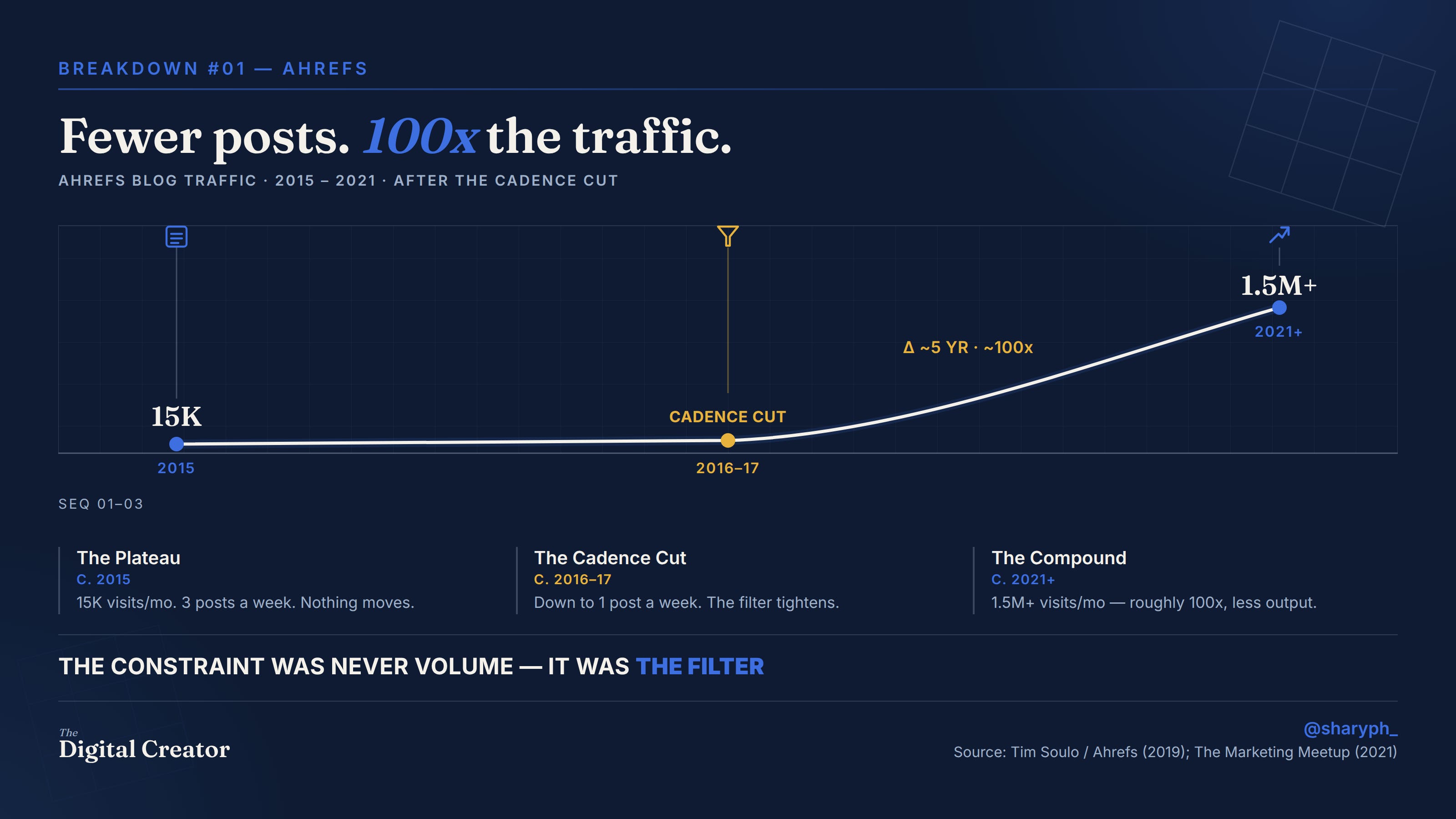
And it worked. The blog went from about 15,000 monthly visits to over 1.5 million. The company crossed $100M ARR without taking a dollar of venture money and, reportedly, without a sales team.
Here’s the part that should bother you more, though.
When that blog was stuck at 15,000 visits, they were publishing three articles every week. The traffic didn’t move. So they cut back to roughly one post a week, and traffic grew tenfold.
Everything you’ve been told about content volume is in that sentence, backwards.
What you’ll learn:
The 0–3 score that decides every topic Ahrefs writes about
Why publishing less was the unlock, not the compromise
The argument for collecting zero emails from a million-visitor blog
How one landing page went from position 8 to position 1 by becoming something else
What Ahrefs killed in 2025 when the ground moved under them
Method: Built from 12+ founder and operator interviews, podcasts, and Ahrefs’ own published posts, plus public company data. Figures Ahrefs hasn’t disclosed are third-party estimates and labeled as such. Sources at the bottom.
The Setup
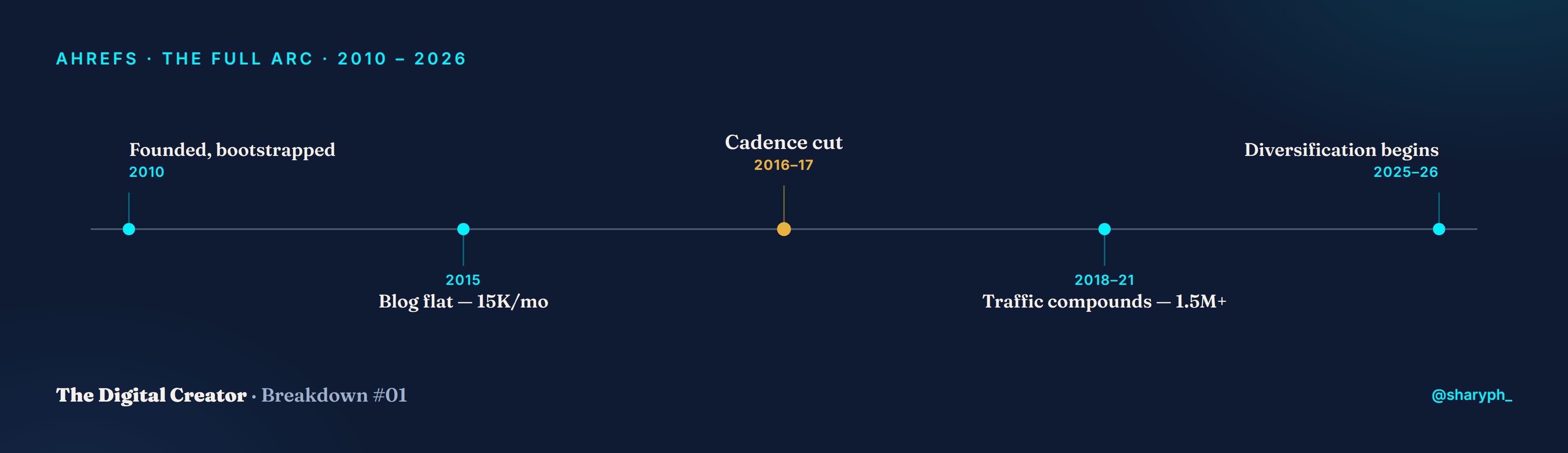
Ahrefs was founded in July 2010 by Dmitry Gerasimenko, a Ukrainian developer. Bootstrapped. No investors, ever. The company later moved its HQ to Singapore.
By 2015 they had a real product and a blog that wasn’t working. Around 15,000 visits a month, flat, despite a three-posts-per-week schedule. That’s the year Tim Soulo joined to run marketing.

His first move was the obvious one: publish better content, more consistently. He did that for a year.
It produced almost nothing.
The content was genuinely good, that wasn’t the problem. It just wasn’t aligned to anything people were actually searching for. Which is a particularly uncomfortable thing to discover at a company whose entire product exists to tell you what people are searching for.
That failed year is the most useful part of this whole story, and it’s the reason I’m starting the series here.
The fix wasn’t effort. They were already trying hard. The fix was a filter.
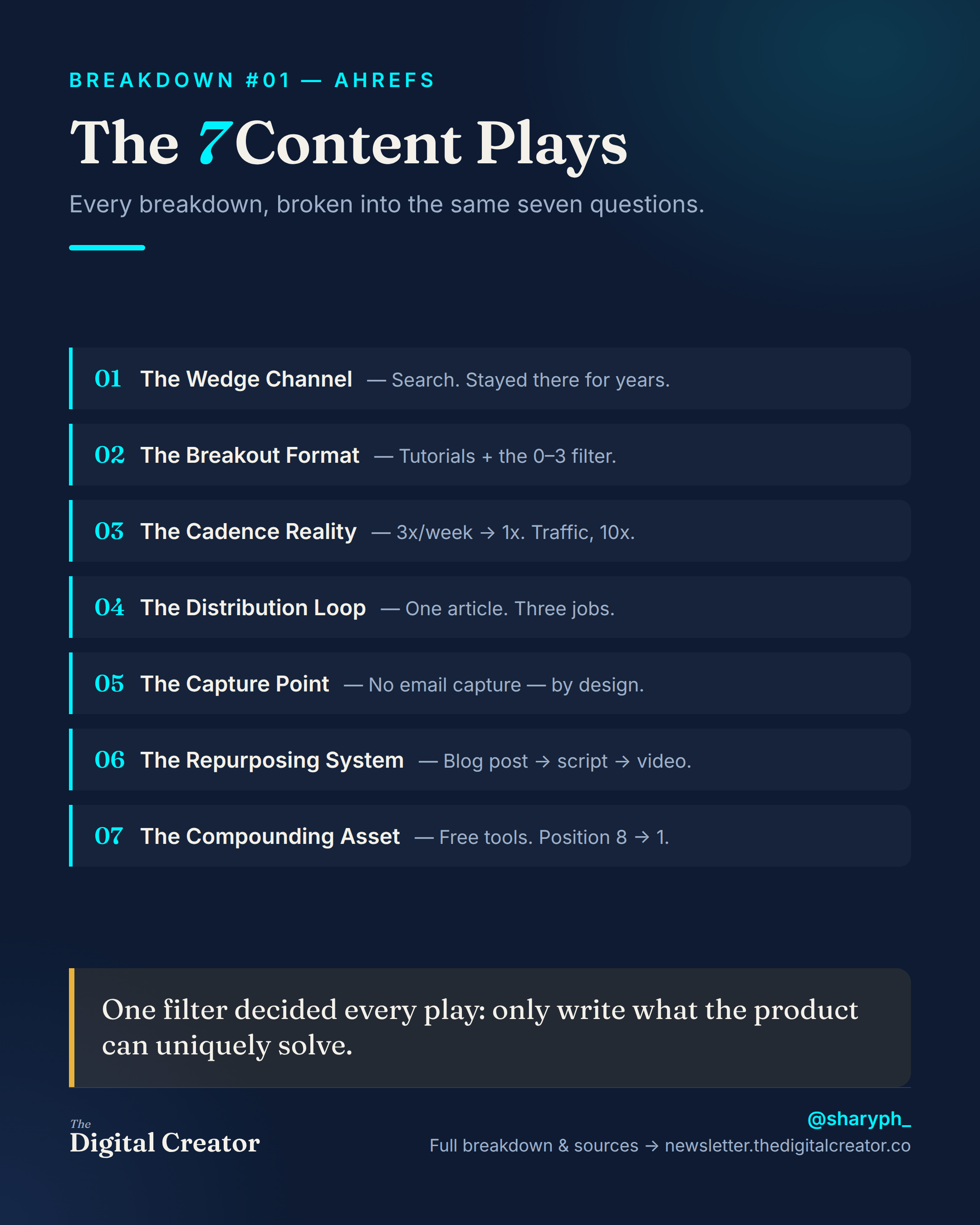
The Seven Content Plays
Play 1 — The Wedge Channel
Ahrefs picked organic search and stayed there. Not as a phase, as the entire strategy, for years, before YouTube got serious attention.
The logic is almost embarrassingly aligned: they sell an SEO tool, so their buyers are people who search. Every article that ranked put the product in front of someone already trying to solve a problem the product solves.
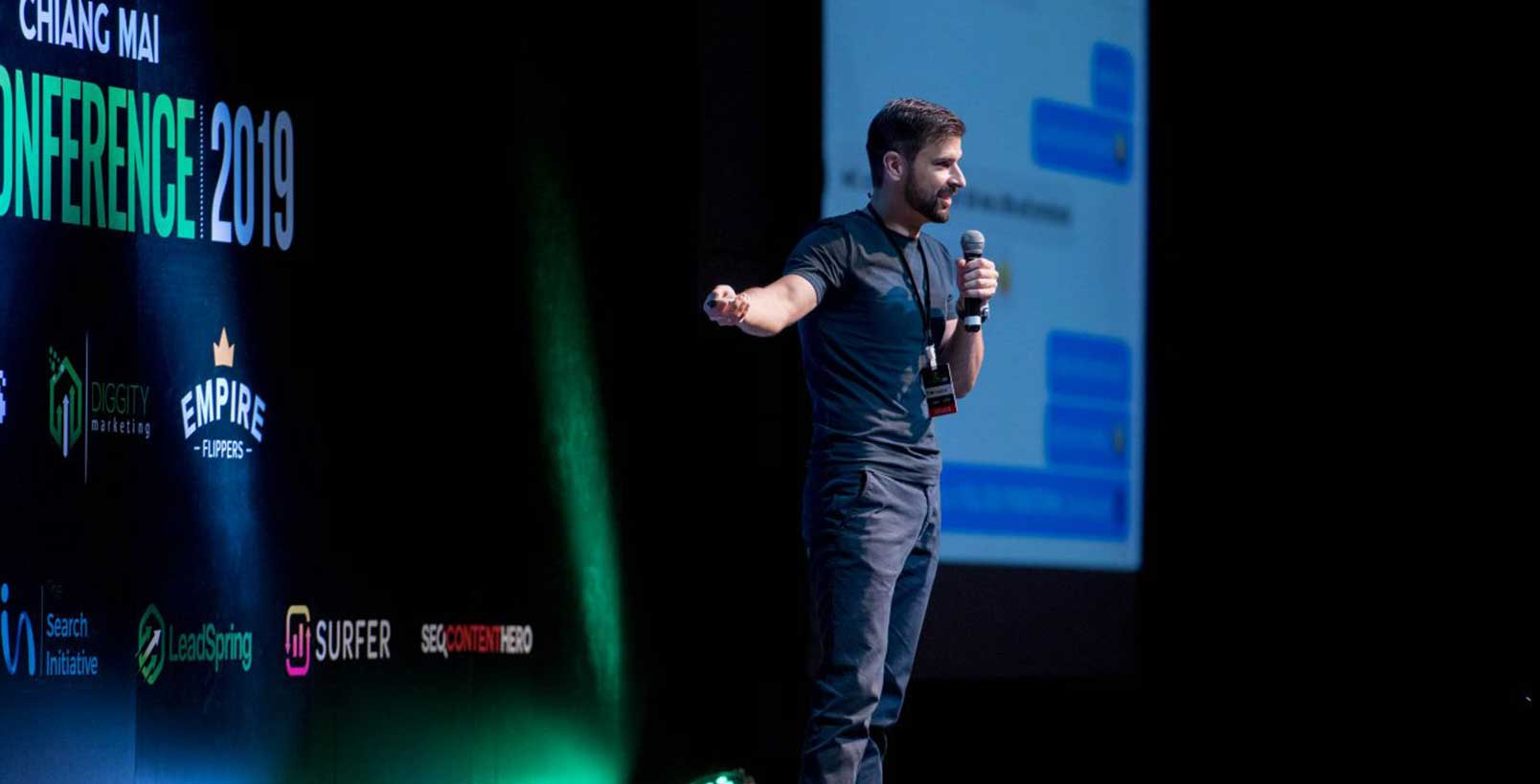
Soulo has been blunt that SEO isn’t universal, if there isn’t enough search volume in your niche, it’s the wrong channel and you should pick a different one. The wedge wasn’t “SEO is best.” It was “SEO is where our buyers already are.”
Most creators pick a wedge based on where they’re comfortable. Ahrefs picked based on where the buyer was standing.
Play 2 — The Breakout Format
The format is a tutorial that demonstrates the tool while solving the reader’s problem.
Not a thought-leadership essay. Not a trend piece.
A how-to, targeting a search query, where the screenshots showing the solution happen to be screenshots of Ahrefs.
Underneath it sits the framework worth stealing…the Business Potential score. Every topic gets rated 0 to 3:
3 — the product is an irreplaceable solution to this problem
2 — the product helps a lot, but isn’t essential
1 — the product can be mentioned, barely
0 — no natural connection
They only write 2s and 3s. Almost zero flexibility, no chasing trends, no covering topics because someone found them interesting.
This is why the blog converts without a funnel. There is no gap between “reader has a problem” and “product solves it” for the funnel to sit in.
Play 3 — The Cadence Reality
Three posts a week produced a plateau. In 2016–17 they dropped to roughly one post a week. Traffic went up tenfold over the following years, later settling around two a week.
Read that again, because it inverts the advice every creator gets.
The volume wasn’t the constraint. The filter was. Three mediocre-fit posts a week generate less than one high-fit post a week, because search compounds on quality of match, not quantity of output.
There’s a second layer here.
Soulo has said his primary KPI was never traffic….it was ARR. Traffic is a number you can grow by writing about anything. He deliberately refused to optimize for the metric that was easiest to move.
Team size matters for honesty: this was a small marketing team, not a content factory.
The output was low because the standard was high, and they could afford that standard because they weren’t chasing a traffic target.
Play 4 — The Distribution Loop
Someone searches a problem → finds an Ahrefs tutorial → the tutorial solves it using Ahrefs → they sign up → they need to learn the tool → they search “how to do X with Ahrefs” → they find another Ahrefs tutorial.
The same article does acquisition and retention. It ranks in Google for a stranger and educates a paying customer, and the education reduces churn while generating word of mouth. One asset, three jobs.
Distribution after publishing was unglamorous and multi-channel: email list, Twitter, LinkedIn, Facebook groups, some paid retargeting, and an in-app notification bell inside the product itself.
That last one is the quiet advantage…they could put every new article in front of their entire customer base without paying anyone.
Play 5 — The Capture Point
This is the play that breaks the template, and it’s the most interesting thing Ahrefs does.
They don’t capture emails on the blog. No lead magnets, no gated content upgrades, no popups.
Soulo’s reasoning: a reader on an Ahrefs article is already on a perfectly tailored sales page. Interrupting them with an email capture doesn’t move them closer to buying, it moves them sideways into a nurture sequence they didn’t ask for, and it makes the page worse for the person reading it.
So the capture point isn’t an email form. It’s the free product tier. Ahrefs Webmaster Tools gives verified site owners a full Site Audit and limited Site Explorer data for their own domain, at zero cost.
You don’t join a list. You start using the thing.
Whether this is correct is genuinely arguable…see the transfer section below. But it’s a real position, held deliberately, for a decade.
Play 6 — The Repurposing System
The YouTube channel started about as unglamorously as possible. Sam Oh joined in a content role and began taking existing blog posts, writing scripts from them, and turning them into videos.
No new research. No separate content strategy. The same Business Potential filter, applied to a second surface.
That channel went from roughly 10,000 subscribers to over 600,000. The discipline carried across: Oh has described a ratio of roughly nine-to-one in favor of videos where the tools can actually be demonstrated. Videos were built into deep playlists rather than one-offs…dozens of videos on a single theme, so a beginner could binge an entire education in one sitting.
The system in one line: research once, publish twice, filter identically.
Play 7 — The Compounding Asset
The clearest single example in this entire breakdown.
Ahrefs had a feature landing page for its backlink checker. It was stuck around position 8 in Google, because everyone ranking above it offered a free tool while Ahrefs offered a page with a trial button on it.
So they turned the landing page into the free tool.
It went to position 1.
That’s the whole lesson, and it generalizes past SEO: when the search intent is “let me try something,” a page describing the thing will always lose to the thing.
The free tool suite that grew out of this now functions as the top of the entire funnel, and it keeps working with no ongoing content cost.
Every durable content company I’ve looked at has exactly one of these. For Ahrefs it’s free tools.
The Kill List
👉 They killed the three-posts-a-week schedule. The single highest-leverage decision in the story, and it was a decision to do less.
👉 They killed topic freedom. No trend-chasing, no writing about whatever’s interesting this week. Soulo has described it as having almost no flexibility in what they write about…a constraint they imposed on themselves.
👉 They killed traffic as a KPI. ARR was the number. Traffic that didn’t convert was, correctly, treated as vanity.
👉 They killed the “great content is enough” belief. Soulo tells a story about spending a month on a piece he thought was his best work, sending it to Rand Fishkin for a share, and getting told it didn’t say anything new. Quality without novelty and without search demand is just an expensive hobby.
👉 And in 2025–26, they started killing pure search dependence. AI Overviews cut click-through rates hard, Ahrefs’ own research reported roughly a 35% drop across 300,000 keywords, and clicks to the number one result falling further from there. Their response was to diversify into LinkedIn, YouTube, original data studies, a conference, and brand-led work, including comparison campaigns willing to make fun of themselves. Their CMO’s framing now is that citations are the new backlinks, and being mentioned matters more than being ranked.
The company that won by going all-in on one channel is currently, publicly, in the middle of leaving it.
What Doesn’t Transfer
The no-email-capture play. This works because Ahrefs’ product is the literal answer to the search query. A reader is one click from the solution. If you’re a creator selling a $97 course, your reader is not one click from the solution…they need a relationship first, and refusing to build an email list would be self-harm. Copy the reasoning, not the tactic: don’t interrupt someone who’s already at the point of purchase. That’s different from never capturing anyone.
The in-app notification bell. You don’t have one. That’s a distribution channel available only to companies with a product base, and it quietly did a lot of work here.
The patience. A year of failure and four more years of compounding is a five-year horizon, funded by an existing profitable product. Most solo creators cannot fund five years of anything.
The Business Potential score, however, transfers completely. It requires no budget, no team, and no traffic. It’s just a filter, and it’s the piece I’d argue is doing most of the work.
Steal from This
1. Score your next ten content ideas 0–3. (from Play 2) How irreplaceable is your offer as the solution to that topic? Delete everything scoring 0 or 1. If you have no offer yet, that exercise will tell you something uncomfortable and useful. Also, let me share something I have developed to create a solid offer
2. Cut your publishing cadence in half and put the time into the filter. (from Play 3) If Ahrefs went from 3 posts a week to 1 and grew tenfold, your posting frequency is almost certainly not your bottleneck.
3. Find your one page that should be a tool. (from Play 7) Something you currently describe that you could let people use…a calculator, a template, a checklist, a mini-audit. Descriptions lose to things.
Which of these seven plays is the one you’re avoiding? Hit reply…I read every one.
Keep it simple,
Sharyph
Founder of The Digital Creator
Sources
Primary — Ahrefs and its team
Tim Soulo — How We Grew Traffic to Ahrefs’ Blog by 1136% (Medium) — cadence, Business Potential, ARR as KPI
Ahrefs Blog — The Great Diversification — AI Overviews click data, channel diversification
Ahrefs — Webmaster Tools — the free tier
Sam Oh — personal site — YouTube growth from ~10K to 600K subscribers
Tim Soulo — personal blog — Business Potential, $100M ARR reference
Interviews and podcasts
6. SaaS Club — SaaS Growth & Unconventional Wisdom with Tim Soulo — no analytics, no lead capture, backlink checker story
7. The Marketing Meetup — Ahrefs’ blog to 1.5M visits per month — traffic milestones, SEO isn’t universal
8. Directive — Yours in Marketing Ep. 5 with Tim Soulo — Business Potential explained
9. Databox — Growing Customers & Revenue with Tim Soulo — the 0–3 scale in detail
10. Upraw Media — What many companies get wrong about SEO — the Rand Fishkin story
11. Matt Byrom — Marketing Strategies Podcast with Tim Soulo — small team, word of mouth
12. Growth Marketing Today — How Ahrefs Grew Their YouTube Channel with Sam Oh — video strategy
13. SEO for the Rest of Us — YouTube SEO Strategies with Sam Oh — the 9:1 product-demonstration ratio
14. Siege Media — Inside Ahrefs’ $100M Growth (also on YouTube) — 2025 diversification
15. SearchPilot — From SEO to GEO in 2026 with Tim Soulo — brand campaigns, AI-era strategy
16. The FXCK — Tim Soulo on organic lead strategy — product-led tutorial format
Third-party analysis (estimates, not company-confirmed)
17. Product Growth — Ahrefs company profile — founding date, headcount, ARR, bootstrapped status
18. The B2B Creator — Ahrefs’ video marketing playbook — how the YouTube channel started
19. SwayOne — How Ahrefs Grew to 600,000 YouTube Subscribers — playlist and series structure
20. BloggersIdeas — Tim Soulo on AI search and brand mentions — citations as the new backlinks
I post too long Form post a week and wonder if it’s too much and should go back to 1
Very interesting concept! Thanks for sharing, Sharyph!