

I’ve reviewed 47 creator offers in the last 60 days.
Every single one had real expertise to share. Most had audiences between 1,000 and 50,000 followers. All of them spent 60-120 hours building their products.
39 of them couldn’t answer this question: “Who is this for, and what exact transformation do they get?”
That’s 83% of creators launching products with unclear positioning.
And unclear offers convert at less than 1%. Clear offers convert at 3-5%.
After making 700+ product sales without ads, I’ve learned something most creators refuse to accept:
Your offer isn’t bad. It’s just unclear. And unclear offers don’t sell…no matter how good your marketing is, how big your audience is, or how valuable the content inside actually is.
Here’s the part that kills me:
I’ve seen the same product go from 0.8% conversion to 4.2% conversion just by changing how it’s positioned. Same content. Same price. 5x more revenue.
I got tired of seeing this pattern everywhere.
So I built an AI skill that scores any offer in 60 seconds and tells me exactly what’s broken.
Today, I’m going to show you how to build the same skill. 15-minute setup. Zero code required.
✅ TL;DR: Build an AI offer analysis tool using Claude Skills that scores digital products across 5 dimensions in 60 seconds. The tool identifies unclear positioning that causes 83% of creator offers to convert below 1%, and provides specific fixes to reach 3-5% conversion rates without changing your product.
Outline:
Why Do Most Creator Offers Fail to Convert?
Why Even Smart Creators Build Unclear Offers?
What Are Claude Skills and How Do They Work?
How Does the AI Offer Analysis Skill Score Offers?
How Do You Build This AI Offer Analysis Tool?
How Should You Use AI Offer Analysis in Your Workflow?
The Revenue Impact of Using AI Offer Analysis?
Building Your Complete AI Team Beyond Offer Analysis
Why Do Most Creator Offers Fail to Convert?
Most creators build unclear offers because they fall into four positioning traps: the curse of knowledge, the expertise trap, the comparison trap, and the validation gap. These traps cause 83% of offers to convert below 1%, costing creators thousands in lost revenue from products they spent months building.
Most creators think they need more followers or better marketing to make sales.
But I’ve talked to 47 creators in the last month. Every single one had a digital product idea. 39 of them couldn’t tell me who it was for or what transformation it delivered.
That’s not a marketing problem. That’s an offer clarity problem.
And it’s costing you every sale you should be making.
Here’s what I mean:
Most creators can’t answer these 5 basic questions about their offer:
Who is this specifically for?
What exact transformation do they get?
What unique mechanism makes this different?
What do they actually receive?
Why should they buy from YOU?
If you’re stuck on even one of these, your offer is unclear.
And unclear offers convert at less than 1%.
Clear offers? 3-5%.
That’s not a small difference. That’s the difference between $2,000 and $12,000 from the same 1,000 visitors.This is exactly why most products fail to sell…the positioning is broken before the product even launches.
Here’s a real example:
Unclear Offer:
“Content Mastery Course - Learn how to create better content and grow your audience with proven strategies.”
Who is this for? What’s “better”? What’s the outcome? What makes it different from 1,000 other content courses?
No one knows. So no one buys.
Clear Offer:
“The 90-Day Newsletter System - Go from 0 to 1,000 engaged subscribers using the 3-template system that grew 47 newsletters past 1K (without paid ads or daily posting).”
Specific audience.
Specific outcome.
Specific timeframe.
Unique mechanism.
Social proof.
Objections removed.
Someone who wants 1,000 newsletter subscribers sees this and thinks: “This is exactly for me.”
The lesson I learned the hard way:
Clarity isn’t a nice-to-have.
It’s THE thing that determines if you make $300 or $30,000 from the same product.
Why Even Smart Creators Build Unclear Offers?
You’d think this would be obvious. But it’s not.
I’ve watched incredibly skilled creators build products no one understands. And it’s not because they’re lazy or dumb.
It’s because of four traps:
1. The Curse of Knowledge
You’ve been thinking about your offer for months. You assume buyers understand context they don’t have.
You write: “I help creators with content systems.”
They read: “What’s a content system? Is that for me?”
The fix: Describe outcomes, not processes. “Post once, reach 10x more people.”
2. The Expertise Trap
The better you are at something, the harder it is to explain simply.
You use insider language: “content atomization,” “funnel optimization,” “SEO strategy.”
Buyers think: “I don’t know these terms. This must not be for me.”
The fix: Speak in transformations they already want.
3. The Comparison Trap
You look at what everyone else is doing. You copy their positioning because it “seems to work.”
Result: You sound like everyone else. “Another course about growing your audience.”
The fix: Find the gap your competitors aren’t filling. When I analyzed how to grow your audience with AI, I focused on differentiation through unique mechanisms rather than copying existing approaches.
4. The Validation Gap
You write your offer once, alone, late at night. You never test it with real people. You launch and wonder why no one buys.
The fix: Get external review BEFORE you build.
This is exactly why I built an AI skill that acts like a ruthless offer reviewer…someone who tells me the truth before I waste months building something no one understands.
What Are Claude Skills and How Do They Work?
Claude Skills are reusable AI “employees” with specific roles and consistent outputs. You set them up once using simple markdown files, and they remember your standards forever…delivering the same quality review in 60 seconds instead of requiring you to explain your business context every time.
If you haven’t heard of Claude Skills yet, here’s what you need to know:
They’re reusable AI “employees” with specific roles and consistent outputs.
You set them up once. They remember your standards forever.
Here’s the difference:
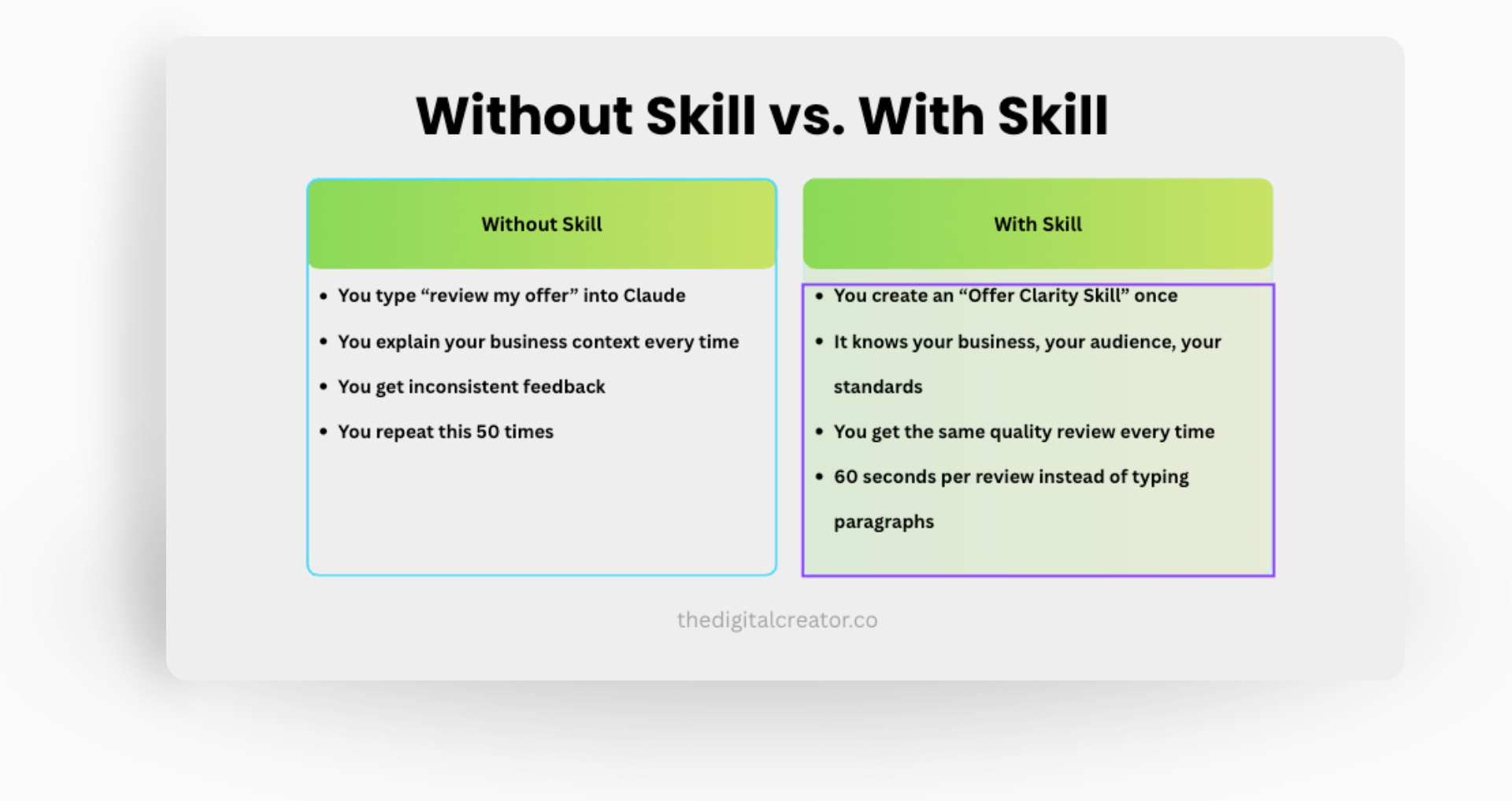
Skills use simple markdown files. No coding required. This approach is similar to how to use AI agents in business…you’re building infrastructure that works repeatedly.
The Critical Distinction: Skills vs. Projects
This confused me at first, so let me make it clear:
Skills = always-on workflows for day-to-day operations
Example: Your Offer Clarity Skill works year-round for every product you build
It’s infrastructure for your business
Projects = campaign-specific with start and end dates
Example: “Christmas product launch” project ends December 26
It’s a one-time campaign
Your Offer Clarity Skill serves every product launch, every positioning test, every sales page you write. You build it once, use it forever.
The Business Case:
Offer review consultant = $2,000+ per session.
This skill = $0, unlimited reviews, 60 seconds each.
You’re building an AI team when you can’t afford to hire. If you’re interested in building AI agents that generate revenue this is exactly where to start.
How Does the AI Offer Analysis Skill Score Offers?
The AI offer analysis skill scores every offer across 5 dimensions on a 1-10 scale: audience specificity, transformation clarity, unique mechanism, deliverables clarity, and pricing rationale. Scores of 40-50 indicate launch-ready offers, while scores below 30 reveal high-risk positioning that needs complete repositioning before launch.
Every offer gets scored across 5 dimensions on a 1-10 scale:
Audience Specificity - Who is this for?
Transformation Clarity - What exact outcome do they get?
Unique Mechanism - What makes this different?
Deliverables - What do they actually receive?
Pricing Rationale - Does the price match perceived value?
Total score: Out of 50.
40-50: Clear offer, ready to launch
30-39: Good foundation, needs refinement
20-29: Unclear positioning, high risk
0-19: Rebuild from scratch
The skill also gives you:
Red flags (vague positioning, weak differentiation)
Before/after positioning alternatives
Specific fixes prioritized by conversion impact
Here’s a real example:
Original Offer (Score: 18/50)
Offer Name: “Content Mastery Course”
Positioning: “Learn how to create better content and grow your audience with proven strategies. Includes video lessons, templates, and community access.”
Price: $197
SKILL ANALYSIS:
Scores:
Audience Specificity: 2/10 - “Anyone who wants to grow” is everyone and no one
Transformation Clarity: 3/10 - “Better content” is unmeasurable
Unique Mechanism: 1/10 - No differentiation from thousands of content courses
Deliverables: 5/10 - “Video lessons and templates” is standard
Pricing Rationale: 7/10 - Price is reasonable but value is unclear
Total: 18/50 - HIGH RISK
RED FLAGS:
Generic positioning (could apply to any content course)
No specific audience (newsletter writers? YouTubers? LinkedIn creators?)
Vague transformation (what does “better” mean?)
Zero differentiation (why this course vs. 50 others?)
No unique mechanism (what’s the system?)
WHY THIS WON’T SELL:
A potential buyer lands on this page and thinks:
“Is this for me?” (unclear)
“What will I actually achieve?” (unmeasurable)
“Why this course?” (no reason given)
Result: They leave. No sale.
Skill Recommendation 1: Specificity Play (Score: 42/50)
Offer Name: “The 90-Day Newsletter System”
Positioning: “Go from 0 to 1,000 engaged subscribers in 90 days using the 3-template system that grew 47 newsletters past their first 1K—without paid ads or daily posting.”
Price: $297
WHAT CHANGED:
Specific audience: Newsletter writers at zero
Measurable outcome: 1,000 subscribers in 90 days
Unique mechanism: 3-template system
Social proof: 47 newsletters
Removes objections: No ads, no daily posting
Higher price justified by specific outcome
Scores:
Audience Specificity: 9/10
Transformation Clarity: 10/10
Unique Mechanism: 8/10
Deliverables: 8/10
Pricing Rationale: 7/10
Total: 42/50 - READY TO LAUNCH
WHY THIS SELLS:
A newsletter writer at 0-500 subscribers lands on this page and thinks:
“This is exactly for me”
“I want 1,000 subscribers in 90 days”
“47 others did it, so can I”
“I don’t have to post daily? Even better”
Result: They buy.
Skill Recommendation 2: Unique Mechanism Play (Score: 44/50)
Offer Name: “Content Once, Published 10x”
Positioning: “Write one 800-word piece every Monday. My AI repurposing system turns it into 10 platform-specific posts by Tuesday. Used by 200+ creators who post 5x more without working 5x harder.”
Price: $247
WHAT CHANGED:
Intriguing name (creates curiosity)
Specific workflow: Monday to Tuesday
Compelling math: 1 piece → 10 posts
Strong social proof: 200+ creators
Contrarian benefit: More output, less work
Scores:
Audience Specificity: 8/10
Transformation Clarity: 9/10
Unique Mechanism: 10/10
Deliverables: 9/10
Pricing Rationale: 8/10
Total: 44/50 - STRONG OFFER
The difference:
Original: 18/50 score, generic, no clear buyer
Option 1: 42/50 score, specific audience and outcome
Option 2: 44/50 score, unique mechanism and efficiency
Same core content. Completely different positioning. Completely different revenue.
How Do You Build This AI Offer Analysis Tool?
To build an AI offer analysis tool, enable Claude Skills in settings, create a new skill with the expert offer strategist prompt, customize it with your business context, and test it on your current offers. The entire process takes 15 minutes and requires zero coding knowledge.
Here’s exactly how to create your own Offer Clarity Skill:
Below this line, I’m sharing the complete expert-level prompt, step-by-step customization guide, and testing framework that turns Claude into your personal offer strategist.
This is the same prompt I use to review every product I build…it’s caught 12 offers I would have launched and failed with.
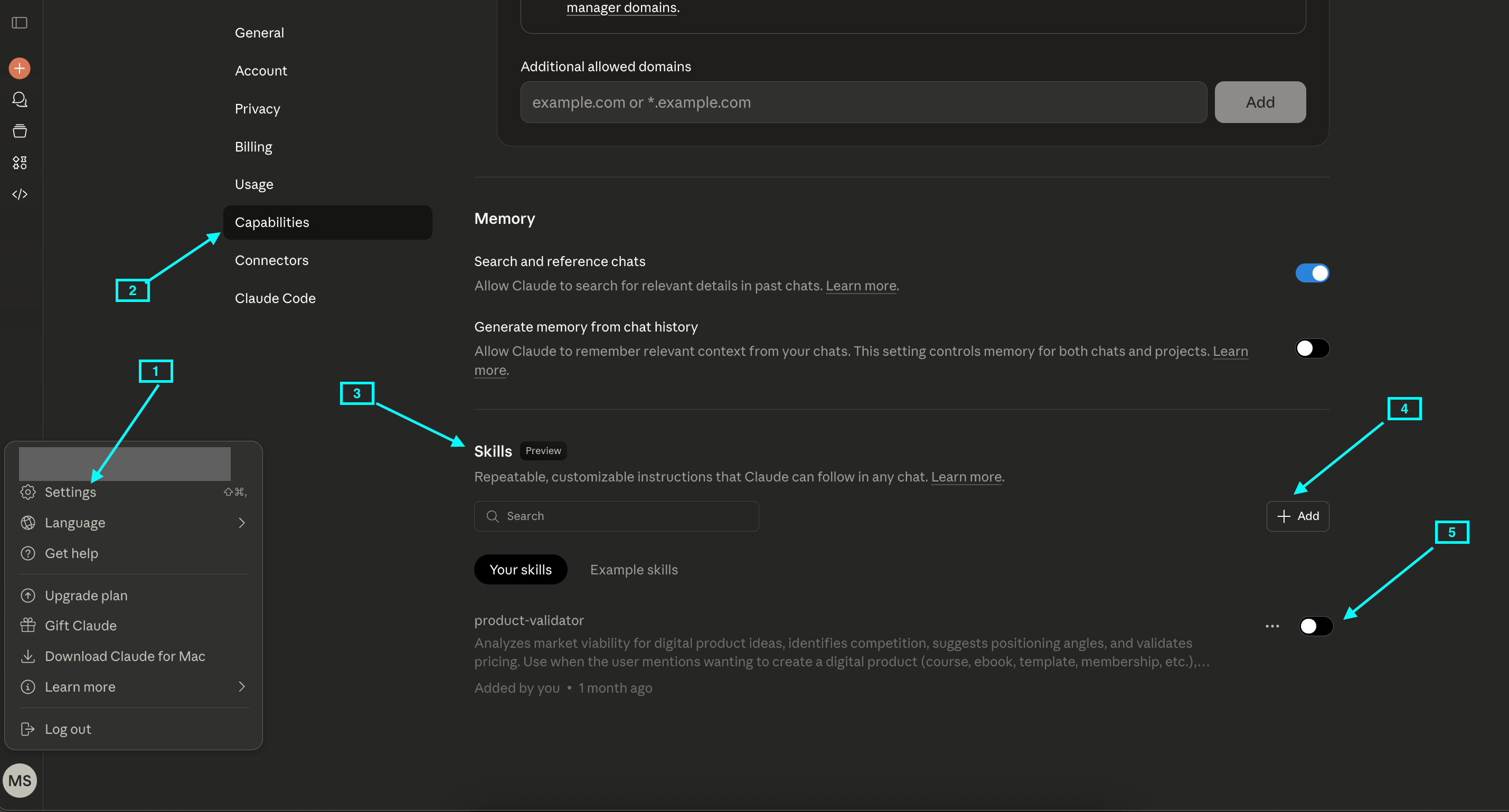
Step 1: Enable Skills (2 minutes)
Open Claude (web or Mac app)
Go to Settings → Capabilities
Scroll to “Skills Preview”
Click “Add New Skill”
Toggle it on
Step 2: Create Your Skill (10 minutes)
Click “Create with Claude” and give it this prompt: