

Last month, I sat down to publish a newsletter post. The content was solid…I’d spent hours researching, writing, and refining the ideas. But before I could hit publish, I had to do the part I dreaded most.
The optimization checklist.
You know the one. It starts simple enough:
Check the title length (has to be under 60 characters or Google truncates it)
Write a meta description that actually converts (155-160 characters, no more, no less)
Create a URL slug (keywords only, no stop words like “the” or “and”)
Add a TL;DR summary at the top (40-60 words, self-contained, no preamble)
Convert 50% of my headings to questions (AI systems love question-based structure)
Add answer capsules after each question heading (another 40-60 words each)
Fix the heading hierarchy (H1→H2→H3, no skipping levels)
Insert 3-5 strategic internal links to related posts
Add alt text to every image
Sixty minutes minimum. Every single time.
And here’s the frustrating part:
I knew exactly what needed to be done. I’d spent weeks researching SEO and AEO best practices. If you have read this post, you will understand the ins and outs.
But knowing what to do and actually doing it consistently are two different things.
So I did what any creator with access to AI should do.
I built a system (with AI Agents) that does it for me.
And the quality didn’t just stay the same. It improved.
Because now, every single post gets:
Perfect SEO metadata
Proper heading hierarchy (AI systems can actually parse it)
Answer capsules in all the right places (the #1 factor for AI citations)
Strategic internal links (builds topical authority over time)
and many more…
All done automatically. Consistently. Every time.
This isn’t a theory or a “someday” project. This is the system I’m using right now, today, to optimize every piece of content I publish.
I built it using Claude Code…Anthropic’s command-line tool that lets you create specialized AI agents that live in your computer and can read, edit, and optimize your files automatically.
If you want a complete guide to set this up in your system (PC/Mac) you can do it by following this guide.👇

Here’s how it works in practice:
I write my draft, change it to markdown (.md file)
I run the command:
/seo-optimize(by attach the draft file - @…)The agent analyzes the content, identifies optimization opportunities, and restructures the draft, according to my brand voice and SEO rules.
That’s it.
And here’s why this matters right now,…
Search is fundamentally changing. Google’s AI Overviews now appear in 16% of desktop searches. ChatGPT, Perplexity, and Claude are becoming primary research tools. According to recent studies, 60% of Google searches now end without a click…People are getting their answers directly from AI-generated summaries.
This means you need to optimize for two different systems:
Traditional SEO (Google, Bing) → Still need to rank
AEO - (ChatGPT, Perplexity, Gemini, Claude) → Need to be cited
Doing both manually? That’s 60-90 minutes per post.
Doing neither? That’s invisible content in a world where AI is answering most questions.
But building a system that does both automatically?
That is something I wouldn’t deny.
That’s what I’m going to show you how to build today.
Whether you write newsletters, blog posts, documentation, or any content that needs to be discoverable, this system will change how you work.
You’ll spend less time on optimization and more time on what actually matters: ideas, insights, and the work only you can do.
By the end of this post, you’ll understand:
The exact framework an SEO/AEO agent needs to work effectively
How Claude Code makes this possible (even if you’re not technical)
How you can build this system yourself (step-by-step guide, including video guides)
Why This Matters More From Now On…
The reality is search is fundamentally changing. If you have read the complete research and my finding you will understand.
This means you’re optimizing for two different systems now:
Traditional SEO (Google, Bing) → You still need to rank
AEO (ChatGPT, Perplexity, Gemini, Claude) → You need to be cited
Doing both manually? That’s 60-90 minutes per post.
Doing neither? That’s invisible content in a world where AI answers most questions.
Here’s How This System Works
My actual workflow now:
Write my draft (any text editor, save as .md file)
Run one command:
/seo-optimize @draft-filename.mdAgent analyzes and optimizes (60 seconds)
Get four output files:
Optimized post ready to publish
SEO metadata for Substack
Optimization report (what changed and why)
Pre-publish checklist
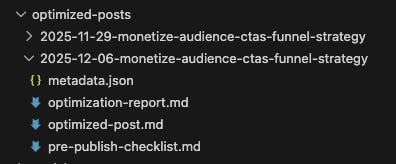
No copying between tools. No manual checklist. No shortcuts because you’re tired.
Just consistent, high-quality optimization. Every single time.
What Changed After I Automated This
Before: Inconsistent optimization. Some posts got the full treatment. Others got whatever I had energy for. Quality varied wildly.
After: Every post gets the same level of optimization. No exceptions.
The results:
✅ Time saved: 35-55 minutes per post
✅ Consistency: Never forget any critical task, like adding internal links, etc.
✅ AI visibility: Better structure = more likely to be cited
✅ Compound effect: Each optimized post strengthens your internal link structure
The system remembers. The system executes. I just write.
How You Can Build This
Skip the 3-hour setup. Get everything pre-built:
What’s included: (available for premium members)
✅ My 1,200-word agent prompt (copy/paste ready)
✅ Three configuration files pre-loaded with my optimization rules
✅ How to set up internal links
✅ Video walkthrough of the complete setup
This is the exact system I use. No theory. No fluff. Just working code and proven optimization rules.
🚀 Premium members: Download the complete package at the bottom of this email.
If you not a premium member, join 👇
Questions? Just reply to this email…I read every one.
Sharyph
P.S. - If you found this valuable, share it with one creator who’s still optimizing their content manually. They’ll thank you.


