Welcome to The Digital Creator, helping creators accelerate with AI. I show you how to use AI to start, create, grow, and scale faster.
Since you are here, here are some AI Agents I have built before:
🚀 How I Built an AI Agent to Create Content for Your Brand.
🚀 How I Built an AI Agent to Research Content for Your Business
🚀 How I Built an AI Agent to Create Authoritative Social Media Content for Your Brand
How many hours have you spent clicking through your own website, page by page, checking whether the SEO is actually right?
If you’ve done it, you know the drill:
Opening each page to count how long the title tag is
Copy-pasting meta descriptions into a character counter
Hunting for images with missing alt text
Checking whether you accidentally have five H1s on the homepage
Running one page at a time through PageSpeed
Opening a competitor’s site in another tab and trying to eyeball what they’re doing that you’re not
You can lose an entire afternoon doing this for a 20-page site.
And here’s the part that actually stings: even after all that clicking, you still can’t answer the only question that matters…what should I fix first? You have a pile of observations and no priority order. You’re guessing.
I’ve been there.
For years I either paid someone $300–$500 for a one-off SEO audit, or I avoided the whole thing because I didn’t have a spare afternoon. The paid audits would land as a 40-page PDF, I’d skim it, feel overwhelmed, and file it away. Nothing changed. The money was spent, and the site stayed the same.
Then it clicked. An SEO audit is the same repeatable checks every single time. Title length. Meta length. H1 count. Alt-text coverage. Canonical present. Schema. Page speed. Compare to competitors. Rank by impact.
It’s a checklist…and anything that’s a checklist can be run by a machine.
So I built one.
Meet the SEO Audit Agent. I pointed it at a real website…gardendesign.com (sorry, guys if there is something on your website that you don’t want to disclose).
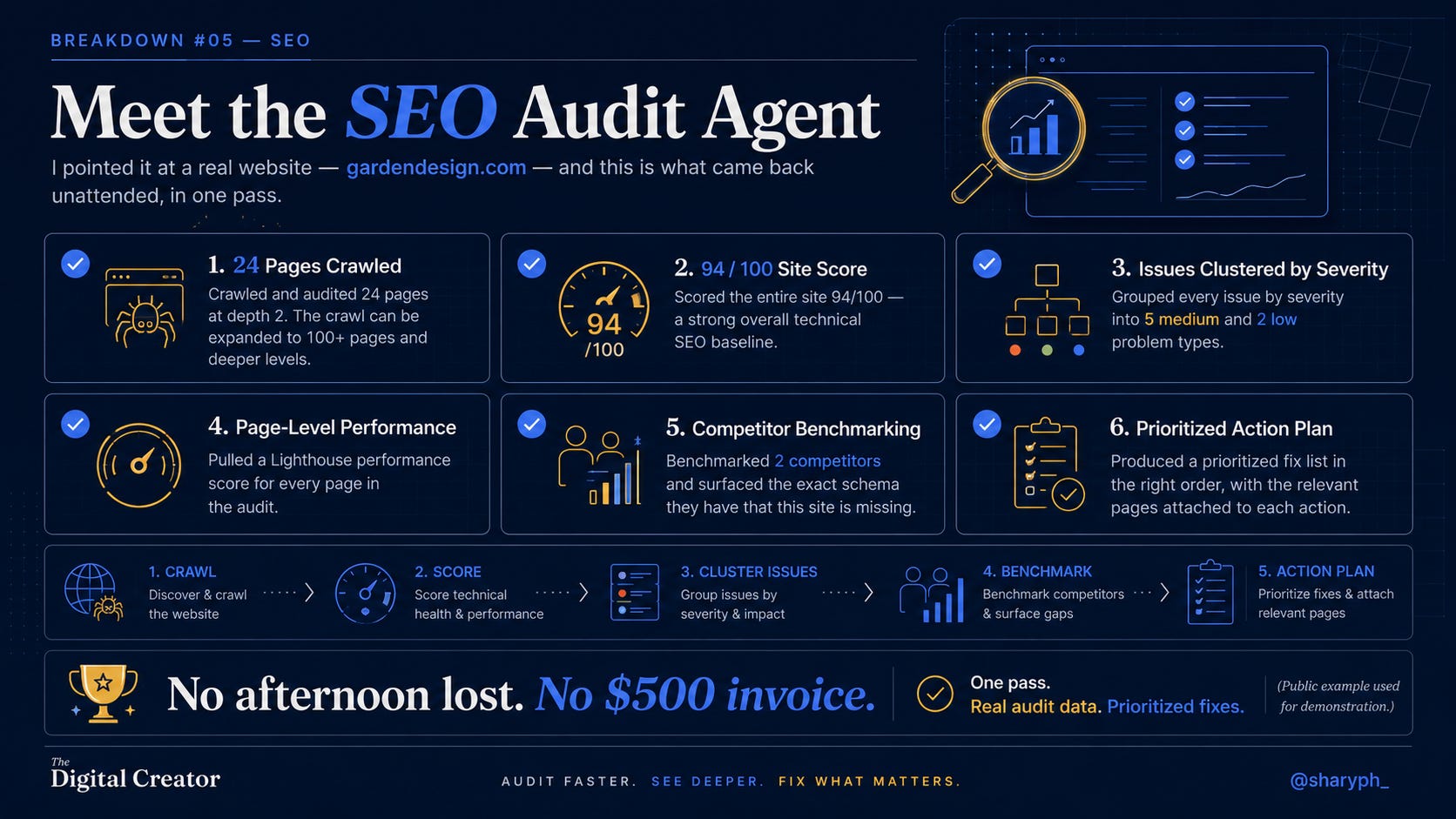
Here’s what came back, unattended, in one pass:
✅ Crawled and audited 24 pages at depth 2 (I can adjust this to 100+ pages and depth as well)
✅ Scored the entire site 94/100 (the garden design guys are doing a good job, I guess).
✅ Clustered every issue by severity into 5 medium and 2 low problem types
✅ Pulled a Lighthouse performance score for every page
✅ Benchmarked 2 competitors and surfaced the exact schema they have that this site is missing
✅ Produced a prioritized action plan, the fixes in order, with the pages attached
No afternoon lost. No $500 invoice.
And because it’s a system, I can run it again next week, or on a client’s site, or on ten client sites, for basically the same effort.
By the end of this issue you’ll have built the same agent.
The crawler, the per-page analyzer, the performance check, the competitor benchmark, and the report…every node, connector, and prompt included. Let’s build it.
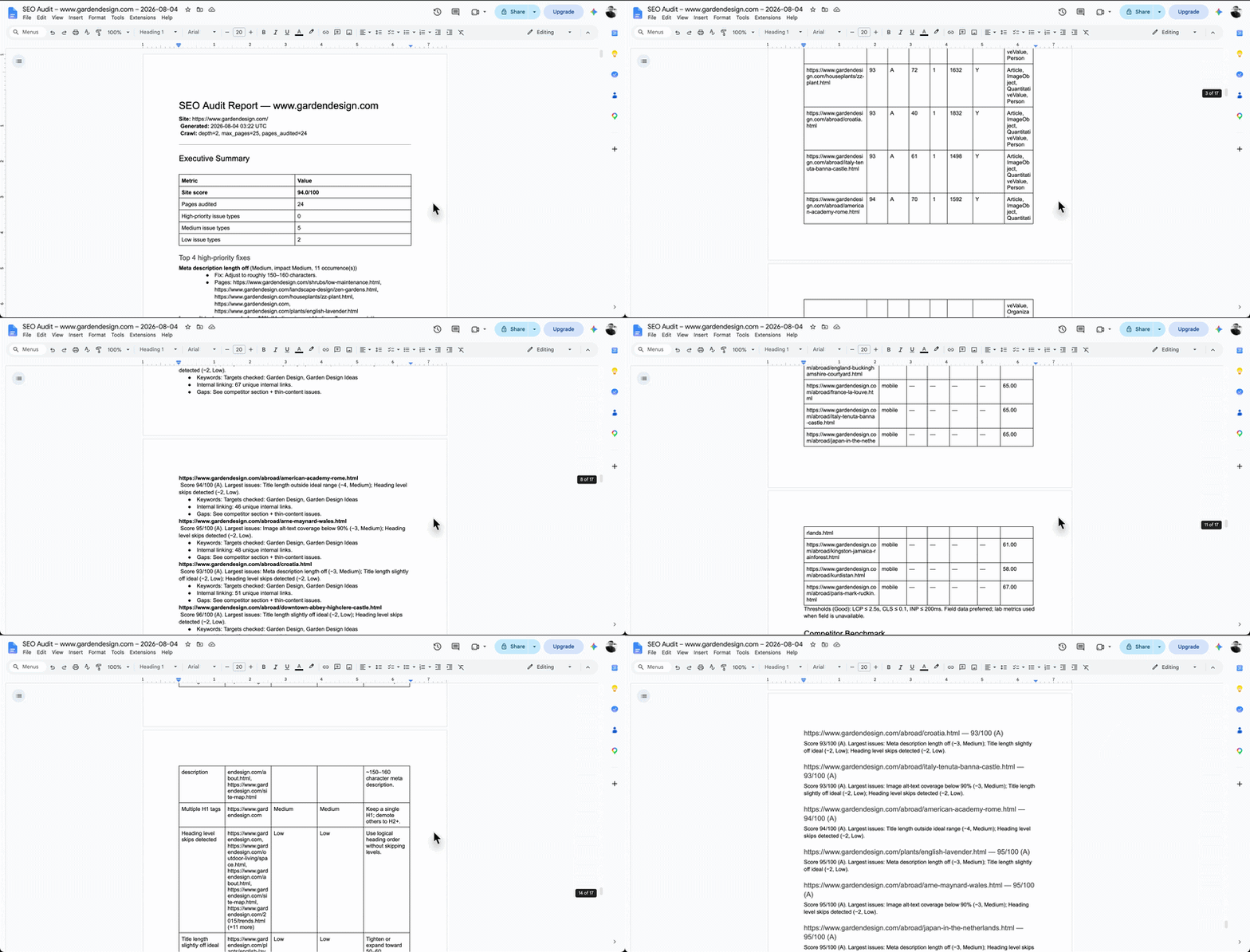
Here is the complete report. I want to see how detailed this is... (only for subscribers)
What you built
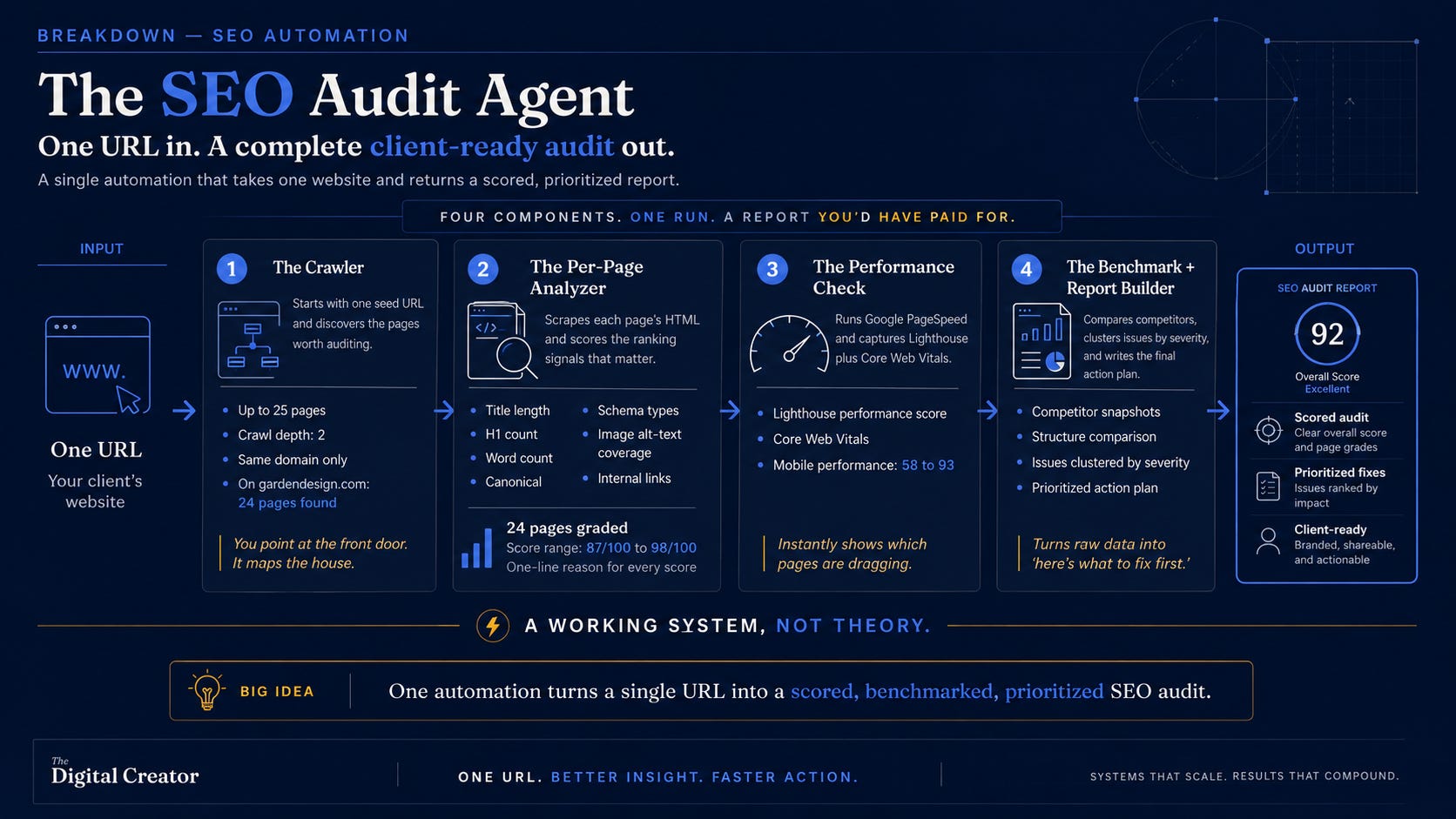
The SEO Audit Agent is one automation that takes a single URL and gives you back a complete, client-ready audit. You give it a website; it gives you a scored, prioritized report.
This isn’t theory. It’s a working system, and the output at the bottom of this issue is a real run.
At a high level, it’s built from four components:
1. The Crawler
Takes one seed URL and discovers the pages worth auditing — up to 25 of them at a crawl depth of 2, staying on the same domain. On gardendesign.com this found 24 pages automatically. You point at the front door; it maps the house. No manual URL list.
2. The Per-Page Analyzer
This is the engine. It scrapes each page’s raw HTML in a loop and pulls the signals that actually move rankings — title length, H1 count, word count, canonical, schema types, image alt-text coverage, internal links — then scores every page against a rubric. On the test run it graded each of the 24 pages from 87/100 (a B) to 98/100, with a one-line reason for every score.
3. The Performance Check
Runs each page through Google PageSpeed and captures the Lighthouse performance score plus Core Web Vitals. On the sample, mobile performance ranged from 58 to 93 — instantly showing which pages are dragging.
4. The Benchmark + Report Builder
Snapshots your competitors, compares their structure to yours, clusters all your issues by severity, and writes the final report with a prioritized action plan. This is the part that turns raw data into “here’s what to fix first.”
Four components. One run. A report you’d have paid for.