


Welcome to The Digital Creator, helping creators accelerate with AI. I show you how to use AI to start, create, grow, and scale faster.
How many times last week did you paste the same context into Claude before it would write anything useful?
You know the ritual. New chat. Then the setup paragraph:
“I’m a creator in the AI space, my audience is solopreneurs, my tone is direct and no-fluff, don’t use corporate language, here’s an example of how I write…”
Then it finally produces something. Then tomorrow you open a new chat and do the whole thing again.
Here’s what that ritual actually costs you:
Re-typing your positioning every single session
Pasting the same three writing samples over and over
Correcting the same mistakes (”stop using ‘delve,’ stop using ‘unlock,’ stop with the em-dash essays”)
Getting output that sounds like every other AI creator because you never told it what makes you different
Throwing away drafts that are 80% right but wrong in a way you can’t be bothered to fix again
And even after all that setup…the writing still drifts.
By message four it’s back to sounding like a LinkedIn robot. You tighten it, it drifts again. You’re not building a system. You’re re-briefing a freelancer who forgets everything the moment they clock out.
I did this for months. I told myself it was fine because each setup “only” took two or three minutes. Then I actually counted. Fifteen-plus chats a week, three minutes of re-briefing each…that’s close to an hour a week spent teaching Claude who I am. Every week. Forever. And I still wasn’t getting consistent output.
Then it clicked. The problem was never Claude. The problem was that I was keeping my brand in my head instead of in a file.
That’s why I built a brand.md.
It’s one markdown file. It holds everything Claude needs to write as me…my positioning, my audience, my voice rules, my banned words, real samples of how I actually write. I write it once. I load it once.
And now every surface where I use Claude…the chat app, Cowork, Claude Code…writes in my voice from the first message. No re-briefing. No drift by message four.
✅ Same voice across every tool
✅ Zero setup per chat
✅ New drafts that need editing, not rewriting
✅ A brand you can hand to a VA, a collaborator, or a future you
By the end of this issue you’ll have:
The full anatomy of a
brand.md— every section and why each one earns its placeA from-scratch build guide, whether you have zero brand, a pile of old posts, or a clear brand with no file
A complete copy-paste Prompt Template
The exact way to deploy it in Claude Chat, Cowork, and Claude Code — because each one loads the file differently, and getting that wrong is why most people’s context files quietly do nothing
Let’s build it.
Meet the brand.md File
A brand.md is a single markdown file that acts as Claude’s operating manual for being you.
Not a brand deck. Not a 40-page guidelines PDF your designer made.
A lean, plain-text file…the kind you can read top to bottom in ninety seconds…that tells Claude who you are, who you’re talking to, and exactly how you sound.
Here’s the one mental model that makes all of this work. Every place you use Claude does one of two things with your file:
It either loads the file in full every time…or it retrieves pieces on demand.
That single distinction decides how you write the file and where you put it.
Claude Code loads it in full at the start of every session.
Claude Chat projects retrieve from it as needed.
Cowork reads it as a real file when you tell it to.
We’ll come back to this…but hold onto it, because it’s the thing 90% of people get wrong.
Why markdown, not a Google Doc or a Notion page?
Because markdown is plain text with light structure…headers, bullets, code blocks.
Claude parses that structure the same way you do: it reads the headers to know what’s what. No formatting to strip, no export step, no app to open. One file that lives anywhere and drops into everything.
This isn’t theory. This is the file I load before I write a single thread, newsletter, or sales page. Let’s break down what goes in it.
The Anatomy: What Goes In, and Why Each Part Earns Its Place
A brand.md has nine sections. Everyone is there for a reason. Skip one and Claude fills the gap with generic…which is exactly what you’re trying to escape.
1. Identity — who you are in one block
Your name, what you do, and your one-line positioning.
Why it matters: This anchors everything. Claude writes differently for “a solo creator teaching AI systems” than for “a SaaS marketing agency.” Without it, the model defaults to a bland average of the internet. This is the ground the whole voice stands on.
2. Mission & POV — what you actually believe
Your mission, plus your contrarian takes…the opinions that separate you from everyone in your niche.
Why it matters: Your point of view is your brand. “More tools ≠ more productive” isn’t a tagline, it’s a filter that shapes every sentence. Feed Claude your beliefs and it stops writing safe, agreeable mush and starts writing your angle.
3. Audience — who you’re writing to, in their words
Who you serve and the exact language they use to describe their pain.
Why it matters: Writing “to everyone” produces writing that lands on no one. When Claude knows your reader says “I never know how much I’m making next month,” it writes to a person…not into the void. Use their real phrases, not your polished summary of them.
4. Voice & Tone Rules — the do’s and don’ts, as commands
Direct instructions: “Write short. Use real numbers. Never motivate — demonstrate.”
Why it matters: This is your actual style control panel. The trick is to make them imperative and specific. “Be conversational” tells Claude nothing. “Use second person. Max four sentences per paragraph. Lead with the number.” tells it everything.
5. Vocabulary — words you use, words you ban
Two lists: your signature words, and your hard-banned words.
Why it matters: The banned list defines your voice as much as the used list. Every AI creator reaching for “delve,” “unlock,” “leverage,” “supercharge,” “in today’s fast-paced world” is why AI writing has a smell. Ban them explicitly and half your “sounds like AI” problem disappears in one line.
6. Writing Samples — show, don’t tell
Two or three real excerpts of your best writing.
Why it matters: This is the single highest-leverage section. A list of adjectives (”witty, warm, direct”) is weak. One paragraph of you actually being witty, warm, and direct is worth more than a page of descriptions. Claude pattern-matches to real examples far better than to labels. If you only nail one section, nail this one.
7. Formatting Preferences — how your content is shaped
Structure, length, emoji use, how you handle lists and headers. Why it matters: Voice isn’t only word choice…it’s shape.
If you never use emojis and Claude sprinkles them in, it reads as fake instantly. Lock the shape and the output stops feeling borrowed.
8. Offers & Links — your products and canonical URLs
Your offers, prices, lead magnet, and the exact links you use.
Why it matters: The moment you ask Claude to write a CTA, it either invents a link or asks you for one. Put them here once and every call-to-action comes out correct and on-brand.
9. Hard Rules — the non-negotiables
A short list of never-do lines. “Never fabricate stats. Never use hype. Never write a fake personal story.”
Why it matters: Reserve this for what truly matters. If you mark everything important, nothing is. Three genuine hard rules get followed. Twenty “important” rules get averaged into noise.
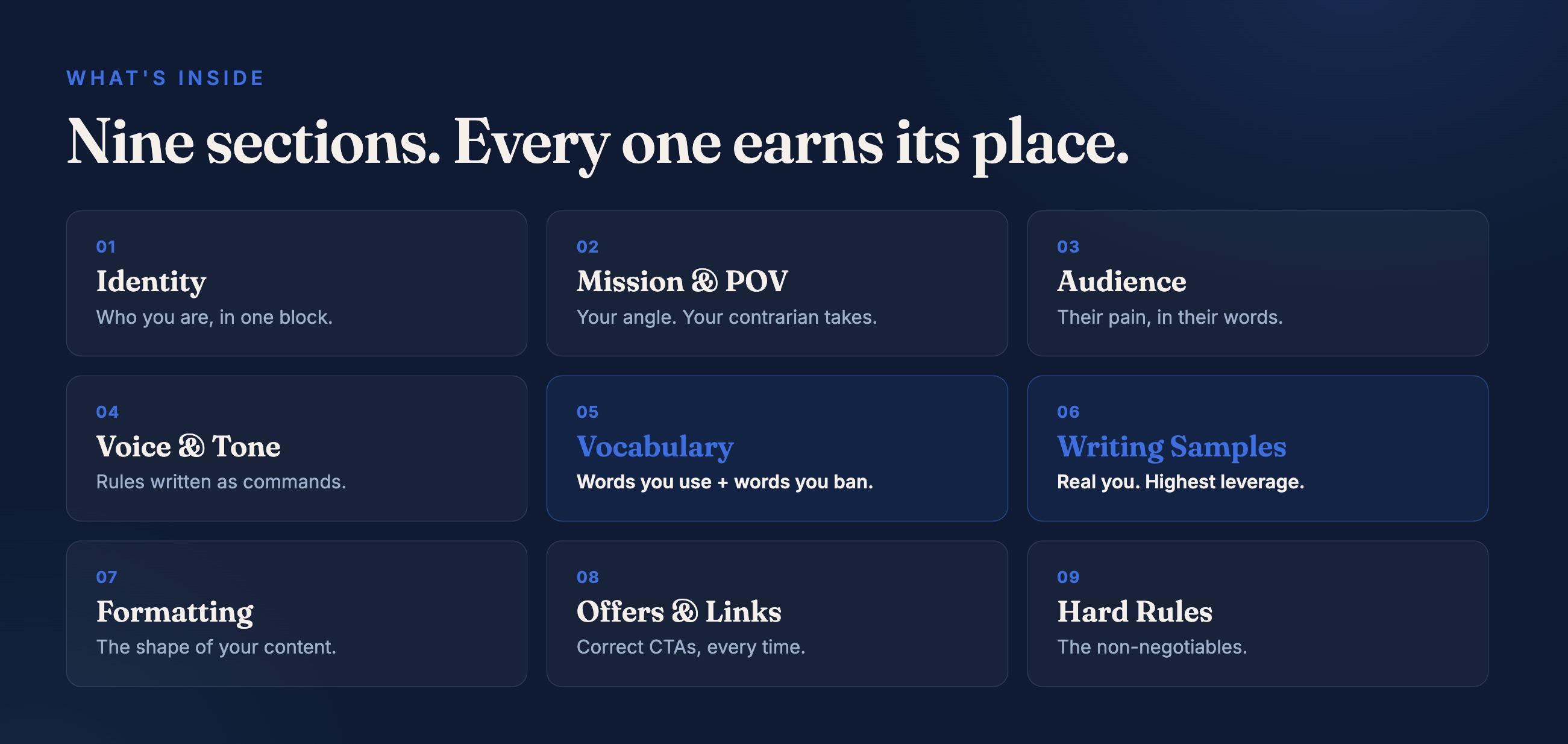
That’s the skeleton.
Now let’s put meat on it…starting from wherever you actually are today.
The Build: Three On-Ramps
You’re in one of three places right now.
Find yours and start there.
All three roads meet at the same file.
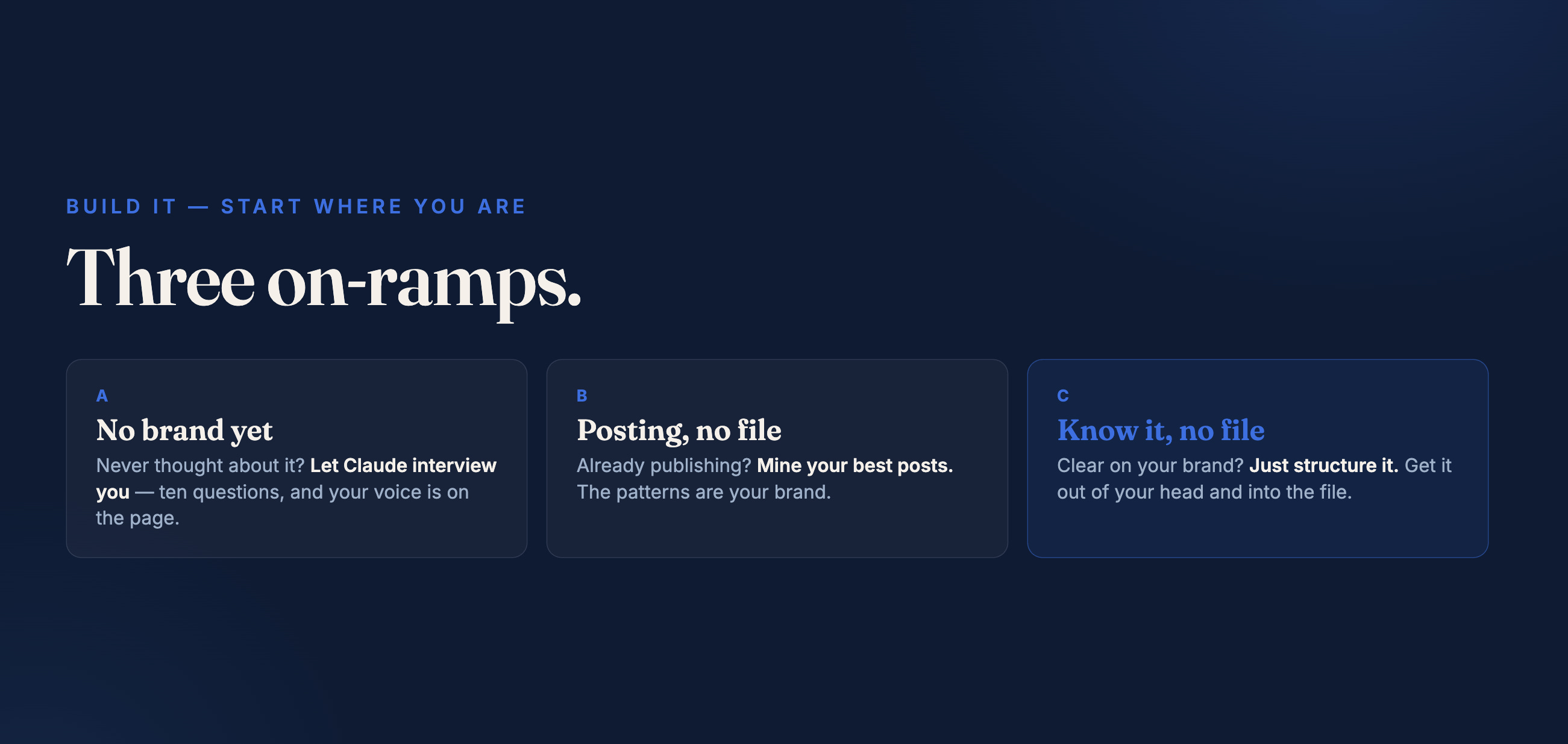
On-Ramp A: “I don’t have a brand yet — I’ve barely started”
No posts, no positioning, maybe you’ve never seriously thought about building online. Perfect.
You have no bad habits to unlearn.
Don’t try to invent a brand in your head. Extract it. Open Claude and paste this:


