

Welcome to The Digital Creator, helping creators accelerate with AI. I show you how to use AI to start, create, grow, and scale faster.
Since you’re here, tools I’ve built before:
How many hours have you spent scrolling back through your own posts, trying to remember what actually got people to reply?
If you’ve done it, you know the drill:
Scrolling months back through your own content, hunting for the post that hit
Trying to recall which question people asked you more than once
Guessing at a price with literally no anchor
Writing a DM that feels like begging
Staring at a blank page, trying to name the thing you’d even sell
You can lose a whole weekend doing this. I know, because I’ve done it more times than I’d like to admit.
And here’s the part that actually stings: even after all that digging, you still can’t answer the only question that matters…would this actually sell? You’ve got a folder of half-ideas and zero conviction.
You’re guessing with better lighting.
Here’s the thing: I’ve actually caused this exact problem before.
Last week I wrote The Offer Playbook and told you to go find your repeated question…the thing you keep explaining for free, scattered across everything you’ve published. A bunch of you did it. You replied with your version of it, exactly like I asked.
And then I watched how long the next step actually took people. Not finding the question…turning it into an offer. A name, a price, a page, an outreach message that doesn’t feel like begging. That part ate weekends.
I’d actually tried to fix this once before. Back in December I built an AI offer analysis tool that scored any offer out of 50...audience specificity, transformation clarity, unique mechanism, the works. It was useful. It told me my positioning was an 18/50 or a 42/50.
But it never once told me what the offer should be. It could grade what I already had. It couldn’t find what I hadn’t named yet.
That’s the gap.
Then it clicked.
Excavating an offer out of your own content is the same repeatable process every single time.
→ Find the signal…replies and DMs, not likes.
→ Find the question you keep answering for free.
→ Pull the language in their words, not yours.
→ Turn that one insight into a few different shapes…coaching, done-for-you, a product.
Attach a way to actually test it before you build anything.
Anything that’s a repeatable process can be run by a machine.
So I built one.
I pointed it at my own archive…published issues…and let it run.
Here’s what came back, unattended, in one pass:
✅ Ingested published issues across the archive
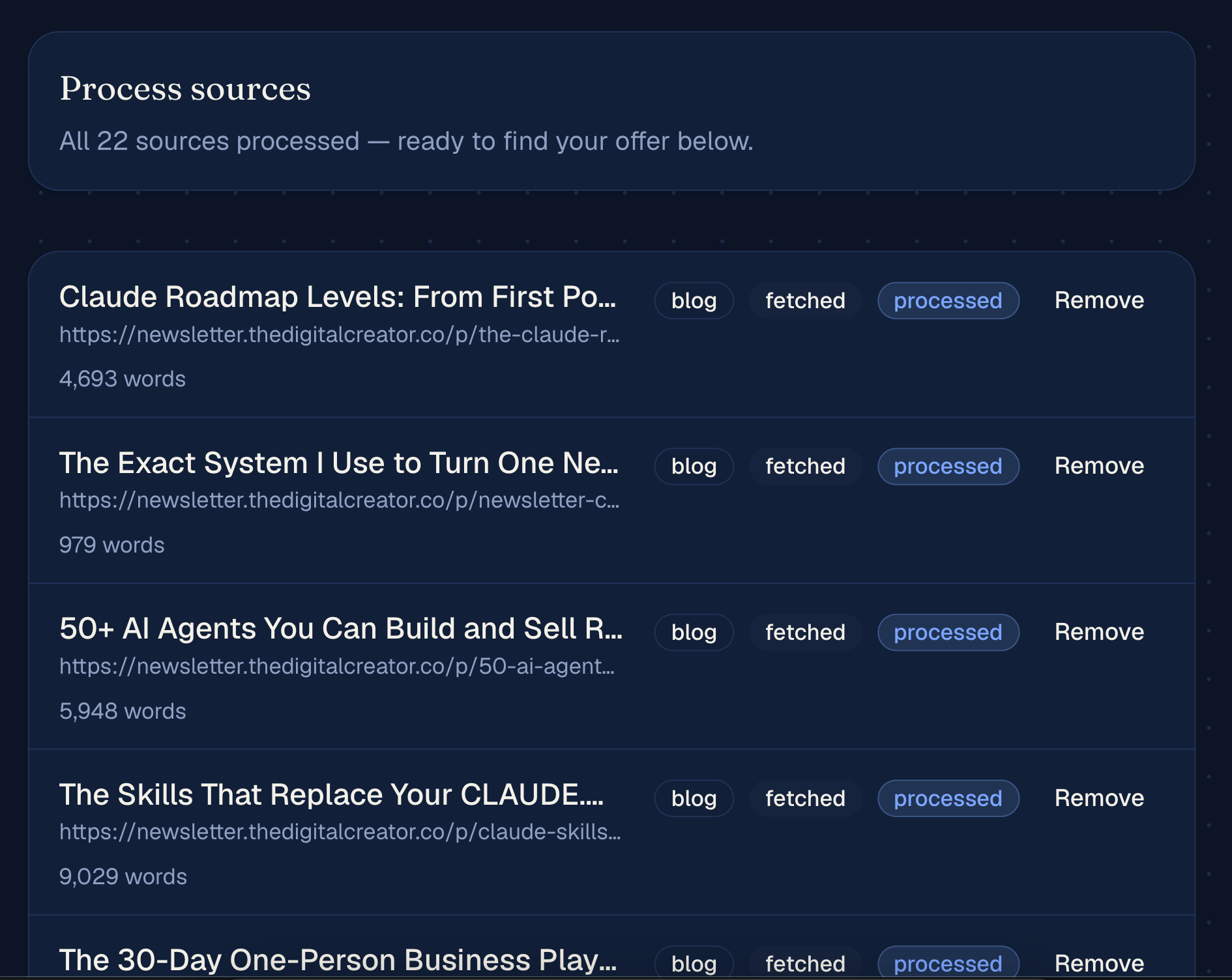
✅ Generated 3 offer directions with confidence score with reasoning for each direction


✅ The output for each Offer Direction:
What is included in the product
The delivery reliability (time needed to deliver)
How to actually build this offer (Build Path)
Pricing with reasoning.
Hand riser email (for validation)
DM Scripts (for validation)
The Offer Landing Page Outline
An actual Validation Plan before building the actual product.
No week of re-reading my own archive.
No guessing at a price with no anchor.
And because it’s a system, I can run it again every ten posts, point it at a completely different niche, or run it for a client’s archive instead of mine.
Here’s what’s actually happening under the hood.
I’m not going to show you the literal prompts…those are the actual moat, and handing them over would just let someone build a worse copy of this in a weekend.
But here’s the architecture, and why it’s split the way it is.
Three stages:
1. Distill
Every source…every post, thread, and issue you paste in…gets read separately, in parallel, and reduced down to structured signal: themes, pain points, the audience’s own language. This is what makes 40+ posts tractable instead of overwhelming. You’re not asking one model to hold your whole archive in its head at once…you’re asking it to extract the useful part from each piece, one at a time.
You don’t read the haystack. It hands you the needle from every piece of hay, separately.
2. Synthesize
All of that extracted signal gets combined…into the repeated question, a bank of your audience’s actual phrases, and three distinct offer shapes. This is where signal over applause actually happens: replies and DMs get weighted heavily, likes get ignored entirely. A post with 3 replies asking “how do I do this myself” beats a post with 400 likes and silence in the comments, every time.
This is the stage that decides what you should build…not just what performed.
3. Package
The direction with the strongest signal gets expanded into the full deliverable: positioning statement, pricing band, what’s actually included, a build path, and outreach copy…a hand-raiser email and DM scripts, ready to send.
Three stages. One run. An offer, not just a score.
Why this isn’t the same as pasting your archive into ChatGPT
I get why that’s the instinct. Here’s the difference in practice.
Paste your content into an AI prompt, and you get something like this back:
“Consider offering a coaching program, a digital course, or a done-for-you service based on your expertise. Price it competitively and market it across your channels for maximum reach.”
Technically true. Completely useless. It could apply to literally anyone.
Here’s what AI Offer Crafter returned instead, from a real run:
“Your audience isn’t asking ‘how do I grow on Substack’ — they’re asking ‘how do I turn 40 subscribers into people who’ll pay me.’ That’s the offer: a paid audit of their first funnel, priced at $750, built for creators at your exact stage.”
Not only this… It completely understands how to build the offer step by step, the landing page outline, and the copy of the landing page, and also, it will provide you an actual plan to validate the offer. (Never build any without validation).
Same input. Completely different output. One’s a suggestion. The other’s an offer you could send to someone today.
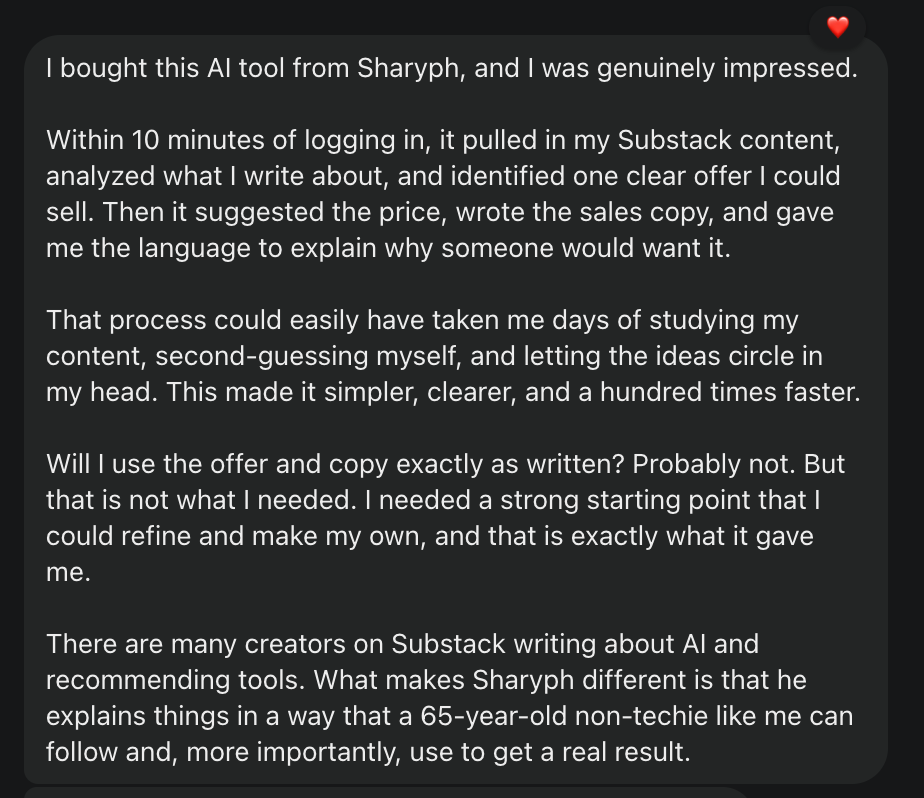
I'm not the only one who thinks so.
Here’s what you get.
AI Offer Crafter is $29, once. Not a subscription…nothing to cancel, no monthly fee eating into the same budget the tool is trying to help you get out from under.
13 people have already grabbed it. It’s capped at the first 50 at this price…after that, the price goes up.
You run it on your own Anthropic API key…which sounds like a hassle until you see the actual cost: $0.30–$0.80 for a full run across ~15 sources.
You see the estimate before you run it, and the real number after. You’re paying Anthropic directly for exactly what you use…not paying me a markup on top of API calls I’d otherwise be marking up.
And it’s backed by this: if you don’t get 3 qualified hand-raiser replies within 14 days, I’ll rework the positioning with you at no charge. Not a refund policy. A promise to fix it until it works.
What’s coming next…
This is day one.
The guarantee you just read? Shipped this week. Here’s what’s next:
→ Receipts:
Every pattern it finds will link straight back to the actual posts it came from. No more taking the tool’s word for it.
→ Input strength meter:
Tells you in real time if you’ve given it enough to work with, before you waste a run.
→ Tiered pricing:
One price band becomes a full good/better/best ladder, automatically.
→ Email Sequences Builder:
Once you choose the offer direction, it will generate the email sequence for the launch and pre-launch series
→ The Offer Page Visualizer:
With your offer direction, the app will show you the landing page design with an actual copy of the landing page.
I’m building this in public…Buy in at $29 now, and every one of these ships to you free…no upsell, no “pro tier” later.
If you’re not ready to buy yet, that’s fine. Just hit reply and tell me what your repeated question turned out to be…the thing you keep explaining for free. I read every one, and it’s genuinely useful to me to see the pattern across all of you, not just my own archive.
Until next time,
Sharyph
Weighting replies over likes is the whole difference between signal and applause.
I like the idea of mining your own archive before creating something new