

A step-by-step system for creators at every stage…whether you don’t have an offer, have one that’s dead, or have one that’s almost working.
TL;DR: To build an offer that converts, mine your own published content for the question people keep asking you for free, then package that answer into a named offer with a specific outcome, proof, and risk reversal. Choose a service, coaching, or digital product based on audience size and how fast you need revenue.
A step-by-step system for creators at every stage…whether you don’t have an offer, have one that’s dead, or have one that’s almost working.
Let me guess how your week went.
You published. Maybe a newsletter issue. Maybe three LinkedIn posts. Maybe a Substack essay you were genuinely proud of. People read it. Some replied.
A few said “this was great.” And your revenue moved by exactly zero dollars.
So you did what every creator does. You assumed the problem was reach. Not enough eyeballs. Need to post more. Need to grow the list. Need to crack the algorithm.
Here’s what I’ve learned after reviewing 47 creator offers and making 700+ product sales without a single ad: you almost never have a traffic problem. You have an offer problem.
And the specific version of that problem is worse than most creators think, because it’s invisible. Your offer isn’t bad. It’s unclear. Unclear offers convert below 1% no matter how good the thing behind them actually is.
I’ve watched the same product go from 0.8% conversion to 4.2% conversion with zero changes to the content…same modules, same price, just different positioning. Same product. 5x the revenue.
Today I’m giving you the full playbook for fixing that…built from studying the frameworks that actually hold up (Hormozi, Dunford, Schwartz, Welsh, Barry) plus what I’ve seen work and fail in my own business.
And here’s the part that matters most: if you’ve been publishing for more than three months, you have already written your offer. You just haven’t extracted it yet. Most of this issue is about how to dig it out.
Let’s get into it. 👇
Outline:
How Do You Find Your Offer in Content You’ve Already Published?
Should You Sell a Service, Coaching, or a Digital Product?
How Do You Price an Offer Without Flinching?
What’s the 7-Day Offer Sprint?
Before we begin, this post is sponsored by Outrank.

Outrank went from $300 to $300k MRR in 15 months, largely by running its own SEO playbook on itself, making it the most recommended SEO tool by ChatGPT & Claude.
It writes and publishes articles to your site daily, builds real backlinks through a DR-matched exchange network, and gets your brand cited in AI answers.
You connect your site once, and it keeps shipping while you build.
If SEO has been on your “later” list forever, this is the version that runs without you.
Back to post...
Which Stage Are You At?
Most creators fall into one of three stages: no offer yet, an offer that exists but isn’t selling, or an offer you understand but still can’t convert. Stage 3 is the hardest, because the obvious fixes are already done. The real fix is usually rebuilding the offer from outside evidence, not inside assumptions.
Before the playbook, find yourself on this map. Your starting point determines which section you actually need.
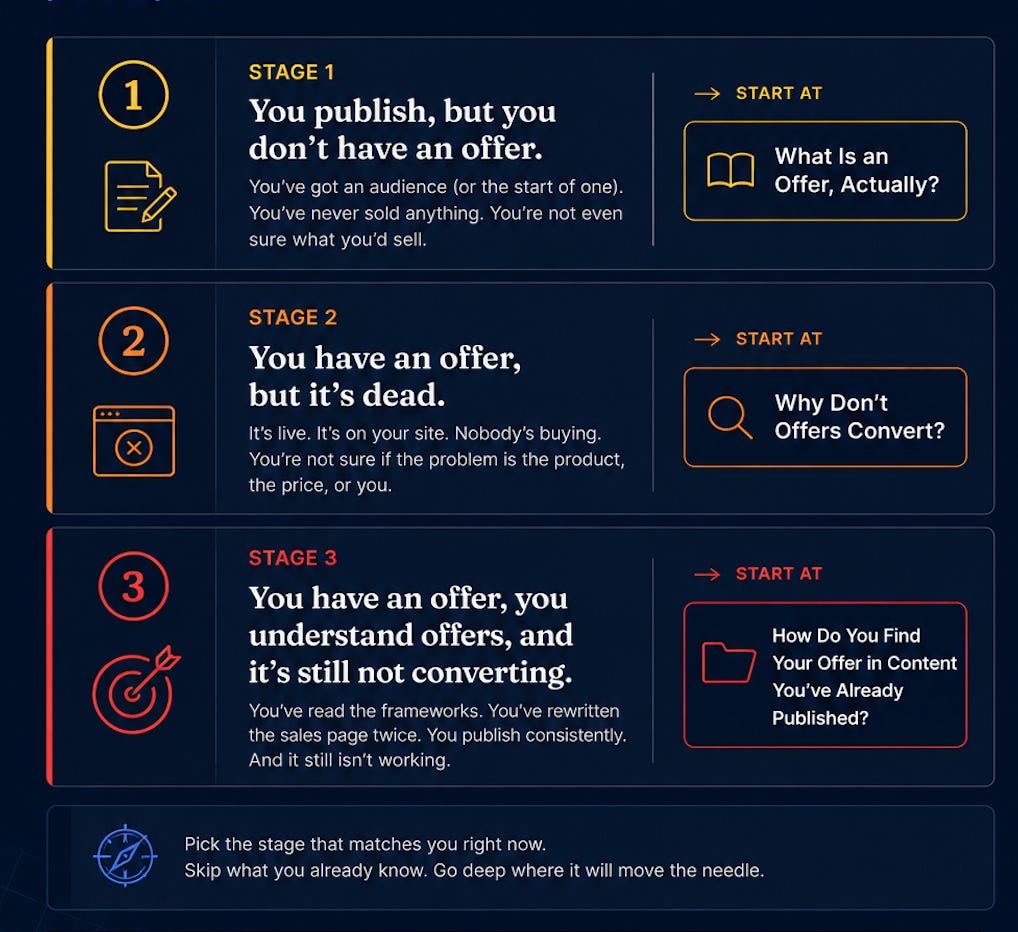
Most readers of this newsletter are Stage 3. That’s the hardest place to be, because the obvious fixes are already done…and the real problem is usually that the offer was built from the inside out instead of the outside in.
We’ll fix that.
What Is an Offer, Actually?
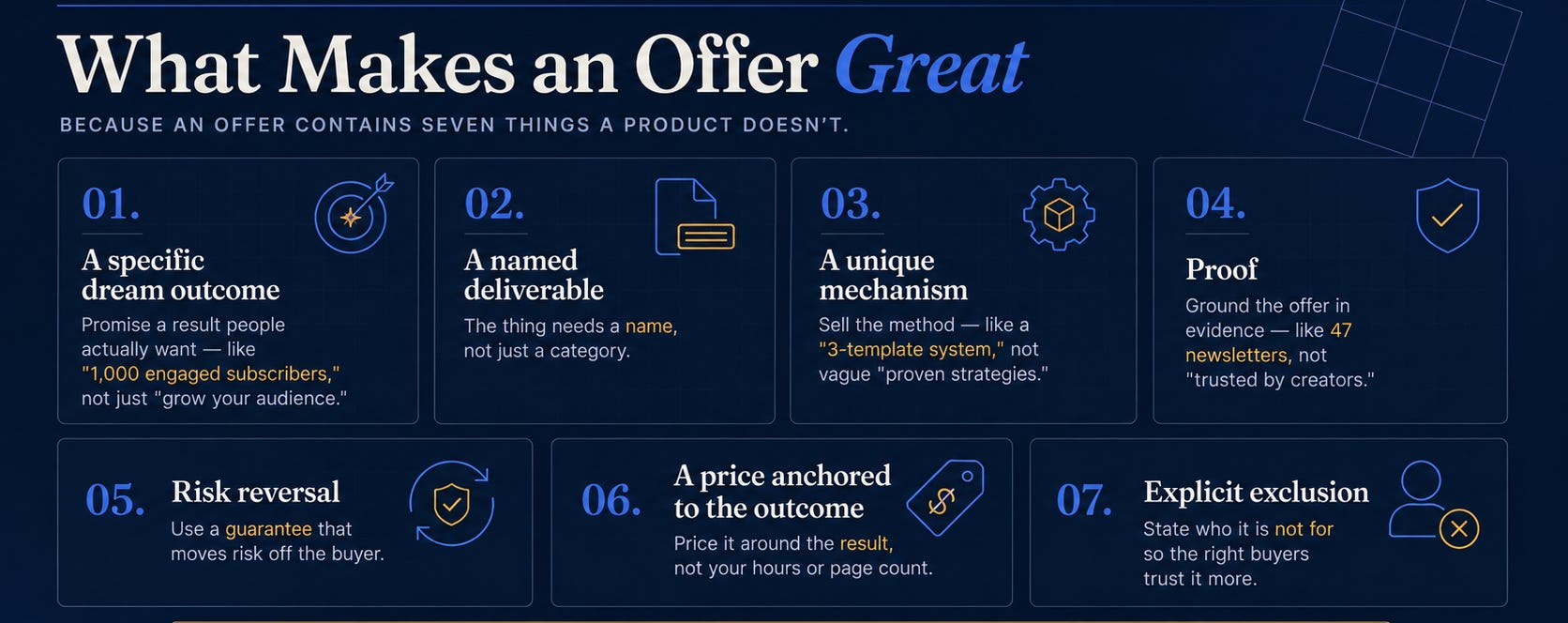
An offer isn’t your product or service…it’s the package around it: a specific dream outcome, a named deliverable, a unique mechanism, proof, risk reversal, and a price anchored to the transformation. A product description lists features. An offer makes the buyer picture the result and removes their reason to hesitate.
(Stage 1: this section is for you. Stage 2 and 3 — skim and move on.)
Most creators use “product,” “service,” and “offer” interchangeably. They’re not the same thing, and the confusion is expensive. Your product or service is what you deliver. Your offer is how you package and frame it. Your lead magnet is free and exists to grow your list…not to make money.
Alex Hormozi defines an offer as what a business provides in exchange for money…and he calls it the foundational starting point for every transaction. Not the marketing. Not the funnel. The offer.
Here’s why this distinction decides whether you earn anything. Two creators sell the same 4-hour course on newsletter growth.
Creator A sells a product: “Newsletter Growth Course…video lessons, templates, community access. $197.”
Creator B sells an offer: “The 90-Day Newsletter System…go from 0 to 1,000 engaged subscribers using the 3-template system that grew 47 newsletters past their first 1K. Without paid ads or daily posting. $297.”
Same content. Creator B charges more and converts better.
Why? Because an offer contains seven things a product doesn’t:
A specific dream outcome — “1,000 engaged subscribers,” not “grow your audience”
A named deliverable — the thing has a name, not a category
A unique mechanism — the “3-template system,” not “proven strategies”
Proof — 47 newsletters, not “trusted by creators”
Risk reversal — a guarantee that moves risk off the buyer
A price anchored to the outcome — not to your hours or the page count
Explicit exclusion — who this is not for
The three-sentence test: right now, without opening your website, write down who your offer is for, the specific measurable outcome, and the price. If you can’t do it in three sentences, that’s your problem. Not reach.
💡 If you’re at this stage and don’t yet know what you’d sell, run the Skill Monetization Matrix from The Claude Roadmap: From First Post to Full-Time Creator before you go further. It surfaces which of your skills are actually monetizable.
Why Don’t Offers Convert?
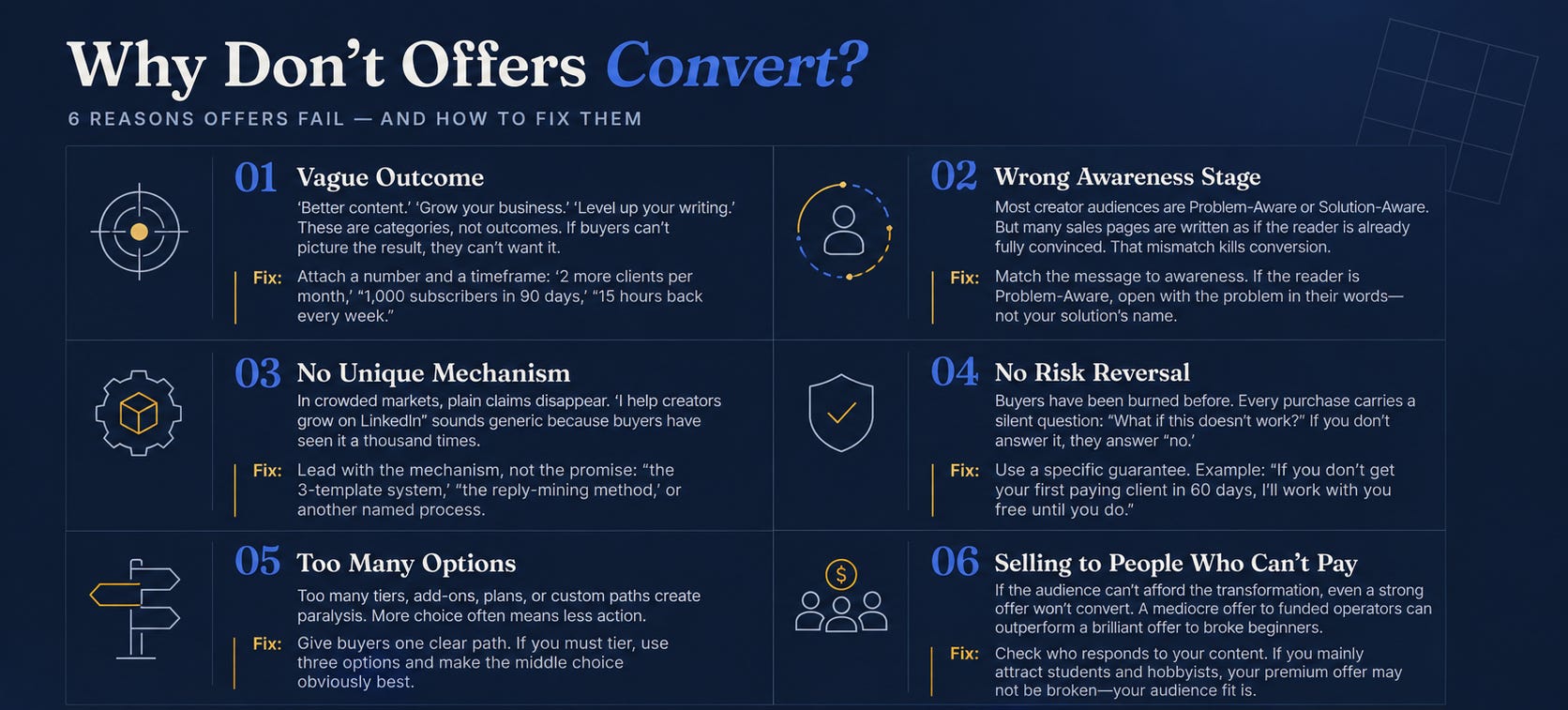
Offers fail to convert for six reasons: vague outcomes, messaging pitched to the wrong awareness stage, no unique mechanism, no risk reversal, too many options, or selling to an audience that can’t afford the transformation. In 47 reviewed offers, 83% failed on clarity…not on the quality of what was being sold.
(Stage 2 and 3: this is your diagnostic. Run every one of these against your live offer.)
When I reviewed those 47 offers, 39 of them couldn’t answer “who is this for, and what exact transformation do they get?” That’s 83%….and every one of those creators had genuine expertise. The failure was never the expertise. Here are the six failure modes, in the order they actually kill offers.
1. Vague outcome
“Better content.” “Grow your business.” “Level up your writing.” None of these are outcomes. They’re categories. A buyer can’t picture themselves having achieved them, so they can’t want them.
Fix: Attach a number and a timeframe. “2 more clients per month.” “1,000 subscribers in 90 days.” “15 hours back every week.”
2. Wrong awareness stage
This one is subtle and it kills good offers. Eugene Schwartz mapped five stages of buyer awareness:
Unaware → Problem-Aware → Solution-Aware → Product-Aware → Most Aware.
Your messaging has to match where your reader actually is.
Most creator audiences arrive Problem-Aware (”my content isn’t making money”) or Solution-Aware (”I know I need an offer”).
But most creator sales pages are written for the Most Aware…they open with features and pricing, as if the reader has already decided.
Fix: If your audience is Problem-Aware, your page opens with the problem in their words, not your solution’s name.
3. No unique mechanism
Schwartz’s second model matters even more in 2026: market sophistication. In a fresh market, you can just state a claim. In an exhausted market, a plain claim is invisible. “I help creators grow on LinkedIn” is a level-5-sophistication claim being made at level 1. There are ten thousand of those. Your reader has scrolled past all of them.
Fix: Lead with the mechanism, not the promise. Not “grow on LinkedIn” — “the 3-template system.” Not “get more clients” — “the reply-mining method.”
💡 I went deeper on why copy-paste positioning stopped working in Copying Big Creators Won’t Work in 2026.
4. No risk reversal
Your buyer has been burned. They’ve bought courses they didn’t finish and hired freelancers who ghosted. Every purchase carries a silent question: what if this doesn’t work? If you don’t answer it, they answer it themselves. And the answer is always no.
Fix: A specific guarantee beats a vague one. Not “satisfaction guaranteed” — “if you don’t have your first paying client in 60 days, I’ll work with you free until you do.” The counter-argument (it attracts bad buyers) is real but rare; in practice, strong guarantees lift conversion more than they lift refunds…if you actually deliver.
5. Too many options
Three tiers, five add-ons, a payment plan, and a “custom” option. You think you’re serving everyone. You’re creating paralysis.
Fix: One clear path. If you must tier, use three and make the middle one obviously correct.
6. Selling to people who can’t pay
Hormozi’s bluntest rule: if your market can’t afford the transformation, no offer will save you. A brilliant offer sold to broke beginners loses to a mediocre offer sold to funded operators.
Fix: Check who’s actually replying to your content. If it’s students and hobbyists, your $2,000 offer isn’t broken…your audience is wrong for it.
💡 If you want to score your offer against these systematically, I built a Claude Skill that rates any offer across five dimensions in 60 seconds: I Built an AI Tool That Tells Me Why My Offers Don’t Sell.
How Do You Find Your Offer in Content You’ve Already Published?
Find your offer by auditing your published content for signal, not applause: sort posts by replies, DMs, and saves instead of likes. The question people keep asking you for free, in their own words, is your offer. Draft it three ways…done-with-you, done-for-you, do-it-yourself…then validate with a hand-raiser email before building anything.
(This is the main event. If you’re Stage 3, this is the section that changes things.)
Here’s the mistake almost every Stage 3 creator makes: they build the offer from the inside out. They ask “what am I good at? What could I teach? What would be impressive to sell?” Then they build it, launch it, and wait.
The creators who convert build from the outside in. They ask a completely different question: “What do people keep asking me for…in their words, not mine?”
The answer is already sitting in your published content, your replies, your DMs, and your comments. You’ve been running unpaid market research for months without reading the results. This is the method. Five steps.
Step 1 — Audit for signal, not applause
Open your archive. Newsletter issues, LinkedIn posts, Substack essays, YouTube videos, X posts. Everything from the last 6–12 months. Now sort them…not by likes or views.
Sort by:
Replies (someone typed a response)
DMs it generated
Saves and shares
“How do I do this?” comments
Likes are a reflex. A reply is a decision. A DM is a decision with friction attached. That friction is exactly what makes it predictive.
Creator-pricing analysts consistently report that saves and shares sit closest to actual purchase intent, while follower count is a lagging signal. Chenell Basilio, who reverse-engineers newsletter growth for a living, frames valuable content as content that optimizes for replies, DMs, shares, and saves…not passive likes.
Honest caveat: no controlled study proves reply → purchase for info products. But every documented case I’ve found runs through this door, so treat it as the strongest heuristic available. Your output: your top 10 posts by signal. Not by reach.
💡 Practical shortcut: export your archive into a sheet, drop it into Claude, and prompt: “Group these posts by underlying topic. Flag the clusters with the highest reply and save rates. Show me the exact phrases readers used in the replies.” If you haven’t set up a proper context file for this kind of work yet, start by building a dedicated business context file for Claude.
Step 2 — Find the question you keep answering for free
This is the whole ballgame. Somewhere in your DMs and replies, the same question keeps appearing in slightly different wording. You answer it every time. You’ve probably answered it fifty times. It feels too obvious to sell.
That obviousness is the tell. It’s obvious to you because you’ve solved it. It’s not obvious to them, which is why they keep asking.
Here’s the canonical case. Justin Welsh….now a $10M+ one-person business…found his first product by rereading his LinkedIn DMs. He was in SaaS sales, expecting sales questions. Instead his inbox was jammed with people asking how he’d grown his LinkedIn following.
He built a $50 course. First month: $10,482. It grossed roughly $75K over 15 months. Then he did the thing most creators never do…he treated that $50 product as what he called a “trust tripwire,” rebuilt it properly, and relaunched at ~$150.
First month of the new version: $94,651. And it converted 2.7x better than the $50 version. Higher price. Better conversion. Same underlying knowledge. His summary: your customers will tell you what to build next…you just have to listen.
Your output: the one question, written in your audience’s exact words. Not your paraphrase. Copy-paste the actual sentence someone sent you.
Step 3 — Extract their language, not yours
Amy Hoy and Alex Hillman named this “Sales Safari”…instead of asking your audience what they want, you observe them and take notes in four buckets:
Pain — what they complain about
Jargon — the exact words they use
Worldview — what they believe about the problem
Recommendations — what they’re currently buying instead
Watch for trigger words: “finally,” “easier,” “I hate when,” “I keep trying to,” “I gave up on.” This is what closes the gap between “I help creators with content systems” (your words) and “I stop you rewriting the same post for four platforms every Sunday” (their words).
Your offer copy should be roughly 70% their vocabulary and 30% yours. Your output: 15–20 verbatim phrases from your own audience.
Step 4 — Draft three offer shapes from the same insight
Do not draft one offer. Draft three, from the same core insight, at three different levels of involvement:
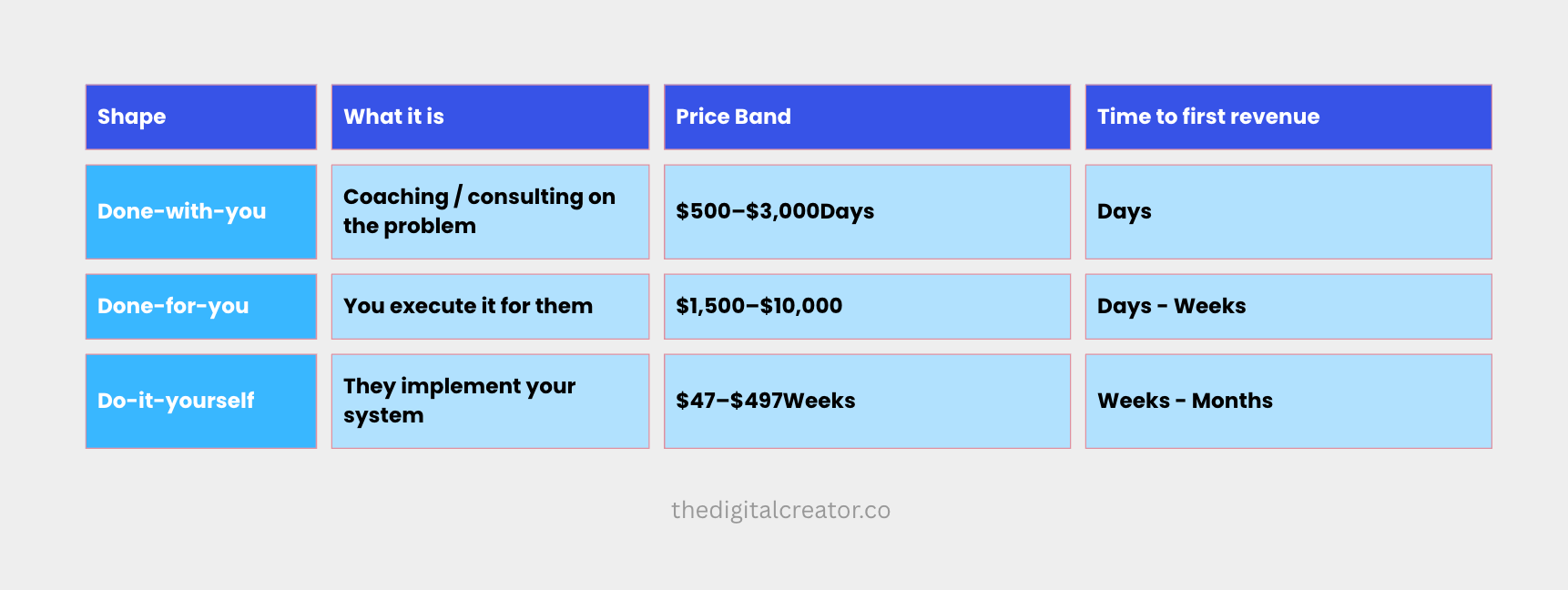
Same insight, three vehicles. This matters because Stage 3 creators usually picked the wrong vehicle, not the wrong topic. The topic was right. Turning it into a $97 course when your audience needed it done for them is why nobody bought.
Your output: three one-paragraph offer descriptions. Each with a name, an outcome with a number, and a mechanism.
Step 5 — Validate with a hand-raiser before you build anything
This is the step almost everyone skips, and it’s the cheapest thing in this entire playbook.
Send one email to your list. Not a pitch..a question. Something like: “I’m putting together something for people stuck on [exact problem in their words]. If that’s you, reply with the word MAP and I’ll send details.”
Then…and this is the part that matters…get on a call or a DM thread with everyone who replies. Ask what they’ve already tried. Ask what they’d pay to never deal with it again. Take notes in their words.
Chenell Basilio documented a version of this in her Growth in Reverse series: Nathan May, working with Jesse Pujji, emailed roughly 300 past readers asking them to reply if they wanted help…then ran 1:1 follow-ups to extract the pain in the readers’ own language.
That single hand-raiser email produced over $20,000, with a $47 low-ticket product laddering into multiple $5,000 upsells.
The insight from that case is exactly the thesis of this issue: the product-market-message alignment came from readers, not assumptions.
The rule that saves you months:
❌ Likes are not validation.
❌ “I’d totally buy that!” is not validation.
✅ Money is validation.
✅ A calendar booking is validation.
✅ “Send me the link right now” is validation.
Ask yourself after every test: did I get commitment, or did I get compliments? If fewer than a handful of people raise their hand from an engaged list, don’t build. Go back to Step 2…you picked the wrong question.
Should You Sell a Service, Coaching, or a Digital Product?
Pick service, coaching, or product based on your runway. Need cash in 30 days with under 1,000 people on your list? Sell a service. Have proven repeat demand and real traffic? Build a product. Fewer buyers at a higher price beats many buyers at a low price…a $2,000 service needs 3 clients; a $47 product needs 852.
You’ve got your insight and three possible shapes.
Now pick one…based on your constraints, not on what looks impressive on a landing page.
Run this top to bottom:
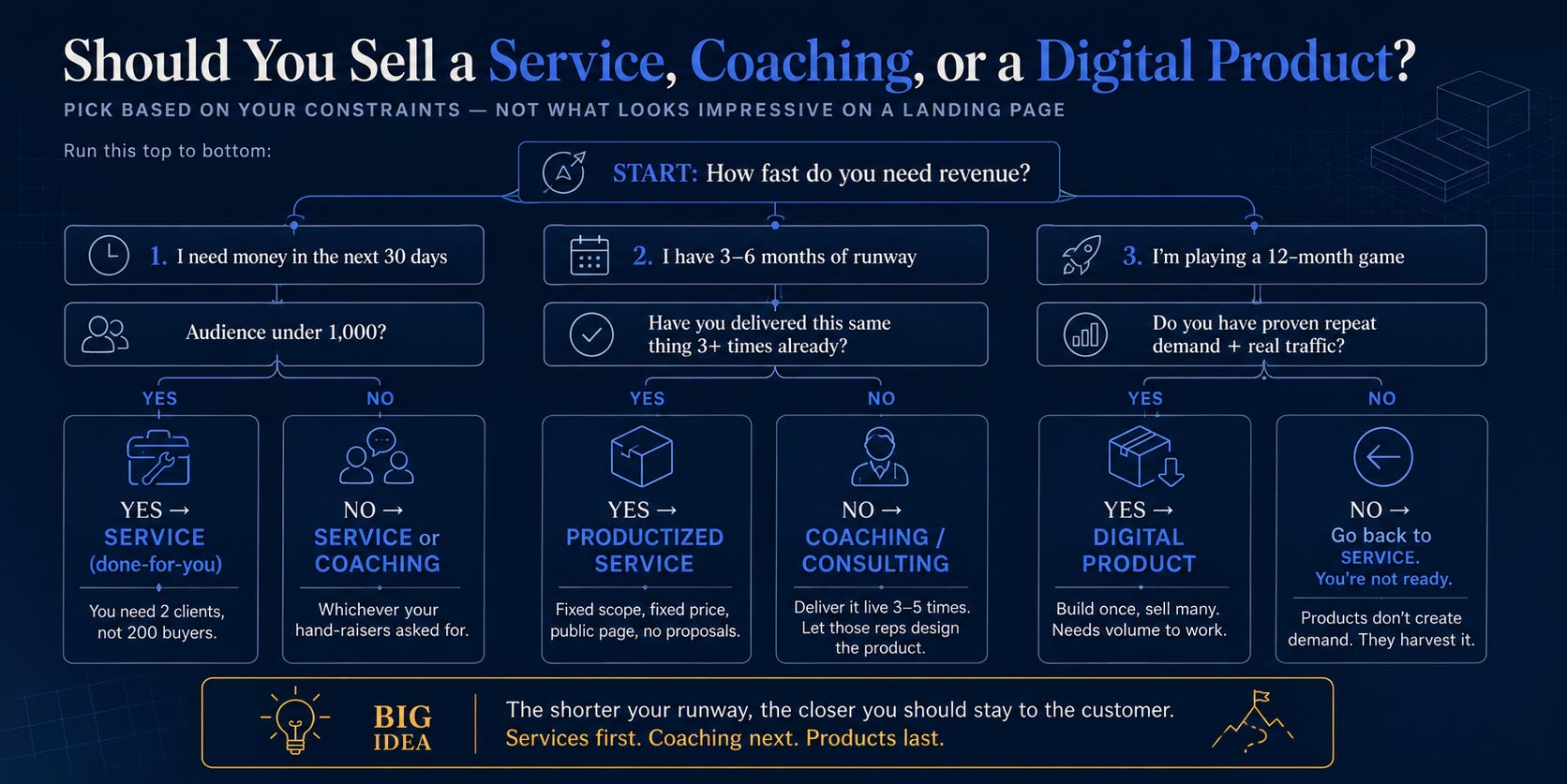
The uncomfortable math behind this tree:
Kevin Kelly’s 1,000 True Fans said 1,000 fans × $100/year = $100K.
Li Jin’s 100 True Fans revised it: 100 fans × $1,000/year gets you to the same place.
The critique of both is fair…converting a casual audience into true fans runs around 1%, and most creators never manage the direct relationship the model assumes.
But the practical lesson is the one that should drive your decision:
Fewer buyers at a higher price is dramatically easier than many buyers at a low price. If your list is 800 people, a $2,000 service needs 3 clients.
A $47 product needs 852 buyers…more than your entire list. One of those is achievable this month.
And the conversion math nobody wants to publish:
Substack’s official guidance suggests 5–10% free-to-paid.
That’s what winners do. Beehiiv’s State of Paid Newsletters 2026, drawing on first-party data across thousands of publications, puts the median at 0.62%…roughly 6 paying subscribers per 1,000.
Only about a fifth of publications are clear 5%. Plan your revenue at 1–3%. If you’re modeling 10%, you’re modeling a fantasy.
The progression almost everyone should follow…and the one Nathan Barry codified as the Ladders of Wealth Creation — is:
Service → Productized service → Digital product.
You can jump rungs. You can’t skip the skills. Selling a $497 course is a distribution problem you’re not equipped to solve until you’ve solved the delivery problem at $2,000-a-client scale.
💡 Once you’re ready to climb, the full rung-by-rung breakdown with real creator numbers is in The Creator Revenue Playbook.
One more thing about 2026 specifically
The market has split, and it matters for which offer you choose.
Commodity work…basic writing, basic design, simple builds…is getting compressed hard. Meanwhile, specialized implementation work is surging.
Fiverr’s Business Trends Index reported that searches for AI-agent freelance expertise jumped 18,347% over a six-month window, with workflow-automation and newsletter-setup specialists posting similar spikes. Fiverr’s own quarterly commentary put it plainly: specialized talent is outperforming while commoditized skills face pressure.
Translation for your offer: stop selling a deliverable. Start selling an outcome you own.
“I’ll write your newsletter” is a deliverable, and it’s being priced down.
“I’ll build the system that publishes your newsletter and repurposes it across three platforms” is an outcome, and it isn’t.
💡 If that direction fits you, I mapped 50 concrete versions of it in 50 AI Agents You Can Build and Sell.
How Do You Price an Offer Without Flinching?
Price the transformation, not your time or hours worked. If quoting your price doesn’t make you slightly nervous, it’s too low. Gumroad’s data across 146,000+ products shows pricing at $30 or higher correlates with roughly 9x more revenue per product than pricing under $10….underpricing doesn’t reduce risk, it attracts buyers who never implement.
Short section, because the principles are simple and the execution is emotional.
Price the transformation, not your time. Jonathan Stark and Blair Enns have spent careers on this single point: hourly billing caps your income at your calendar and punishes you for getting faster. What the client gets is what you charge for.
Use the discomfort test. If quoting the price doesn’t make you slightly nervous, it’s too low.
Don’t underprice to reduce risk. It doesn’t work. Underpricing attracts buyers who don’t value the outcome enough to implement it…which produces no results, no testimonials, and no referrals.
Gumroad’s analysis across 146,000+ products found pricing at $30+ correlated with roughly 9x more revenue per product than pricing under $10.
Price bands to anchor against:
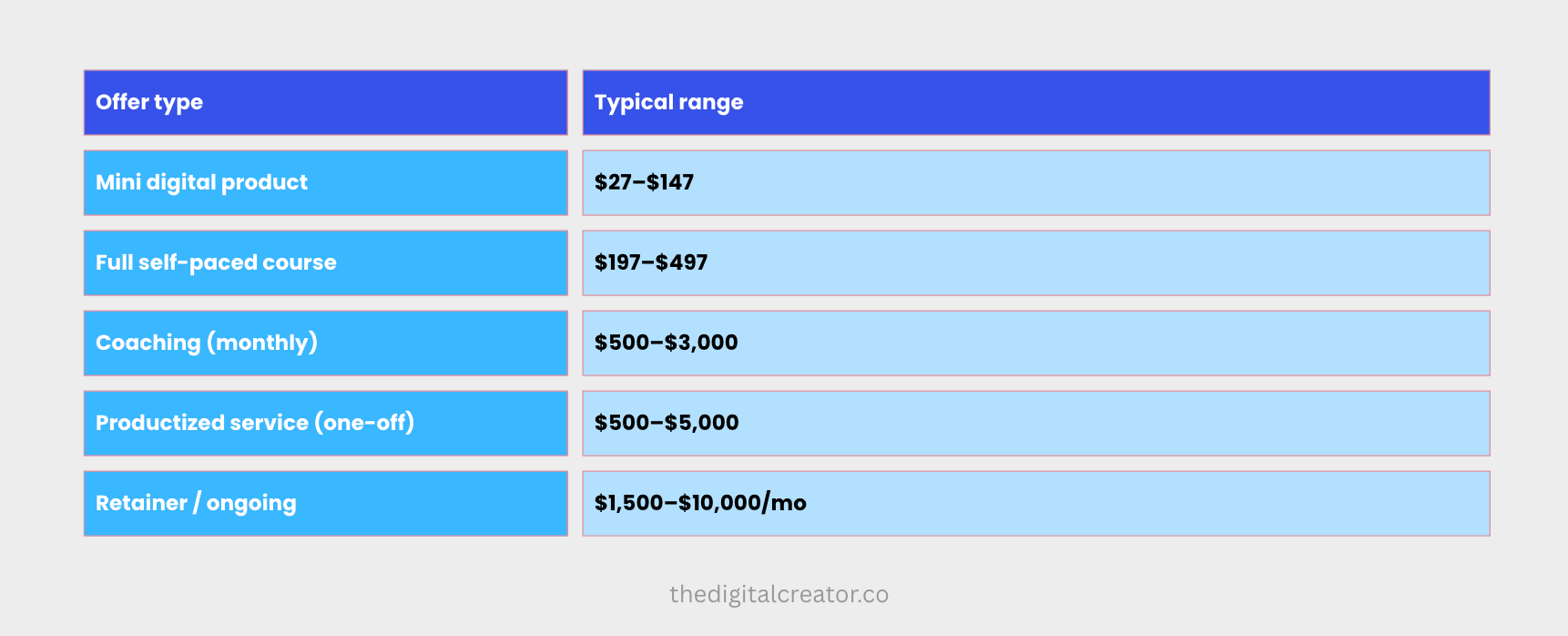
Use the speed bumps. Price just under psychological thresholds: $97, $197, $497, $997, $1,997.
How Do You Actually Sell It?
Sell through your newsletter by teaching the problem for 2-3 issues, then opening with a real, time-bound reason before pitching. In DMs, warm beats cold: 50 messages to people who already engage with your content outperform 1,000 cold pitches. Track revenue per conversation, not messages sent, and always end your offer page with who it’s NOT for.
You have an offer. Here’s how it reaches people without you feeling like a used-car salesman.
The newsletter path
Your list is your conversion engine…social distributes, email converts. But most creators do one of two broken things: never mention the offer, or blast a hard pitch out of nowhere.
The sequence that works:
Teach the problem (2–3 issues). Genuinely useful content about the pain your offer solves. Soft P.S. link at the bottom.
Open with a reason. Founding-member pricing. Limited cohort. Real scarcity — never invented.
Handle one objection per email. Not five in one email. One.
Close with a deadline. A date, not a vibe.
One idea per email. One CTA per email. Write the CTA around the outcome — “Show me the system,” not “Learn more.”
The DM path
Warm beats cold, decisively. 50 DMs to people who already engage with your content will outperform 1,000 cold messages…and won’t damage your reputation.
The structure that works:
Line 1 — Specific reference. Something they actually posted. Not “love your content.”
Line 2 — The observation. A gap or pattern you noticed, offered as insight, not criticism.
Line 3 — The question. Not the pitch. “Is that something you’re working on right now?”
That’s it. No link in the first message. You’re opening a conversation, not closing a sale.
Track revenue per conversation, not DMs sent. Ten conversations that go somewhere beat 200 that go nowhere.
💡 I automated most of my own version of this…the research, the personalization, the drafting…in How I Built My Subscriber Pitch Agent.
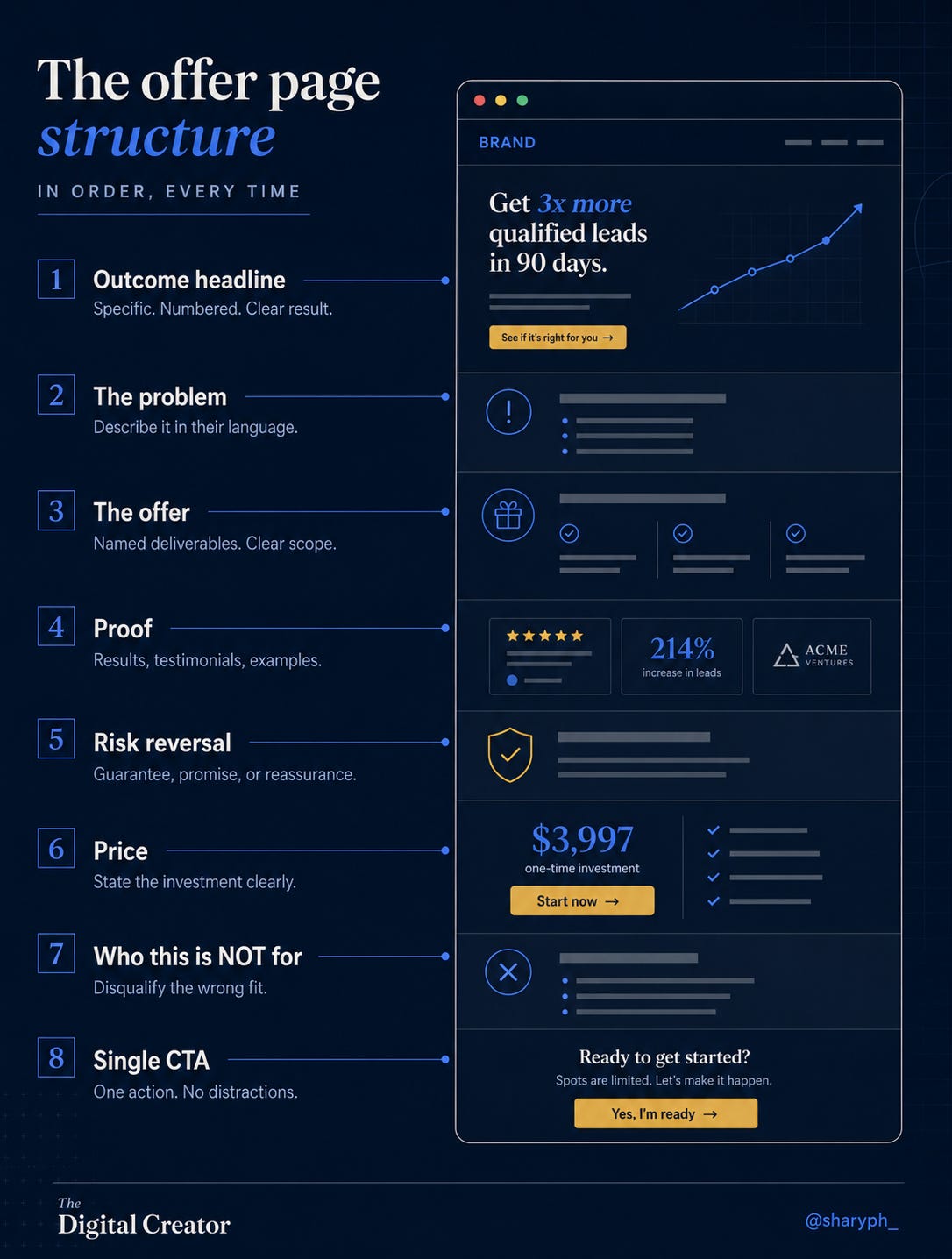
The offer page structure
In order, every time:
Outcome headline (specific, numbered)
The problem, in their language
The offer + named deliverables
Proof
Risk reversal
Price
Who this is NOT for
Single CTA
Your tagline
Use this as a clarity tool, not a slogan:
“I help [specific person] achieve [specific outcome] through [unique mechanism] without [the thing they dread].”
April Dunford…the sharpest thinker on positioning…argues against treating fill-in-the-blank statements as your actual strategy, and she’s right: the formula captures your assumptions, not market truth.
Her process runs deeper (competitive alternatives → unique attributes → value → who cares → market frame).
So use the formula externally for clarity.
Use Dunford’s process internally to make sure the clarity is pointed at something true.
What’s the 7-Day Offer Sprint?
The 7-day sprint: pull your top 10 posts by replies and saves, find the repeated question in your own words, extract verbatim phrases, draft three offer shapes, run the decision tree, send a hand-raiser email, then talk to everyone who replies. You’ll have a validated offer, or proof you asked the wrong question in a week.
Everything above, compressed into a week. No new tools. No new subscriptions.
Day 1 — Pull your top 10 posts by replies, DMs, and saves. Not views.
Day 2 — Find the repeated question. Write it in your audience’s exact words.
Day 3 — Extract 15–20 verbatim phrases from your replies and comments.
Day 4 — Draft three offer shapes: done-with-you, done-for-you, do-it-yourself.
Day 5 — Run the decision tree. Pick one. Name it. Attach a number to the outcome.
Day 6 — Send the hand-raiser email. One question. No pitch.
Day 7 — Talk to everyone who replied. Ask what they’d pay to make this go away.
At the end of the week you either have a validated offer and a short list of buyers...or you have proof you picked the wrong question, which you found out in seven days instead of three months.
Both outcomes are wins. Only one of them costs you a quarter.
The One Thing
If you implement nothing else from this issue:
Stop asking “what should I sell?” and start asking “what do people keep asking me for?”
The first question is a guess. The second one has an answer, and the answer is sitting in your inbox right now.
Your offer isn’t something you need to invent. It’s something you need to notice.
Frequently Asked Questions
What’s the difference between an offer and a product?
A product or service is what you deliver. An offer is how you package it: a specific outcome, a named deliverable, a unique mechanism, proof, risk reversal, and a price anchored to the transformation. Two creators can sell the identical course…the one with a real offer around it charges more and converts better.
How do I know what offer to build if I don’t know what to sell?
You already know. Sort your published content by replies, DMs, and saves rather than likes, then find the question people keep asking you for free. That repeated question, written in their exact words, is your offer. Most creators who’ve published for 3+ months have already written it without noticing.
How long should it take to validate an offer before building it?
One week. Days 1-3 audit your archive and extract the repeated question in your audience’s language. Days 4-5 draft three offer shapes and pick one using the decision tree. Days 6-7 send a hand-raiser email and talk to everyone who replies. You’ll have a validated offer or proof to pivot…either way, in 7 days.
Should I build a service, coaching program, or digital product first?
Match it to your runway, not your ambition. Need revenue in 30 days with under 1,000 people on your list…sell a service. Have 3-6 months and you have delivered the same thing 3+ times…build a productized service. Have 12 months and proven repeat demand…build a digital product. You can skip stages, not skills.
What’s a reasonable price to charge for a first offer?
Price the transformation, not your time. Gumroad’s data across 146,000+ products shows items priced at $30+ generate roughly 9x more revenue than those under $10. Use psychological price points just under round numbers…$97, $197, $497, $997…and if the price doesn’t make you slightly nervous, it’s probably too low.
Key Takeaways
Diagnose before you build: 83% of the 47 offers reviewed failed on clarity, not quality…run the six-reason checklist against your live offer before touching the product itself.
Mine your archive for the offer: sort your last 6-12 months of content by replies, DMs, and saves, and find the question you’ve answered “for free” more than a dozen times.
Draft three shapes, not one: turn the same insight into a done-with-you, done-for-you, and do-it-yourself version before picking a direction.
Validate with money, not likes: send one hand-raiser email and treat only replies, bookings, or “send me the link” as real signal…plan to build only if a handful of an engaged list raises a hand.
Match the vehicle to your runway: under 1,000 subscribers and need cash in 30 days, sell a service (2-3 clients); 12 months of runway and proven repeat demand, build the digital product.
Your Next Step
If you’re Stage 1 (publishing, no offer yet): Start with the free playbook…it covers niche, lead magnet, and getting your first content working before you spend a dollar. → Grab the Lean AI-Powered Business Playbook — Free
If you’re Stage 2 or 3 (offer exists, isn’t converting):
Do Day 1 and Day 2 of the sprint today. Then hit reply and send me your one repeated question…the thing people keep asking you. I read every reply, and I’ll tell you honestly whether there’s an offer in it.
That’s the whole ask this week. One reply. One question.
One more thing.
Everything in Part 3…the archive audit, the signal sorting, the language extraction, the three offer shapes…is a process. And processes that run the same way every time should eventually stop being manual.
So I’m building it.
A tool where you paste in your content…Substack posts, LinkedIn posts, YouTube videos, your About page…and it returns a set of validated offer directions.
Not just the offer: the tagline, the exact deliverables, the realistic time-to-deliver, how to find and approach the first clients, and the full build path for whichever direction you pick.
Same excavation method. Ten minutes instead of a week.
I’ll show you the whole build and how I use it to build offers and the complete offer system for my clients. (want to build your offer using this system..? just reply “offer”.)
Sharyph
P.S. If this issue clarified something for you, forward it to one creator who’s stuck publishing without earning. That’s the single fastest way this reaches the people who need it. And if you post about it, tag me on X @sharyph_ — I’ll jump in.
Until next time — Sharyph | Founder of The Digital Creator
The bit about mining your own archive for the question people keep asking for free is the part I’d underline. It took me a while to work out that the thing I kept answering in DMs was itself the offer. Naming it properly made the difference: people struggle to buy something they can’t describe to someone else.
The question people keep asking you for free is the offer sitting right there in your inbox.