

Welcome to The Digital Creator, helping creators accelerate with AI by showing you how to start, create, grow, and scale faster.
Before we begin today’s actual content, I want to introduce My Operation Command Center. Right now I am working on content repurposing workflows, but it is way broader than just content repurposing.
TL;DR: Content repurposing means rebuilding one newsletter natively for each platform…not copy-pasting it. Cross-posting risks originality penalties only from app watermarks, duplicate files, or zero-effort aggregation. A five-platform system (LinkedIn, X, Substack Notes, Instagram, video) built on a brand voice file turns one pillar into five native posts in 30 minutes.
You write one great newsletter. Then it lives and dies in one inbox.
It goes out. Your subscribers read it (or don’t). And then it just... sits there.
Doing one job, when it could be doing five.
That’s the quiet tragedy of most creator content. Not that it isn’t good. It’s that your best thinking gets trapped in one format, for one audience, on one day - and then you go back to a blank page and start over.
Here’s the thing though - this isn’t another “post more” newsletter. I’m not telling you to be on six platforms, feeding six algorithms, chasing six different audiences.
I’m going to show you the exact system I use to take one newsletter and turn it into five platform-native pieces of content - without touching a keyboard for most of it, and without it reading like AI wrote it. Thirty minutes, start to finish.
But first, we need to kill a bad assumption. Because most creators aren’t stuck because they can’t write. They’re stuck because they think the problem is volume.
It isn’t.
Is “Post More” Actually the Answer?
No. Sprout Social’s 2025 analysis of nearly 3 billion posts found brands publishing less (9.5 posts/day, down from 2023) while engagement rose almost 20%. The real fix isn’t more content…it’s distribution: reaching the audience you already have, spread across 6-7 platforms a month, instead of trapping every idea in one inbox.
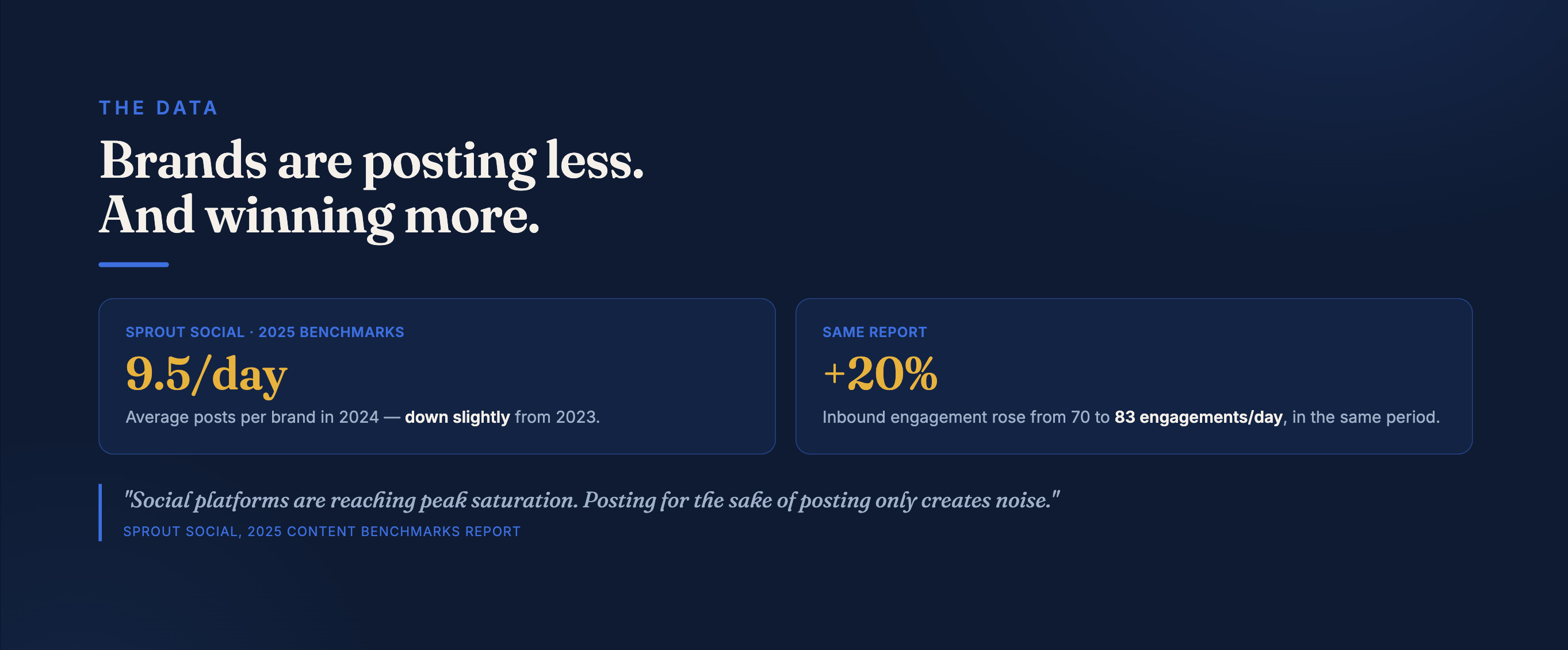
Here’s what nobody tells you: the brands winning right now are posting less, not more.
Sprout Social’s 2025 Content Benchmarks Report analyzed almost 3 billion messages across roughly 1 million public profiles. What they found should change how you think about your content calendar: brands published an average of 9.5 posts a day in 2024 - down slightly from 2023 - while inbound engagement rose almost 20%, from 70 engagements a day to 83.
Fewer posts. More engagement. Sprout’s own words on it: social platforms are reaching peak saturation, and posting for the sake of posting only creates noise.
So if “post more” isn’t the answer, what is?
It’s distribution. Specifically - reaching the audience you already have, wherever they actually are. Because DataReportal’s Digital 2025 report, built on GWI data, puts the average person on roughly 6–7 different social platforms a month. Your audience isn’t sitting in one inbox waiting for you. They’re scattered.
One newsletter reaches the people who open newsletters, on the day it lands. Everyone else - the people who live on LinkedIn, the people who scroll X at 11pm, the people who only ever see Substack Notes - never sees your best idea at all.
And here’s the part that actually hurts: this is the exact thing burning creators out.
Billion Dollar Boy, in partnership with Censuswide, surveyed 1,000 creators in mid-2025. 52% said they’d experienced burnout directly because of their career. 37% had actively considered leaving the profession. The #1 named cause? Creative fatigue - cited by 40%.
Not lack of ideas. Fatigue.
Because most creators think the fix for “my content isn’t reaching enough people” is make more content. So they sit down and manually rewrite the same idea five different ways, for five different platforms, every single week.
That’s not a content problem. That’s a distribution problem wearing a content problem’s clothes.
The real fix isn’t willpower. It’s a system - one that takes the newsletter you already wrote and turns it into everything else it should have been, without you doing the manual labor five times over.
That’s what the rest of this issue is going to build.
Does Cross-Posting Actually Get You Penalized?
Rarely, and only for three specific triggers: carrying another app’s watermark, uploading byte-identical duplicate files, or aggregating content with zero added value. Your own idea, rewritten in your own words for the platform it’s landing on, isn’t a violation…it’s normal content strategy. Even flagged accounts recover within Instagram’s rolling 30-day window.
Here’s the belief that’s quietly costing you the most reach: “If I post the same idea on multiple platforms, I’ll get penalized for it.”
So creators do nothing. One newsletter. One inbox. Forever.
I want to correct this properly, because the correction is actually good news.
Platforms do not punish you for posting your own idea in more than one place. What they punish is much narrower - and once you see the three actual triggers, you’ll realize you were never in danger to begin with.
❌ Trigger 1: Other apps’ watermarks. Instagram head Adam Mosseri said it plainly back in October 2024: what they try not to do is recommend Reels carrying another app’s logo - but your own logo is fine, don’t worry about it. TikTok’s own Originality Policy says the same thing in different words: repurposed content carrying a watermark or logo generally doesn’t count as original.
❌ Trigger 2: Byte-identical duplicate files. Back in April 2024, Instagram confirmed that if it finds two or more identical pieces of content, it only recommends the original. Same file, uploaded twice - that’s the problem. Not the idea living in two places.
❌ Trigger 3: Aggregation with nothing added. This is the one that just got bigger. As of April 30, 2026, Instagram expanded this originality enforcement from Reels to photos and carousels too. Their exact standard, and I want you to actually read this line: watermarks or credits do not count as making something original. You need real transformation - commentary, structure, your own framing - not a border slapped on someone else’s work.
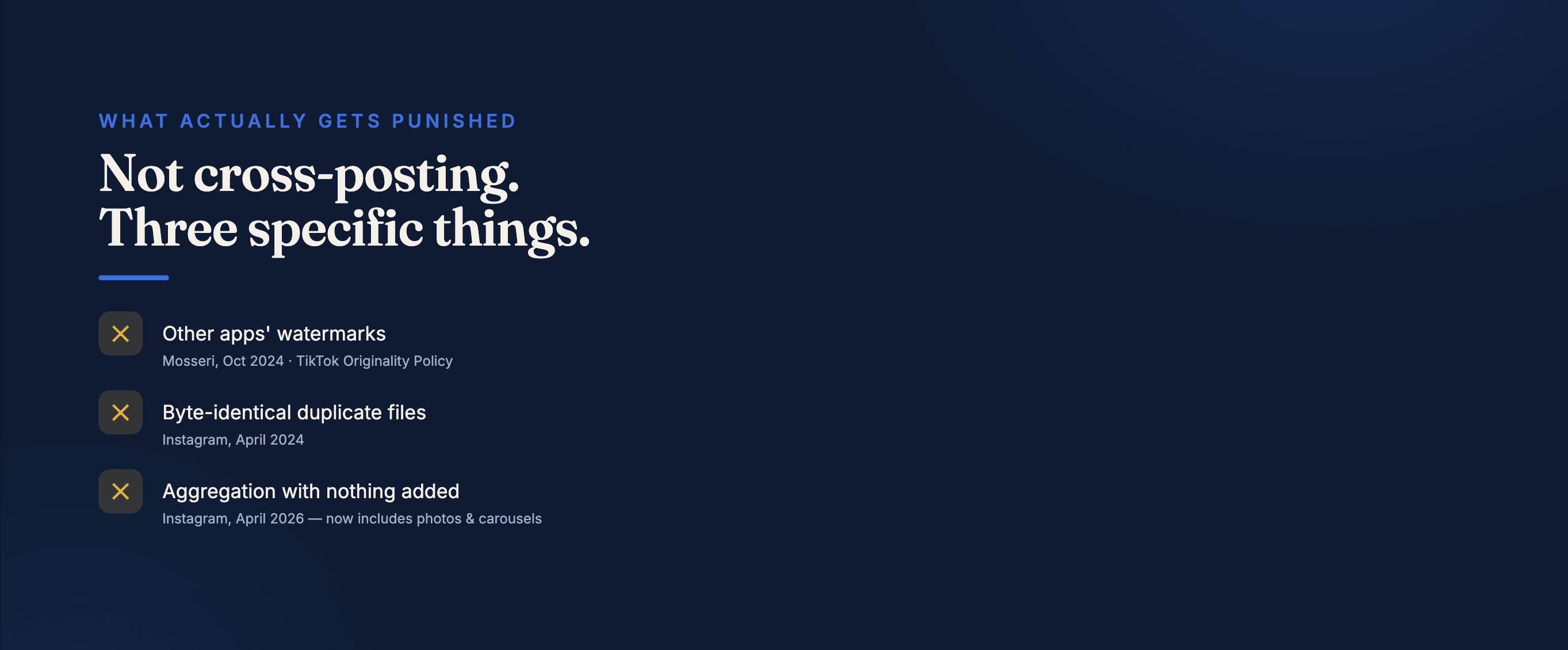
Here’s what none of these three things are: your own idea, rewritten in your own words, formatted for the platform it’s landing on. That’s not a violation. That’s just... doing your job.
💡 Here’s the part I actually want you to sit with: I went looking for the scary stat you’ve probably seen - “cross-posting cuts your reach by 42%,” or the “72% penalty with a watermark.” I could not find a single study behind either number. It traces back to one SaaS blog, no data, no methodology, nothing. It’s not research. It’s a made-up number that got repeated so many times it started sounding true.
That’s the real lesson here. Half the fear keeping creators stuck to one platform isn’t even based on anything real.
What’s the Difference Between Cross-Posting, Repurposing, and Atomizing?
Cross-posting uploads the same file unchanged and risks dedup penalties. Repurposing rebuilds the same idea natively for each platform’s format and reaches new audiences. Atomizing breaks one pillar into multiple standalone pieces that compound reach over time. This is COPE, Create Once, Publish Everywhere…a modular content model NPR’s team coined in 2009.
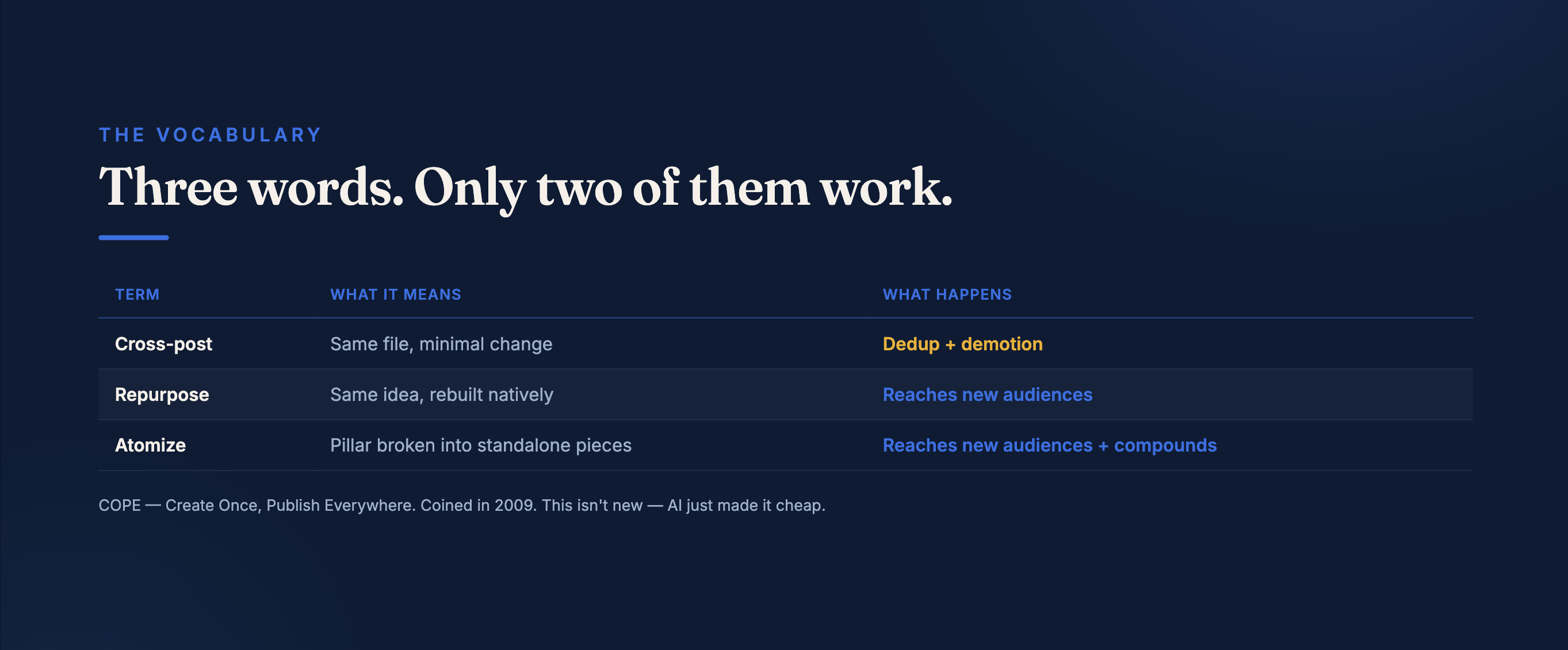
This isn’t a new idea, and it isn’t an AI-era invention, and it is by Daniel Jacobson’s team at NPR, describing a modular, format-agnostic approach to content. Jacobson himself noted that COPE is agnostic as to whether you build the system or buy it - which is a useful thing to remember later in this issue, when we get to the build-vs-buy conversation.
Sixteen years old. This principle was true before AI existed. AI just made the execution of it cheap enough that you no longer have an excuse to skip it.
So here’s the shift I want you to make:
Stop asking “should I post this everywhere?”
Start asking “have I rebuilt this natively for where it’s landing - or did I just copy-paste it and hope?”
That one question is the difference between getting demoted and getting discovered.
How Do You Know If Your Newsletter Is Repurpose-Ready?
A repurpose-ready pillar has 3-7 distinct teachable points, 1-3 real stories or examples, 1-2 sourced data points, and at least one genuine stance, not just a summary of the space. If your newsletter is missing these, fix the pillar first. Atomizing thin content just spreads thin content across five platforms instead of one.
Before we get into the mechanics, I need to stop you for one second. Because everything I’m about to show you only works if the thing you’re repurposing is actually good.
You can’t atomize thin content into thirty useful pieces. You just get thirty pieces of thin content.
Garbage in, garbage out…except now the garbage is spread across five platforms instead of one.
So before you run a single newsletter through a repurposing system, run it through this test. A genuinely repurpose-ready pillar has:
✅ 3–7 distinct, teachable points - not one big idea stretched thin
✅ 1–3 real stories or examples - yours, a client’s, a case study
✅ 1–2 sourced data points - something with a number and a name attached
✅ At least one real stance - a “here’s what I actually believe” moment, not just a summary of the space
If your newsletter doesn’t have at least that, don’t automate it yet. Fix the pillar first. Everything downstream depends on it.
Here’s why this matters more than it sounds like it should: Buffer’s analysis of 2.1 million Instagram posts across 102,000 accounts found that posting 3–5 times a week more than doubles follower growth compared to 1–2 times. Push to 6–9 times a week and growth climbs to roughly 3.7×. Push past 10 and you’re at roughly 5.5× - but the returns are clearly diminishing by that point. You’re doing 2× the work for a fraction of the extra lift.
Read that data correctly and it tells you something important: the goal was never “post as much as possible.” It’s “post genuinely native content, consistently, without burning out producing it.” Five real posts beats twenty noisy ones - every single time.
That’s the whole premise of this issue. Not more content. The same strong idea, made cheap to distribute properly.
💡 If you’re not sure your last few issues would pass this test…that’s worth sitting with before you build anything.
And if you’re just getting your first pillar off the ground, this is exactly what The Lean AI-Powered Business Playbook for Creators walks you through…building a clear offer and a content system before you ever touch automation. It’s free.
How Do You Adapt One Idea for Each Platform?
Each platform has its own physics. LinkedIn rewards posts that survive the 210-character “see more” fold. X’s open-sourced algorithm now weighs reply-chain depth over likes and penalizes in-body links. Substack Notes now reaches non-followers by default. Instagram rewards a 1-2 second hook. Copy-pasted text ignores all of this…and reads as low quality.
Okay. Your pillar passed the test. Now here’s where most people still get it wrong - not because they cross-post, but because they don’t actually translate.
Copy-pasting the same words into five different boxes isn’t repurposing. Each platform has its own physics. Ignore them, and even a genuinely native idea reads like it doesn’t belong there - and the algorithm reads that scroll-away as “low quality,” penalty or not.
Here’s what actually changes, platform by platform.
🔗 LinkedIn AuthoredUp’s analysis of 372,126 posts (Sept 2025–Feb 2026) found posts between 1,301–2,500 characters earn roughly 27% higher engagement than anything under 400. But the number that actually decides whether anyone reads that far is the “see more” fold - roughly 210 characters on desktop, and closer to 140 on mobile, where most of LinkedIn’s traffic lives. Your first two lines aren’t an intro. They’re the entire pitch.
On links: the old “just put it in the first comment” advice has gotten more complicated in 2026 - LinkedIn’s algorithm now recognizes that pattern too, and can flag it as “bridge behavior.” The safer move now is to write a post that stands on its own, mention the resource naturally, and only add the link where it feels earned - not to lead with the link as the entire point of the post.
And here’s the stat that should genuinely change how you feel about LinkedIn: 80% of LinkedIn profiles post just once a week. Show up 3–5 times with something real, and you’re already ahead of the vast majority of the platform.
🔗 X This is the platform where the rulebook just changed, and most creators haven’t caught up. In January 2026, X open-sourced its entire recommendation algorithm - a Grok-powered transformer model that reads your post’s actual content to rank it, rather than relying on hand-built rules.
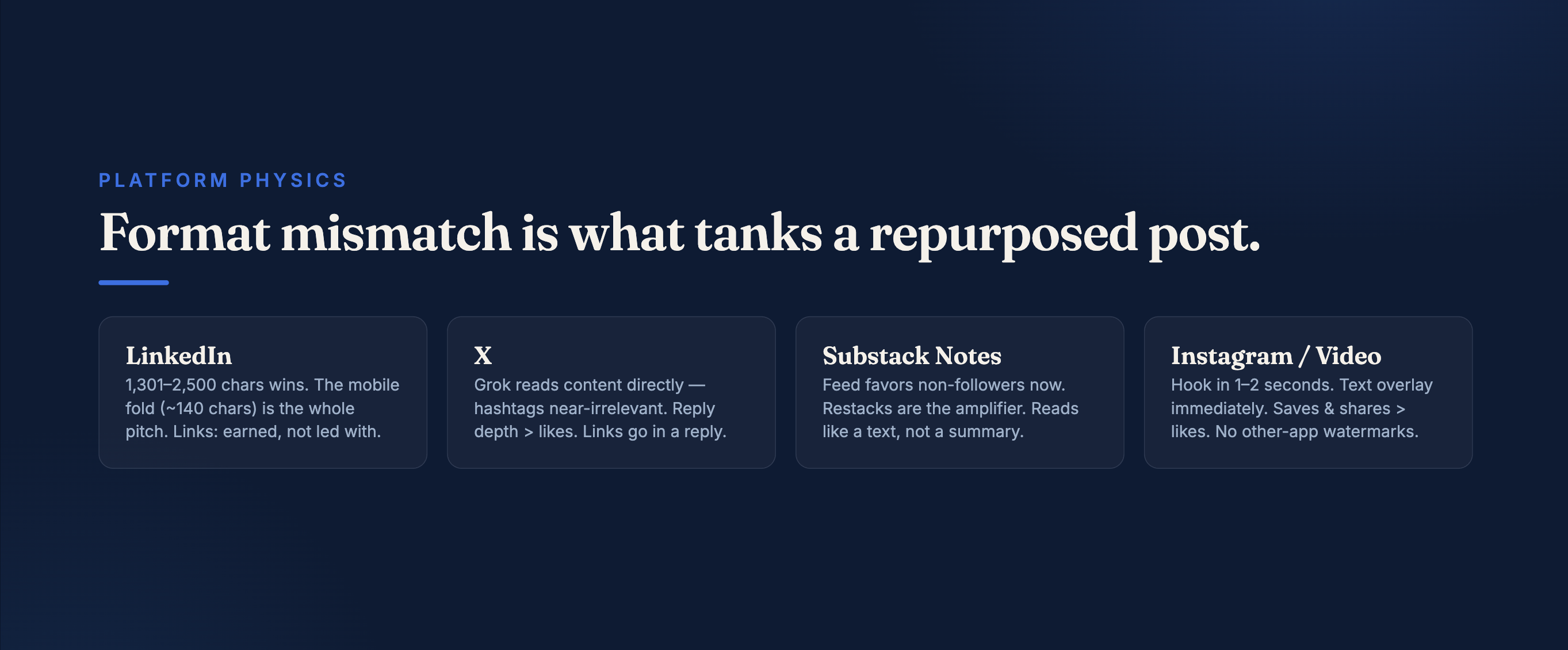
Practical upshot: hashtags are close to irrelevant for discovery now. The model doesn’t need them to understand what you wrote.
What the code confirms actually matters: conversation depth - reply chains, especially ones you respond to - is the strongest signal, ahead of likes.
Early velocity in the first 30–60 minutes matters enormously. And external links in the body remain a real reach cost - put them in a reply instead.
🔗 Substack Notes (your home base - treat this one differently) Substack changed this feed in the second half of 2025, and it’s the single biggest shift most creators haven’t adjusted for: the Notes feed no longer prioritizes people who already follow you. Most of what you see now comes from writers you’ve never followed - which means most of what you post can reach people who’ve never heard of you, without you doing anything extra.
Restacks are the amplifier here, not likes. A single restack from someone with real reach can outperform your last dozen Notes combined. And a Note doesn’t read like a headline - it reads like a text to a friend. Short. A little unfinished. Not a summary of the newsletter - a single thought pulled out of it.
Here’s the throughline across every platform above: the algorithm isn’t punishing you for showing up in five places. It’s punishing you for showing up the same way in all five. Native format is the entire unlock.
Which raises the obvious next question: who has time to rewrite one idea five different ways, correctly, every single week?
That’s exactly what we’re building next.
Why Most AI Repurposing Fails
Here’s a confession before I show you the system: I built the generic version first, and it was garbage.
Anyone can wire up an AI model and tell it “turn this newsletter into a tweet.” I know, because that’s basically what I did the first time I tried. And it was fine. Generic-fine. The kind of fine that reads perfectly correctly and says absolutely nothing. Completely forgettable.
Because here’s what nobody tells you about AI-repurposed content: nobody wants five more pieces of nowhere-content clogging up their feed.
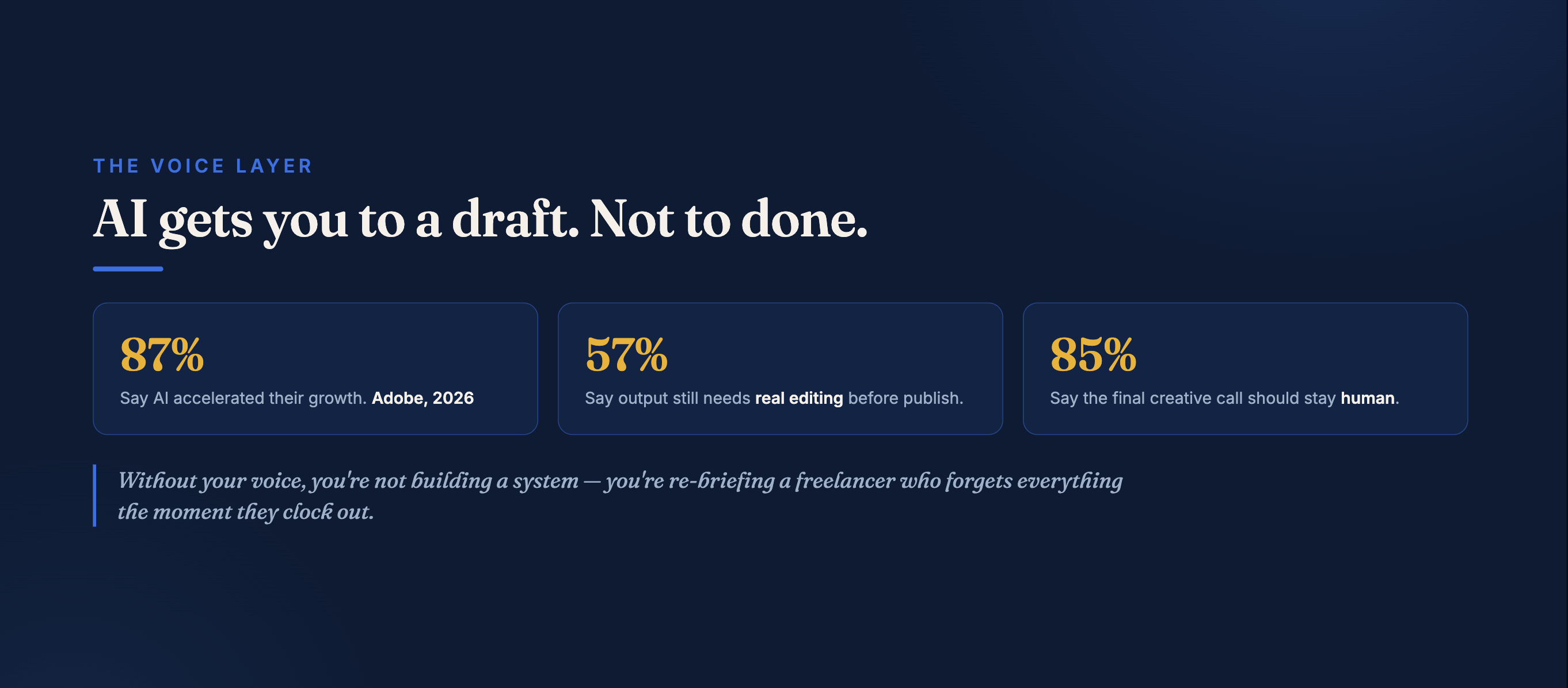
And it turns out this isn’t just my experience - it’s the industry’s, at scale. Adobe’s 2026 Creators’ Toolkit Report, surveying more than 16,000 creators across eight countries with The Harris Poll, found that 87% of creators using creative AI say it’s genuinely accelerated their business or audience growth. That’s real. AI works.
But look at the second number: 57% say the AI output still needs moderate or extensive editing before it’s ready to publish. And 85% say the final creative decision should stay with the human, not the model. AI gets you to a draft fast. It doesn’t get you to done.
(Worth naming honestly: Adobe sells the tools in this story, so read their 87% the way you’d read any vendor’s own research - a real signal, but not a neutral one.)
Here’s why that editing gap exists, and it’s the same reason my first attempt was forgettable: the model wasn’t told anything about who I am. No voice. No rules. No banned words. Just “write like a professional.”
And “professional” is exactly what everyone’s AI output sounds like right now…which means it sounds like no one.
The hard part - the part that took the most iteration when I built this properly - wasn’t teaching the tool a voice. It was teaching it my voice. Not “a professional tone.” My tone. My rules. My banned words.
That’s what a brand.md file actually is. One markdown file that acts as Claude’s operating manual for being you.
I broke down the full nine-section structure - Identity, Mission, Audience, Voice & Tone Rules, Vocabulary, Writing Samples, Formatting Preferences, Offers & Links, Hard Rules - in a previous issue, and the Writing Samples section is the single highest-leverage piece of the whole file.
Here’s the line that made this click for me: without it, you’re not building a system. You’re re-briefing a freelancer who forgets everything the moment they clock out. Fifteen-plus AI chats a week, three minutes of re-explaining who you are each time - that’s close to an hour a week just teaching a tool your own identity. Every week. Forever.
The fix is embarrassingly simple once you see it: write it down once. Banned words like “delve,” “unlock,” “leverage,” “supercharge,” “in today’s fast-paced world” - gone. Real writing samples in your actual voice - in.
📖 If you haven’t built yours yet, this is the full walkthrough: The One File That Makes Claude Write Like You
Once that file exists, the AI isn’t guessing at your voice anymore. It’s reading your operating manual. And that’s what turns “generic-fine” into something that actually sounds like you wrote it - at 2am, in five different formats, without you touching a keyboard.
Which brings us to the system itself.
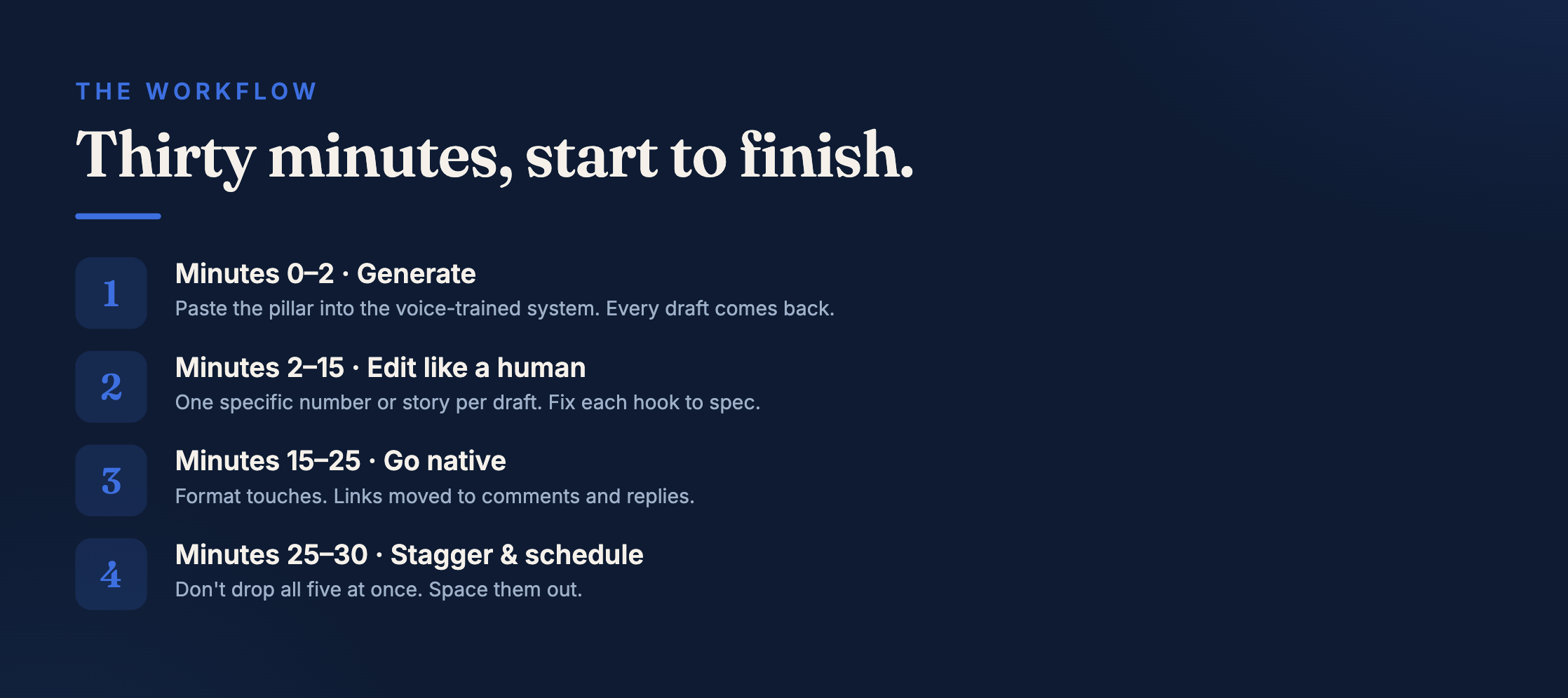
The 30-Minute Workflow
Here’s my honest framing before I show you this: this is my demonstrated workflow, not an industry benchmark.
I’m not claiming a study proved “30 minutes” as some universal number.
I’m telling you this is genuinely how long it takes me, end to end, and thirty minutes is more than enough time to do it properly.
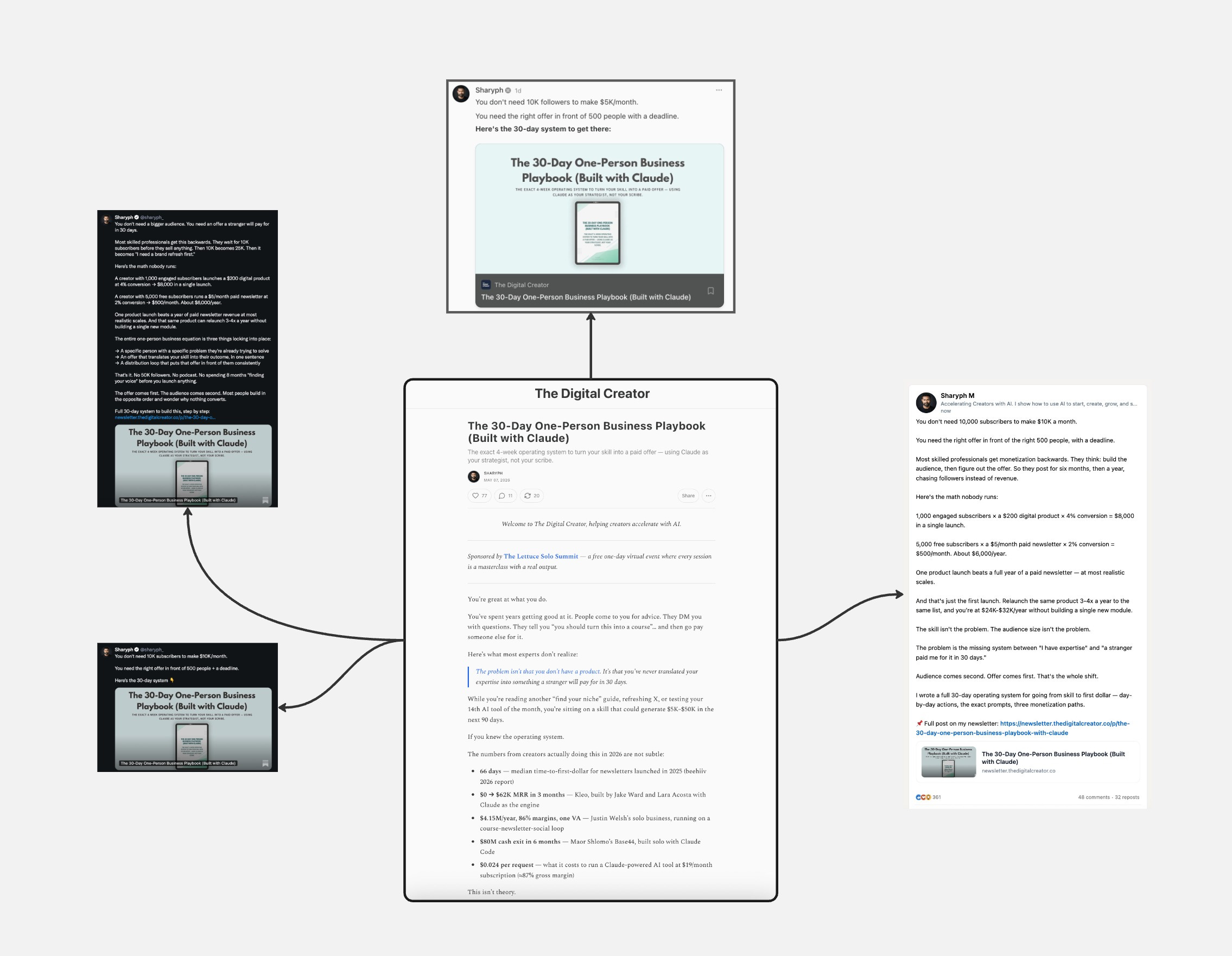
👉 Minutes 0–2: Generate. Paste the pillar - the newsletter, the link, whatever the core piece is - into the voice-trained system. Hit go. Every platform-native draft comes back in one to two minutes.
👉 Minutes 2–15: Edit like a human. This is the part that actually matters, and it’s the part AI can’t do for you. One specific number or story dropped into each draft. The hook adjusted to the exact platform spec we walked through earlier - the LinkedIn fold, the X thread opener, the Substack Note that sounds like a text and not a summary.
👉 Minutes 15–25: Go native. Format touches. A carousel or clip where it fits. Links moved out of the body and into comments or replies, the way each platform actually wants them handled.
👉 Minutes 25–30: Stagger and schedule. Don’t drop all five at once. Space them out.
That’s it. Thirty minutes, and one newsletter has become five platform-native pieces of content instead of one thing sitting in one inbox.
Here’s exactly how I built the system that does the heavy lifting in that first two-minute step.
Repurposing HQ
I named it exactly what it does. You give it one newsletter, and it hands you back a full set of platform-native content….without you touching a keyboard for the repurposing part.
Paste a Substack link, or paste raw text if the link extraction fails…it basically never fails, because raw text is always the fallback. It pulls the article, cleans it, and rewrites the core idea per platform.
It’s built on three parts, and each one solves a different problem:
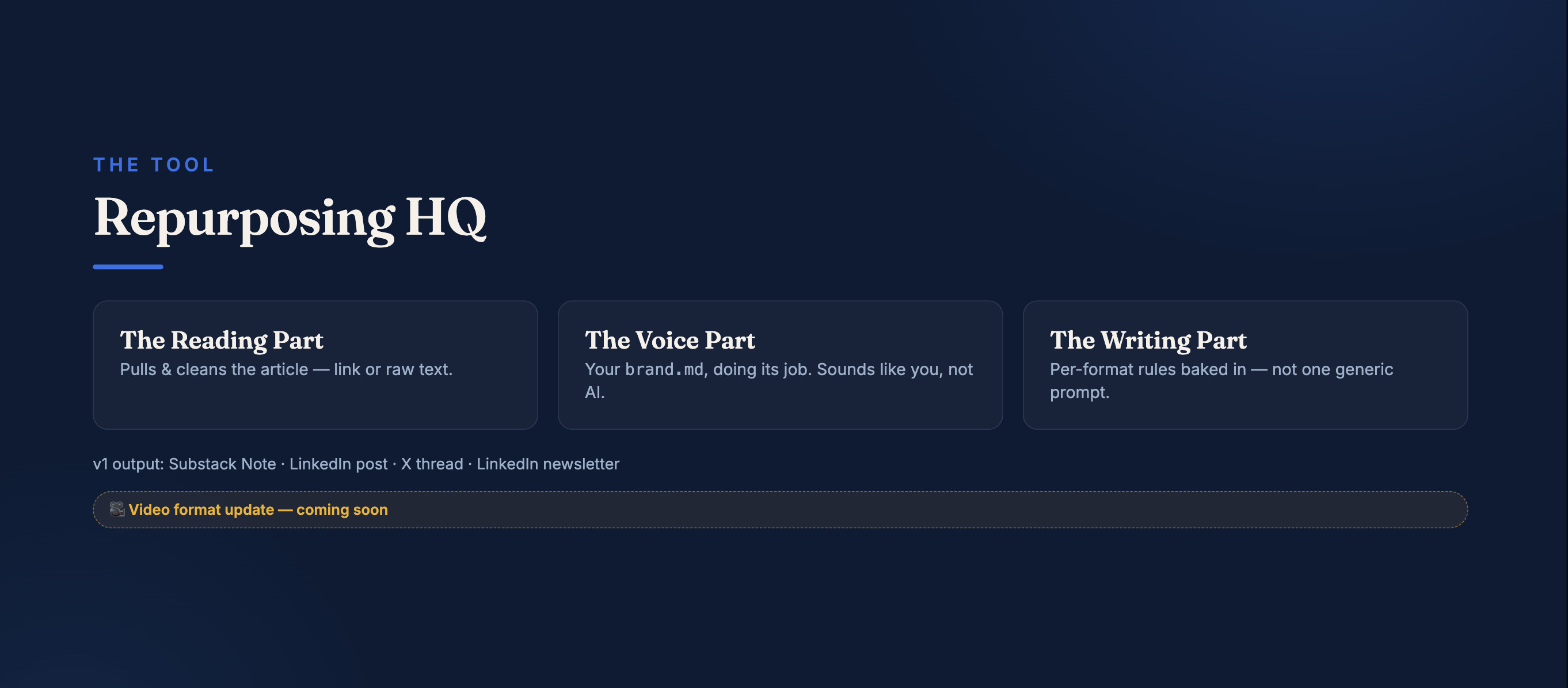
👉 The Reading Part - pulls and cleans the article from wherever it lives. Link or raw text, it doesn’t matter. This part just makes sure nothing gets lost going in.
👉 The Voice Part - this is the brand.md file we just talked about, doing its actual job. The core claim, and the one that matters most: it doesn’t sound like AI wrote it. It sounds like you did.
👉 The Writing Part - not one generic prompt for everything. Baked-in, per-format rules. X threads get a hook-first structure with a strict character limit per tweet. LinkedIn posts get built around the “see more” cutoff, because if your hook doesn’t land in the first couple hundred characters, nobody ever taps to expand it.
v2 output, formats:
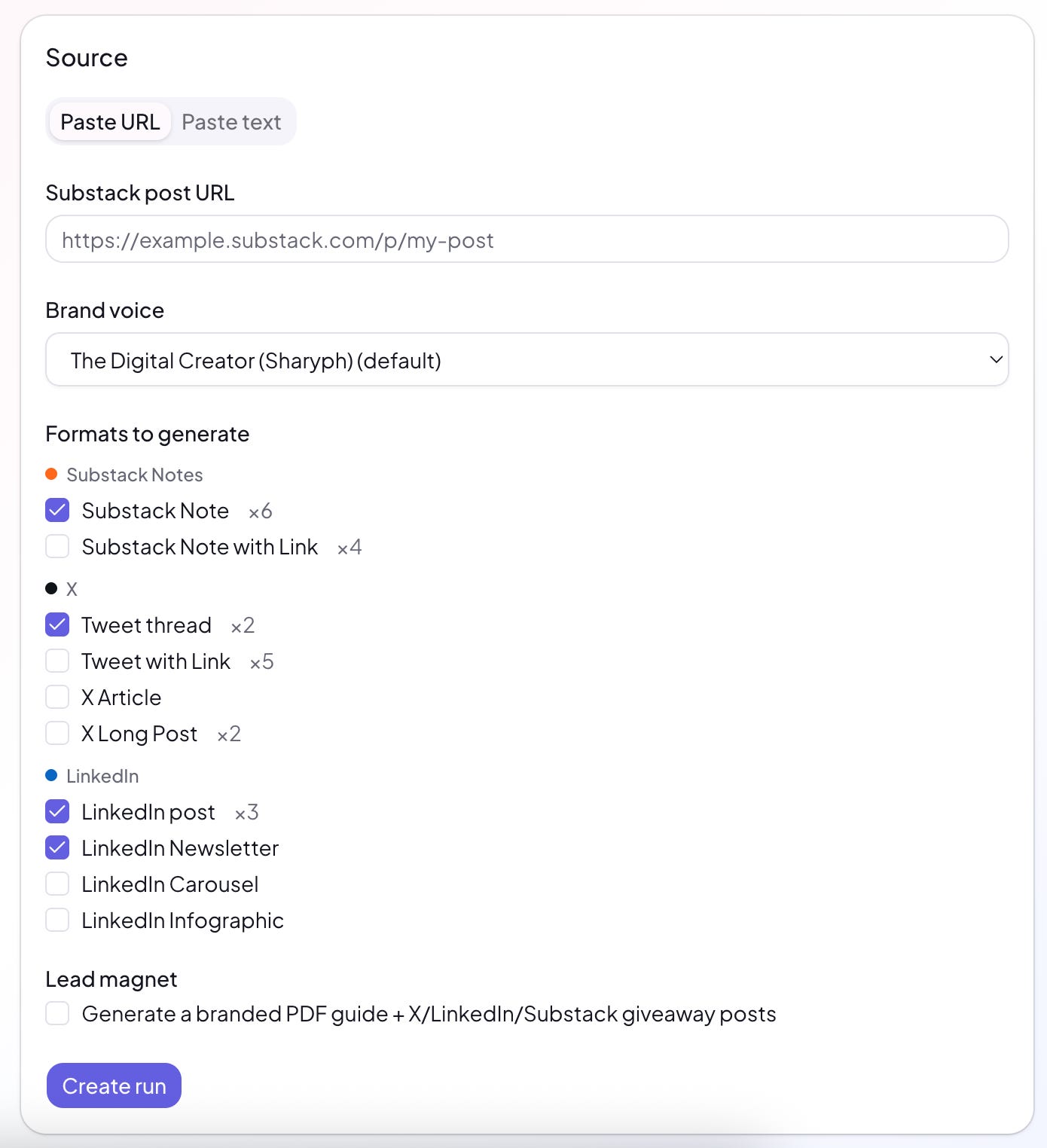
The full build - architecture, prompts, the exact iteration that got the voice right - is broken down in a previous issue if you want to go deeper on how it actually works under the hood:
📖 I Built My Own AI Repurposing Tool. Here’s Exactly How.
And this is the whole mindset shift I want you to leave this section with:
Stop thinking of repurposing as a manual chore you’ll get to eventually, and start thinking of it as a system problem. Systems get solved once. Chores get skipped forever.
Not “post more.” Not “hire a VA.” Just - take the thing you already wrote, and let a system that knows your voice turn it into everything else it should have been.
Should You Build or Buy a Repurposing Tool?
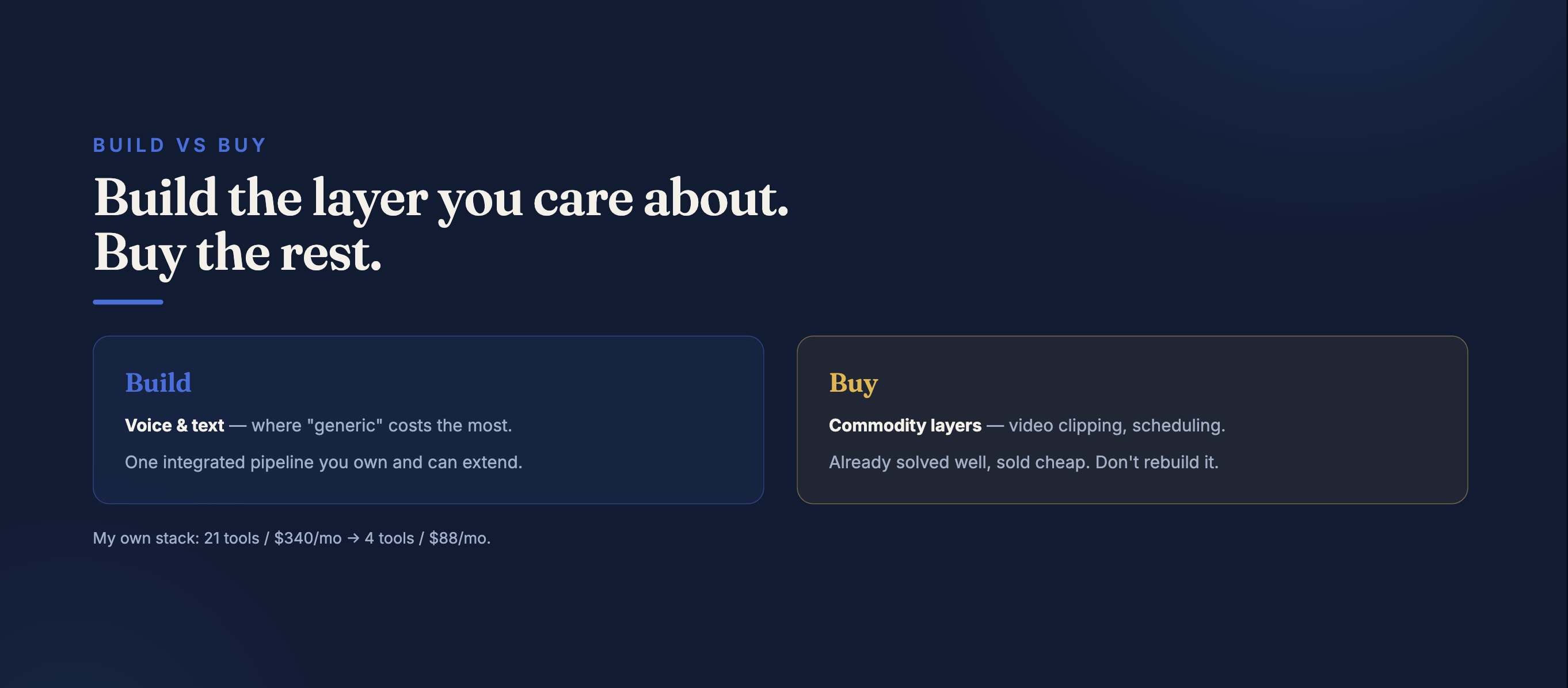
Build the layer you care most about…for most creators, that’s voice and text, since generic AI output costs you the most editing time there. Buy the commodity layers: video clipping, scheduling, anything already solved well and sold cheap. If a $15-29/month tool does the job, rent it instead of building it yourself.
Let me be upfront about my bias here, because you deserve to know it before I make the case: I built Repurposing HQ myself.
So take everything in this section with that in mind…and then let me argue against myself anyway, because the honest answer isn’t “always build.”
Here’s where I actually stand: more tools doesn’t mean more productive. My own tech stack used to be 21 tools costing $340 a month. Today it’s three - Claude, Kit, and Typefully - at $88 a month.
If I can’t explain how a tool directly generates revenue or saves me five-plus hours a month, it doesn’t make the cut. That’s the filter everything in my business runs through, and it’s the filter I want you to run this decision through too.
The case for building the voice layer:
Off-the-shelf AI repurposing tools give you “generic-fine” by default - because they don’t know your voice, only “a professional tone.” You end up editing just as much as if you’d written it yourself, except now you’re editing something that doesn’t sound like you to begin with.
There’s also the pricing shape of it. Most SaaS tools in this space run on a per-seat or per-credit model that scales against you - the more you use it, the more it costs, right when you need it most.
And there’s a quieter argument too: one integrated pipeline beats five disconnected tools stitched together with duct tape. You own the asset. You can extend it whenever you want, without waiting on someone else’s roadmap.
Even the person who coined the whole “Create Once, Publish Everywhere” model agrees this isn’t a build-only philosophy - Daniel Jacobson himself described COPE as agnostic to whether you build or buy.
So don’t mistake this section for me telling you to build everything from scratch. That’s not the argument.
The mature answer, and the one I actually live by:
✅ Build the layer you genuinely care about - for me, that’s voice and text, because that’s where “generic” actually costs me the most.
✅ Buy the commodity layers - video clipping, scheduling, anything that’s already been solved well by someone else and sold cheap.
If a $15–29/month tool already does the commodity job well, buy it. Don’t build what you can rent for less than an hour of your own time is worth.
Core + Secondary
Now I need to hand you the honest counterargument to everything in this issue - because if I don’t, this becomes hype, and hype is exactly what I promised you this newsletter isn’t.
Here’s the pushback, and it’s a fair one:
Five platforms gives you five different cultures, five different formats, five different algorithms to learn - and if you’re spreading yourself across all of them from day one, you end up with zero clean signal on any single one.
Post once a week across five different platforms, and every algorithm treats you as a casual, low-priority account on all five. You don’t build depth anywhere. You build a thin presence everywhere.
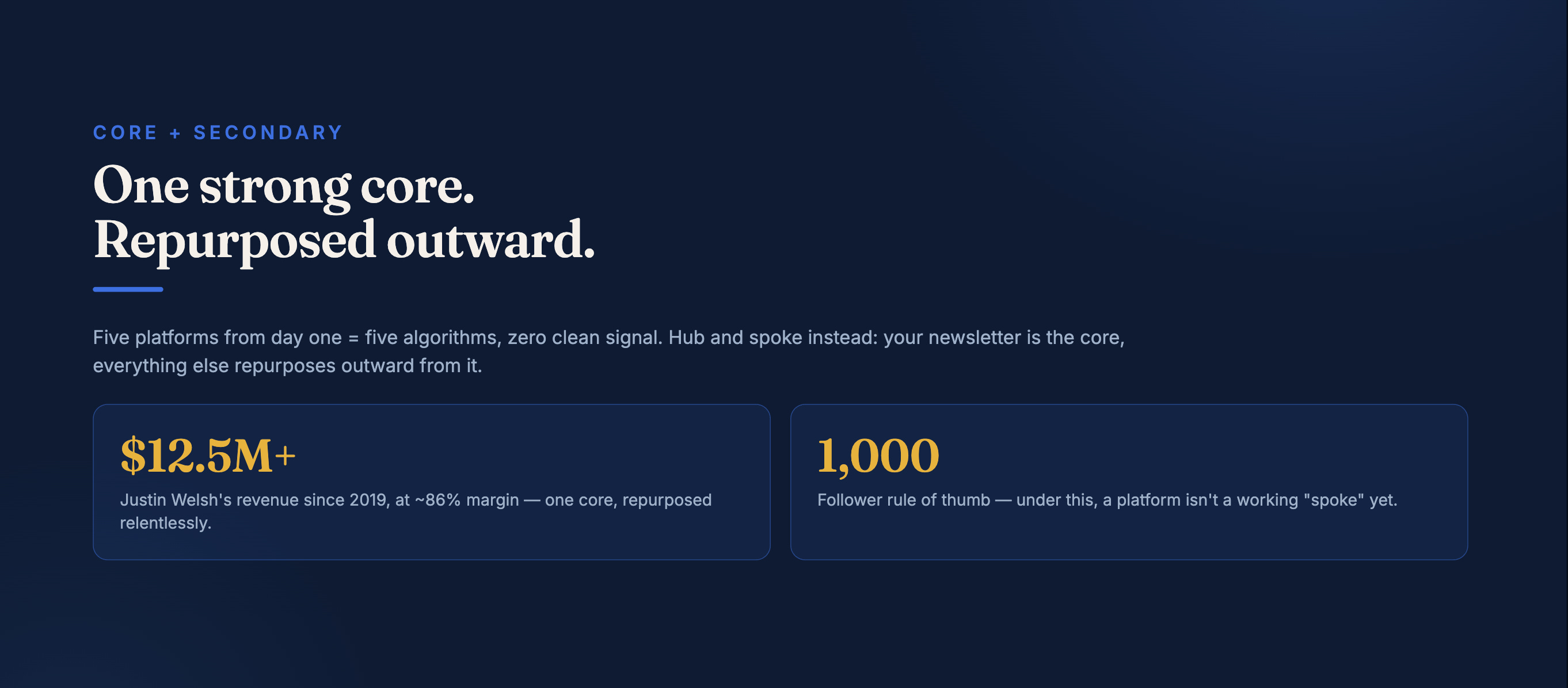
This is where the reconciling model actually matters - hub and spoke, sometimes called Core + Secondary.
One platform where the real relationship with your audience lives. Everything else repurposes outward from that core. You don’t chase presence on a platform you’ll quietly abandon in six weeks.
Look at how Justin Welsh actually built his - publicly, he calls it a Content Operating System: one newsletter, and 6–12 social pieces a week built outward from it.
His own site puts it at 500M+ yearly content impressions across LinkedIn and X, and an independent breakdown of his business puts revenue north of $12.5M since 2019, at roughly 86% margin.
That’s not five platforms run shallow. That’s one strong core, repurposed outward, relentlessly.
For you, the structure is already sitting there: the newsletter is your pillar. Substack is your home base.
Everything in this playbook - the translation rules, the workflow, Repurposing HQ - exists to take that core and extend it outward, not to replace it with five competing priorities.
A rule of thumb worth holding onto:
If you’re under 1,000 followers on a given platform, it isn’t a working “spoke” yet - it’s an experiment. Pick your core plus one genuine secondary, and go deep there before you add a third.
The honest contrarian take doesn’t undo this whole playbook. It defines the shape of it. Repurpose outward from something strong. Don’t chase presence everywhere at once.
Frequently Asked Questions
Will cross-posting the same newsletter idea get me penalized on social media?
No, not for posting the idea itself. Penalties only trigger from carrying another app’s watermark, uploading byte-identical duplicate files, or aggregating content with nothing added. A genuinely rewritten, platform-native version of your own idea has never been the problem…and even flagged accounts recover within a 30-day window.
How long does it actually take to repurpose one newsletter into five platforms?
About 30 minutes, split into four stages: 2 minutes to generate platform-native drafts from a voice-trained system, 13 minutes to edit in real specifics and adjust each hook, 10 minutes for native formatting touches, and 5 minutes to stagger publishing across the day instead of dropping everything at once.
Should I post on all five platforms if I’m just starting out?
No. Use the Core + Secondary model instead…one platform (your newsletter) as the pillar, one genuine secondary you’ll actually sustain. If you’re under 1,000 followers on a platform, treat it as an experiment, not a working spoke. Depth on two platforms beats a thin presence on five.
What should go in a brand voice file for AI content repurposing?
A brand.md file needs nine sections: Identity, Mission, Audience, Voice & Tone Rules, Vocabulary, Writing Samples, Formatting Preferences, Offers & Links, and Hard Rules. Writing Samples is the highest-leverage section…it’s what stops AI output from reading like generic “professional tone” instead of your actual voice.
We’ve come to an end. What’s the first platform you’re going to rebuild your last issue for?
Just reply to this email…I read every one.
Whenever you’re ready to take the next step:
→ The Lean AI-Powered Business Playbook for Creators - free. Start here if your pillar isn’t strong yet.
→ Premium Membership - $39/month or $150/year. Claude Skills, the AI Agents Collection, the Substack SEO/AEO toolkit, and 45% off every paid course.
→ Book a call if you are someone who wants a system like this to implement for your brand.
If you want to talk through where your content system actually stands right now, hop on a call with me - happy to help you figure out the next move.
Until next time - Sharyph | Founder of The Digital Creator
P.S. - If you build your brand.md this week, reply and tell me what your banned words list looks like. I read every one, and I’m always curious what “sounds like AI” to you specifically.
P.P.S. - Know a creator drowning in five platforms and zero system? Forward this one to them. That’s usually the moment it clicks.
One strong idea should keep working longer.
I learned the hard way that posting more does not get you anywhere. Now I focus on SEO and only post twice a day on LinkedIn with an explicit offering attached to each. It's definitely paid off more.