

Let me ask you something honest.
How long have you been posting content?
Weeks? Months? Maybe years?
And how much have you earned from it?
If there’s a gap between those two answers…you’re not alone.
Here’s what I see constantly in this space:
Creators who are genuinely talented. Writing threads. Publishing newsletters. Building audiences. Putting in real work every single day.
But the revenue? Flat. Inconsistent. Sometimes nonexistent.
And they can’t figure out why.
Here’s the truth nobody wants to say out loud:
Posting is not a business. Distribution is not a product. An audience is not income.
Until you connect those three things with a clear, structured path, you’re just spinning your wheels on a content treadmill.
I’ve been there. When I started, I had ideas. But no direction.
No clear offer. No system. Just noise.
So let’s fix that today.
Because when I looked at how creators like Justin Welsh crossed $5M in revenue, how Lenny Rachitsky built a $2M+/year paid newsletter, and how Easlo turned Notion templates into $500K+ at 20 years old…
One pattern showed up every single time.
Not luck. Not going viral. Not some secret platform hack.
A ladder.
A specific, repeatable product ladder that turns your knowledge into income…rung by rung.
And the best part?
AI now compresses every single step of that ladder.
What used to take years can now take months. What used to require a team can now run with one person and a $100/month AI stack.
That’s what this issue is about.
Today, I’m giving you the full Creator Revenue Playbook.
Here’s exactly what you’ll get:
✅ The hard truth about why most creators never earn consistently (and the data to back it up)
✅ The 4-rung product ladder that every 6 and 7-figure creator has climbed
✅ An 8-step repeatable framework you can start executing this week
✅ The AI execution layer…which tools to use, at which step, and how
✅ The reality filter…so you go in with the right expectations
This is not theory.
This is the playbook.
Let’s get into it. 👇
The Truth About Creator Revenue (Read This Before You Do Anything Else)
Before we get into the playbook…
I need to tell you something the creator economy doesn’t want you to hear.
Because if you skip this part, nothing else in this issue will land the way it should.
The Numbers Behind the Dream
You see the screenshots.
The “$10K month.” The “I quit my job.” The “passive income while I travel.”
And they’re real. Some of them, anyway.
But here’s what nobody shows you alongside those screenshots:
Gumroad…one of the biggest platforms for digital products…analyzed data from 146,271 products across 43,884 sellers.
The results?
❌ 44% of products on the platform earned exactly $0.
❌ The median product earned just 28 sales at a $13 price point…roughly $364 lifetime.
❌ The top 1% of sellers control 99.5% of all revenue on the platform.
Read that again.
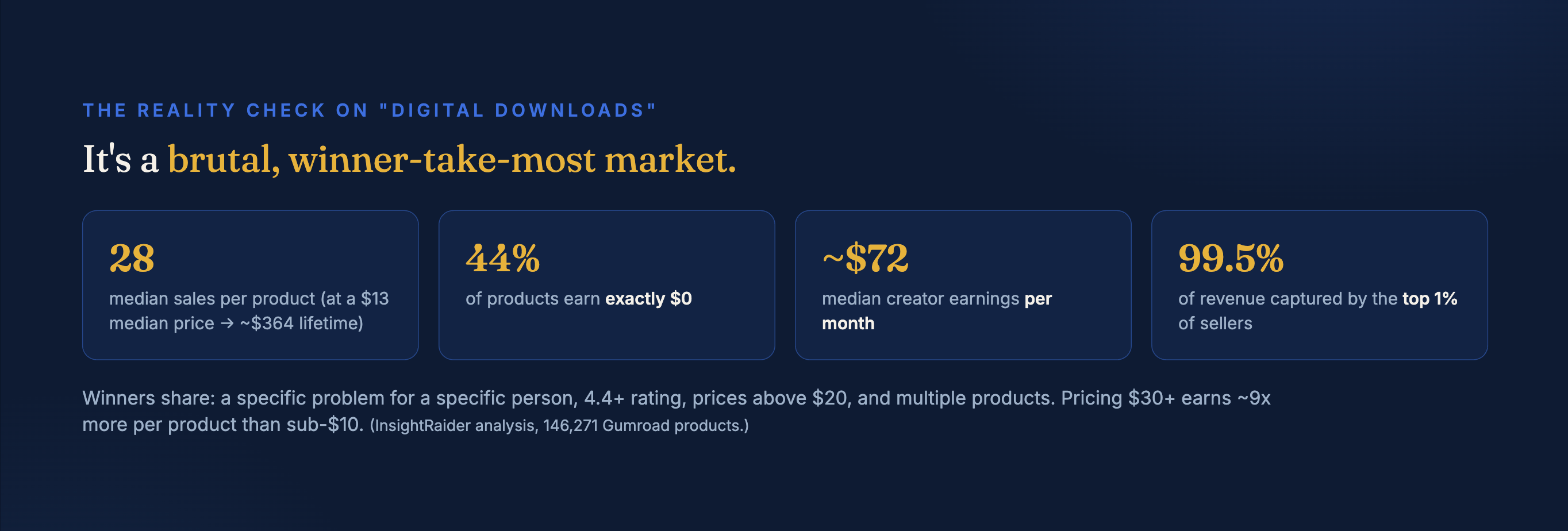
The top 1% take nearly ALL of it.
That’s not a platform problem. That’s a positioning problem.
And the creators sitting in that top 1%? They didn’t get there by just posting more. They got there by doing something structurally different from everyone else.
The Wrong Order is Killing You
Here’s the mistake I see constantly.
Creator gets inspired → Creates a product → Tries to find an audience to sell it to.
That’s backwards.
Every single 6 and 7-figure creator in this space did it the other way around.
They built an audience first.
Gave away free value until people trusted them.
Then monetized that trust with a product that solved a real, documented problem.
👉 Justin Welsh posted on LinkedIn every single day…for years…before his first course.
👉 Lenny Rachitsky wrote weekly on Substack for 9 full months before he charged a single dollar.
👉 Easlo shared free Notion templates on Twitter and Product Hunt before he ever put a price tag on anything.
The product didn’t create the audience. The audience validated the product.
That’s the order. And if you get it wrong, it doesn’t matter how good your product is.
The One Pattern That Actually Explains 6 and 7-Figure Creators
I spent a lot of time studying the creators who crossed six and seven figures.
Justin Welsh ($5M+ one-person business).
Ali Abdaal ($4.5M–$5M/year).
Lenny Rachitsky ($2M+/year from his newsletter alone).
Dan Koe (~$2.5M in 2023).
Easlo ($500K+ from Notion templates).
They are completely different people. Different niches. Different platforms. Different product types.
But strip away all of that, and the same pattern shows up every single time:
Distribution beats product type.
It doesn’t matter if you sell templates, courses, a community, or a paid newsletter.
What matters is that you built a real audience on ONE platform first…then converted that audience into income using a structured product ladder.
Justine Welsh built on LinkedIn.
Easlo and Nicolas Cole built on X.
Ali Abdaal built on YouTube.
Lenny built on Substack.
One platform. Consistent free value. A specific niche. Then a product.
That’s it.
That’s the whole game.
But Here’s the Catch
Knowing the pattern isn’t enough.
Because the real question isn’t what they did.
It’s how they did it…step by step…in the right order.
That’s what the rest of this playbook is going to show you.
And we’re going to layer in exactly how AI compresses every single step of the process.
Because the creators who figure this out right now…in 2025 and 2026…are going to climb this ladder in months, not years.
Let’s get into it. 👇
The Product Ladder: The Real Business Model Every 6 and 7-Figure Creator Uses
Here’s a question most creators never ask themselves:
“What’s the path from someone discovering me today… to them spending $500 with me in 6 months?”
If you can’t answer that question clearly, you don’t have a business.
You have a content hobby.
The creators who crossed six and seven figures didn’t get there by selling one thing to everyone.
They got there by building a ladder…a structured sequence of products that take someone from free value all the way up to premium.
And here’s the insight that changes everything:
Every rung of the ladder serves a different purpose.
The bottom rungs build trust. The middle rungs build revenue. The top rungs build real leverage.
Let me show you exactly how this works.
🪜 Rung 1 — The Entry Point (Months 0–6)
Free Lead Magnet + Low-Ticket Digital Product
This is where every creator should start.
Not with a course. Not with a community. Not with a coaching offer.
With a free lead magnet and a cheap, narrow digital product…priced between $20 and $150.
Why?
Because at this stage, nobody knows you yet.
You haven’t earned the right to ask for $500.
But you can earn the right to ask for $27 or $47…if what you’re offering solves a real, specific problem.
Here’s the proof:
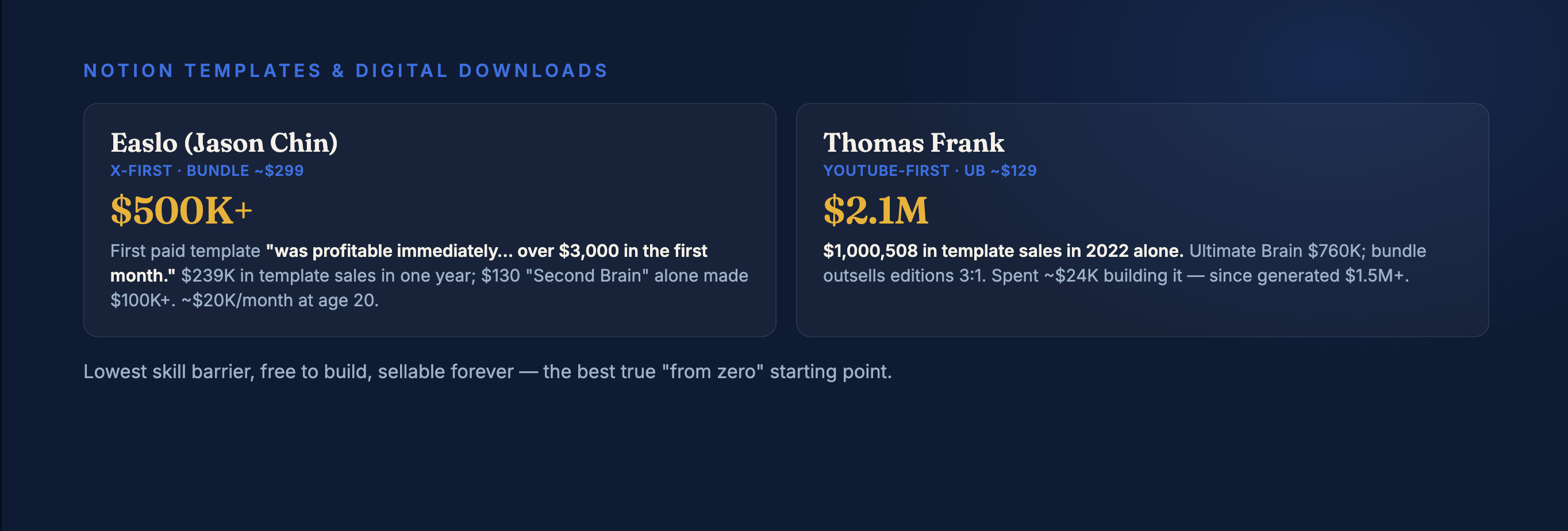
Easlo…earning $500K+ from Notion templates…started by sharing free minimalist templates on Twitter and Product Hunt. He switched from $0 to paid by literally changing the price on Gumroad. His first paid template brought in over $3,000 in the first month.
He didn’t start with a $297 course.
He started with a $0 template. Then a $19 template. Then a $130 template. Then a $299 bundle.
Rung by rung.
What belongs on Rung 1:
✅ A free lead magnet (a guide, checklist, mini-playbook, or template)
✅ A low-ticket digital product ($20–150): a Notion template, ebook, prompt pack, mini-guide, or quick-start toolkit
✅ Published on a simple platform: Gumroad is perfect here (no upfront cost, built-in checkout, handles global payments)
The benchmark to move up: Your first 10 sales. Or 100+ email signups from your lead magnet. Either signals enough trust to build the next rung.
💡 I’ve used Gumroad for most of my product launches — 700+ sales, zero ads. It works because it removes every barrier between you and your first dollar.
🪜 Rung 2 — The Leverage Layer (Months 6–18):
Self-Paced Course ($150–500)
This is where things start to compound.
Once you have proof…once real people have paid you for something and told you it helped…you build the bigger thing.
A self-paced course. A comprehensive guide. A step-by-step system.
This is the highest-leverage product format once you have an audience. Near-zero marginal cost. 80–95% margins. And it keeps selling while you sleep.
Here’s the proof:
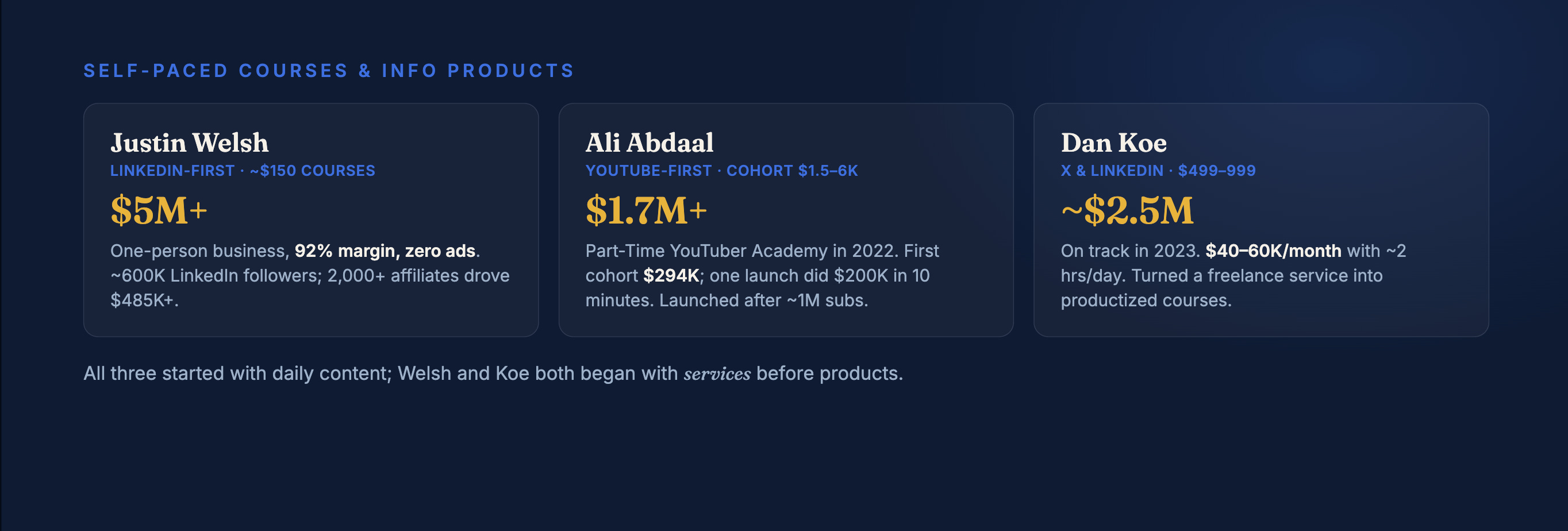
Justin Welsh built his entire $5M+ business on self-paced courses priced at around $150 each. Two courses. Simple delivery. Massive distribution.
His LinkedIn OS and Content OS courses alone generated millions…at a margin of 92%.
Dan Koe scaled to ~$2.5M in 2023 with “The 2 Hour Writer” and “Digital Economics”…courses in the $499–$999 range.
Neither of them launched these courses with zero audience.
They built trust first. Then they monetized it.
What belongs on Rung 2:
✅ A self-paced course teaching one complete system or transformation
✅ Priced between $150–500 (don’t underprice — pricing below $30 dramatically underperforms in the data)
✅ Pre-sold before it’s built — this is non-negotiable (more on this in Section 3)
✅ Delivered via a simple platform: Gumroad, Thinkific, Stan Store, or Kajabi
The benchmark to move up: Consistent monthly sales + a growing list of people asking for more depth, community, or direct access to you.
💡 My AI Digital Product Builder course ($67) walks through this exact process from validating your idea to building and selling your first course with AI doing most of the heavy lifting.
🪜 Rung 3 — The Recurring Engine (Months 12–24+):
Membership + High-Ticket Cohort
This is where six figures becomes the floor, not the ceiling.
Because here’s the math nobody talks about:
Six-figure creators on Kajabi average just 309 paying customers.
Not 10,000 followers. Not 50,000 email subscribers.
Just 309 people who paid for something.
Read that again.
At $39/month, 309 people is $12,051/month. That’s $144,612/year.
From 309 customers.
That’s the power of recurring revenue. And that’s why the third rung — a community or membership — is where everything shifts from income to a business.
Here’s the proof:
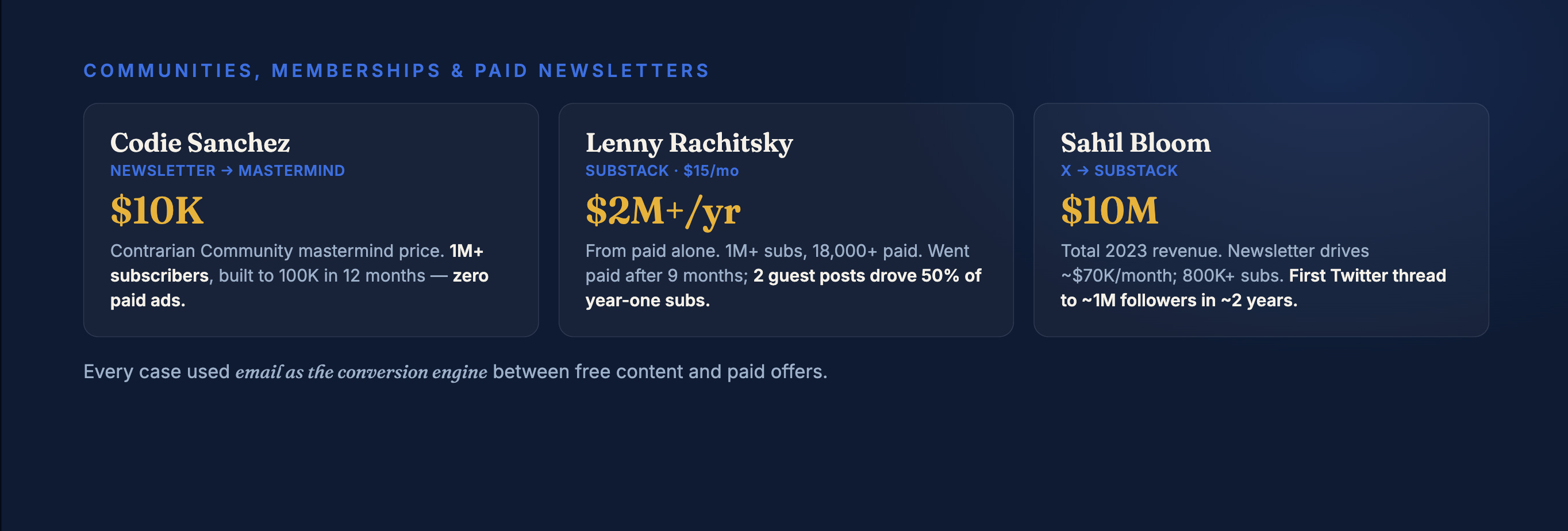
Lenny Rachitsky started with a free newsletter and a small paid tier. Nine months of weekly writing before he charged a dollar. But once he built the recurring layer, he scaled to $2M+/year from paid subscriptions alone.
Codie Sanchez built the Contrarian Community mastermind at $10,000/year. Dickie Bush and Nicolas Cole’s Premium Ghostwriting Academy crossed $3M in revenue in its first year, built entirely on top of the audience and trust they’d built at Rung 1 and 2.
What belongs on Rung 3:
✅ A membership or community ($10–50/month on Skool, Circle, or Substack) — recurring revenue that compounds every month
✅ A cohort-based course or mastermind ($750–$10,000) — live, high-touch, and your highest-ticket offer
✅ These require real audience and existing proof from Rungs 1 and 2 — don’t try to launch here from zero
The benchmark to keep scaling: Consistent recurring revenue + customers asking for even more direct access, which signals your next high-ticket tier.
💡 This is exactly what my Premium Membership does — giving subscribers 45% off all courses, access to premium Claude Skills, AI agents, and a direct community. Priced at $39/month or $150/year.
🪜 Rung 4 — The Flywheel:
Your Email Newsletter as the Owned Bridge
This isn’t a product rung.
It’s the glue that holds every rung together.
Every single creator in this study…Lenny, Welsh, Sahil Bloom, Easlo, Nat Eliason, Codie Sanchez…used email as their conversion engine.
Not social media.
Not DMs.
Email.
Social platforms distribute your ideas. Email converts them into revenue.
Here’s how the flywheel works:
→ You post free value on ONE platform (X, LinkedIn, YouTube, or Substack)
→ That content drives people to your lead magnet
→ Lead magnet grows your email list
→ Email list converts into Rung 1 buyers
→ Rung 1 buyers become Rung 2 buyers
→ Rung 2 buyers become Rung 3 members and community
→ The community generates testimonials and word-of-mouth that feed back into your social content
And the loop keeps compounding.
This is not a launch strategy.
This is a living system that earns every single day — with or without you posting.
Tools for Rung 4:
✅ Kit (formerly ConvertKit) — best for creators selling products (automation, sequences, tags)
✅ Beehiiv — great for newsletter-first creators focused on growth and ad revenue
✅ Substack — best for discovery network effects (but takes a 10% fee on subscriptions)
The Full Picture: What the Ladder Actually Looks Like
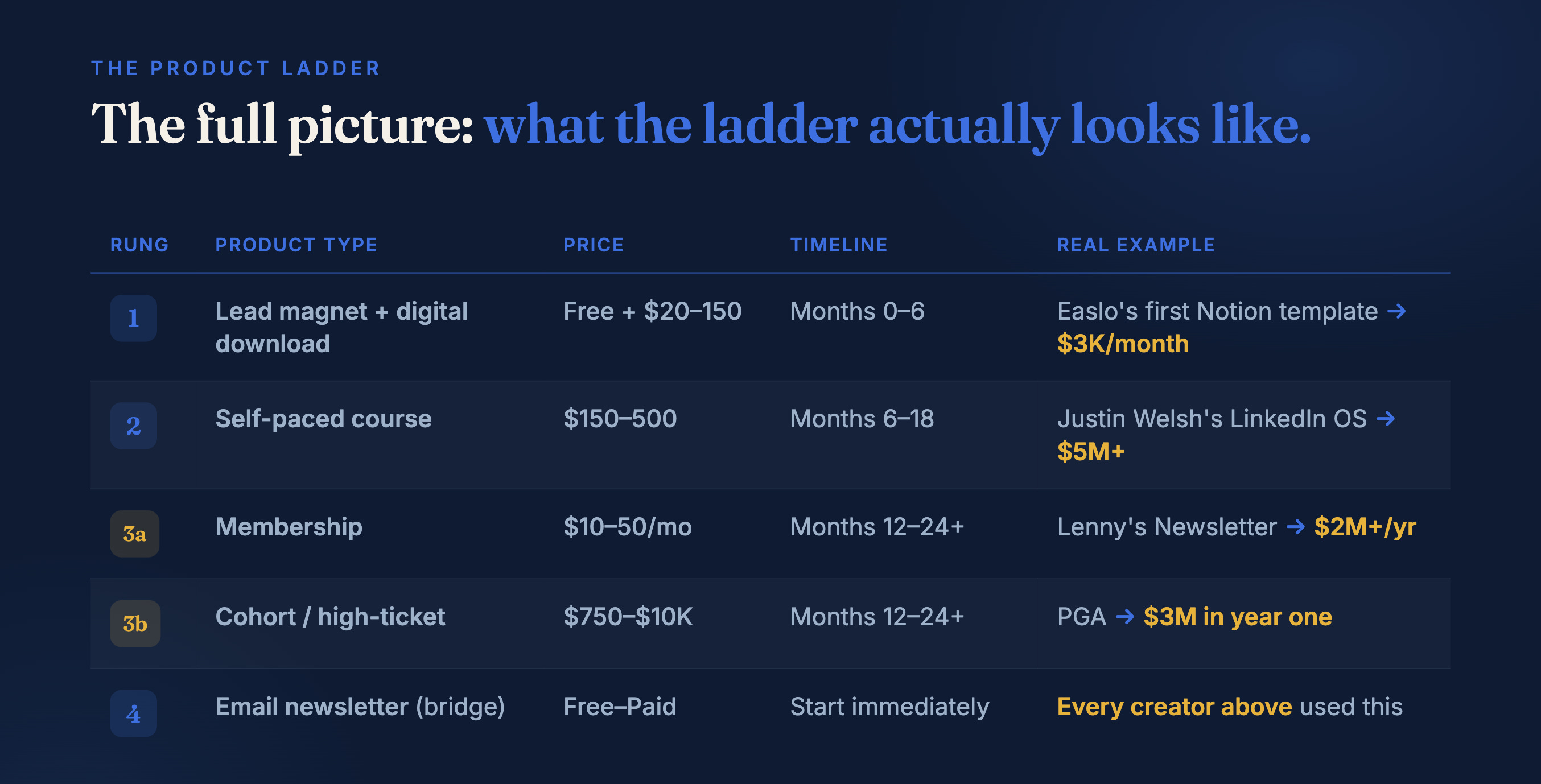
The ladder only works in one direction.
You can’t skip rungs.
Trying to launch a $5,000 mastermind with no audience is like trying to climb a ladder starting from the third rung — there’s nothing under you.
But when you build it rung by rung?
Every step you take upward is supported by everything below it.
Trust compounds. Revenue compounds. The product ecosystem compounds.
And with AI compressing every step of the building process — you can climb this ladder faster than any creator who came before you.
That’s what we’re covering next. 👇
The 8-Step Repeatable Framework: From Zero to Your First $10K
You now know what the ladder looks like.
Now let’s talk about how to actually climb it.
Because knowing the destination is not the same as knowing the route.
This 8-step framework is pulled directly from studying the creators who built to six and seven figures. Strip away the different niches, the different platforms, the different personalities…
And this exact sequence shows up every time.
Let’s walk through it step by step.
Step 1 — Choose a Niche (Specific Outcome × Specific Person)
This is where most creators make their first…and most expensive…mistake.
They go too broad.
❌ “I help entrepreneurs.” “I write about productivity.” “I cover AI tools.”
That’s not a niche. That’s a category.
A niche is a specific outcome for a specific person.
Here’s the formula: Who + Problem + Outcome = Your niche positioning.
Look at how the best in this space did it:
Tiago Forte started with: “I help people organize their Evernote without tags.” Not “productivity.” Not “note-taking.” Organize Evernote without tags.
Justin Welsh started with a hyper-specific audience…burned-out healthcare sales executives…before expanding.
Lenny Rachitsky deliberately kept his focus on product management for consumer tech companies before eventually broadening.
They started painfully specific.
Then they expanded.
Not the other way around.
Your niche test: Fill in this sentence right now.
“I help [specific person] who struggles with [specific pain] to achieve [specific outcome].”
If you can’t complete that sentence without using words like “entrepreneurs,” “professionals,” or “people who want to grow”…you need to go narrower.
Use Claude to run the Skill Monetization Matrix exercise — it surfaces your monetizable skills, maps them to audience pain points, and helps you find the intersection where your expertise meets real demand.
The Sahil Bloom “10-year test”: Before you commit to a niche, ask yourself…can I still see myself talking about this in 10 years?
If the answer is no, keep narrowing until you find something that genuinely energizes you. Excitement is more sustainable than discipline alone.
Step 2 — Validate Before Building
I’ve built products that felt perfect in theory.
Complete with branding, a landing page, even a full email sequence.
Then I launched…
And sat in silence, refreshing Stripe.
Zero sales. Zero feedback. All that effort wasted.
It was painful…not because I failed…but because I realized I had skipped the one step that would have saved me everything: validation.
Here’s the truth about validation that most creators get wrong:
❌ Getting likes on your idea post is NOT validation.
❌ Someone saying “I’d totally buy this!” is NOT validation.
❌ Positive survey responses are NOT validation.
That’s interest. Not intent.
Real validation only happens when someone commits something that costs them.
Their money. Their email. Their time. A DM saying “send me the link now.”
The three fastest validation methods:
Method 1 — The Pre-Order Tweet (Nat Eliason’s approach)
Tweet your course idea with a simple landing page and a price. Nat Eliason did this for his AI app-building course and collected $200,000 in pre-orders in a single week. The tweet was the test. The demand was already there.
Method 2 — The $50 PayPal Pot (Dickie Bush’s approach)
Dickie Bush launched Ship 30 for 30 as a $50 accountability deposit in a Slack channel. Six days after the launch tweet, 50 people had joined. That $50 was real commitment — not a like, not a comment. Real money, real signal.
Method 3 — The “3 Buyers” Rule (Lenny Rachitsky’s approach)
Before building anything, find 3 people who will say: “Yes, I will pay for this. Send me the link.” Not “that sounds cool.” Not “maybe.” Three firm commitments. If you can’t find 3, the offer needs work.
The key question to ask after any validation test:
Did I get commitment — or just compliments?
Compliments are cheap. Commitment is gold.
💡 Want the full validation system?
My AI Digital Product Builder course ($67) walks through the exact process I used to validate Twitter Success Mastery before writing a single word of it…and how to use Claude and Reddit data to find real demand signals in under an hour.
Step 3 — Build Your Audience on ONE Platform
Choose one. Not two. Not three.
One.
Every creator who scaled to six figures picked ONE primary platform and went all-in on it before expanding anywhere else.
Welsh chose LinkedIn. Daily posts. For years.
Easlo chose X. Free templates shared consistently.
Ali Abdaal chose YouTube. First 50 videos were “for him,” not the algorithm.
Lenny chose Substack. One post per week, every single week.
The platform you choose should match your medium:
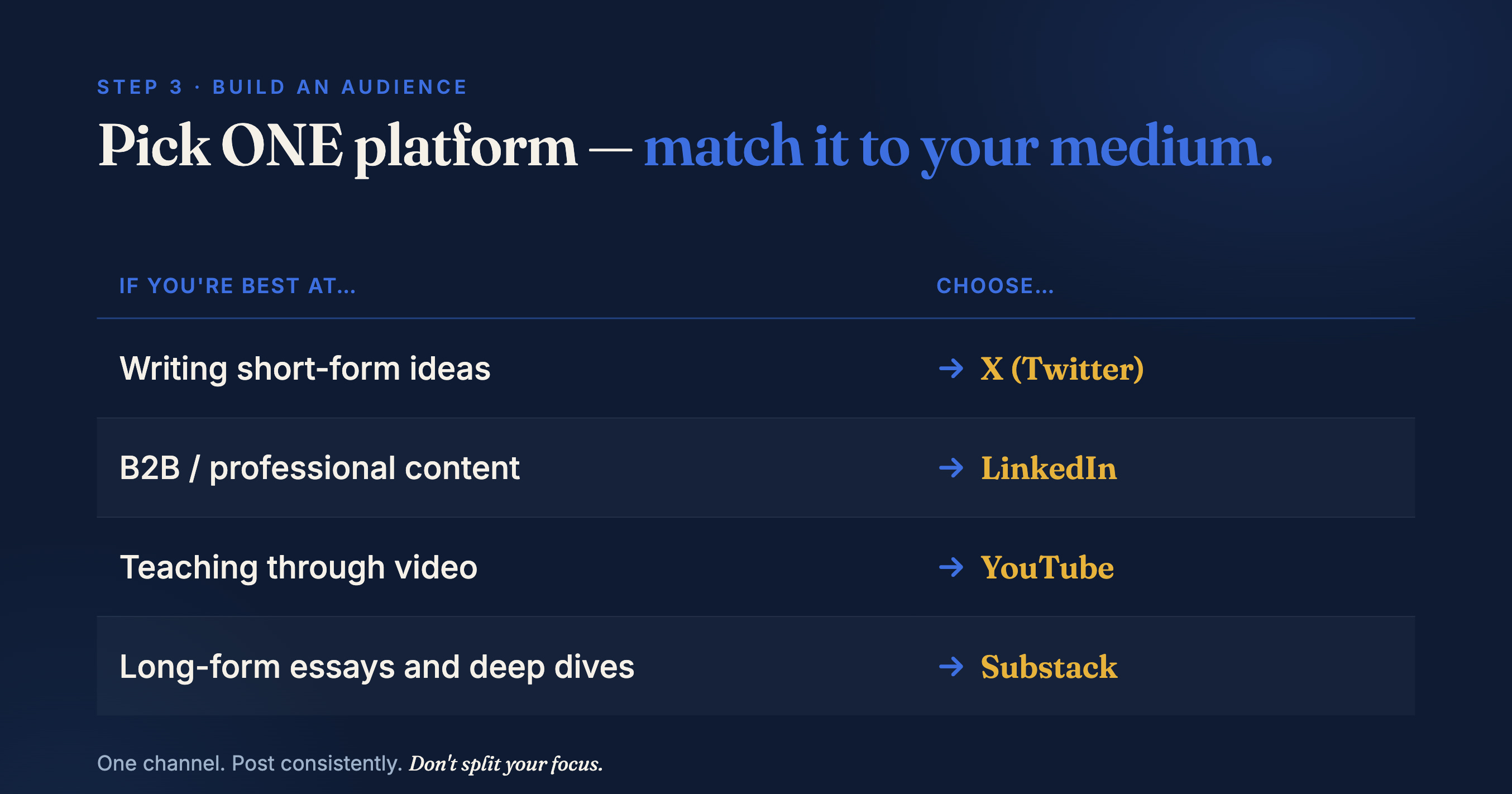
The benchmark before you monetize: ~1,000 engaged followers or 500 email subscribers. That’s not a magic number…it’s a trust signal. It means enough people care about what you say that some of them will pay for what you build.
And remember: you’re not posting for the algorithm.
You’re posting to document your journey, build trust, and create a body of evidence that you know what you’re talking about.
Ali Abdaal called his first 50 videos practice. Not content. Practice.
Give yourself that same permission.
Step 4 — Create the MVP (Minimum Viable Product)
Here’s where most creators over-engineer.
They want it perfect before they launch it.
Wrong.
Done beats perfect. Every single time.
The MVP rule is simple: solve ONE problem completely. Not five problems partially. One problem, completely.
Look at how the best kept it tight:
Justin Welsh’s courses are 2–3 hours long and priced around $150. Not 40-hour deep dives. Focused, specific, complete.
Thomas Frank’s “Ultimate Brain” Notion template had one job…replace your fragmented productivity system with one organized workspace. One outcome. $129. Generated $760K in a single year.
My AI Digital Product Builder course was built around one promise: discover your monetizable skill, Validate demand, Build your product, and Launch it.
The MVP test: Can you describe what your product does in one sentence? If it takes a paragraph to explain what your product covers, it’s too broad.
The build-with-AI shortcut:
You don’t need weeks to build your first product. Using Claude, you can:
→ Draft a 30-page ebook or guide in a weekend
→ Build a Notion template in an evening
→ Create a prompt pack or toolkit in a few hours
The goal isn’t a masterpiece.
The goal is a useful, specific, complete solution to one real problem.
Step 5 — Price With Confidence
This one is uncomfortable for most creators.
So let me give you the data instead of opinions.
Gumroad’s analysis of 146,271 products showed that pricing a product at $30+ correlates with roughly 9x more revenue per product than pricing it under $10.
9x. Not 9%. Nine times.
Underpricing doesn’t attract more buyers. It attracts the wrong buyers…people who don’t value the transformation enough to implement it.
The pricing principles that work:
✅ Price for the transformation, not the hours. A $47 guide that saves someone 3 months of trial and error is worth $47. A $150 course that helps someone land their first client is worth $150. The value is the outcome — not the page count.
✅ Feel a little uncomfortable with the price. Lenny Rachitsky’s rule: if the price doesn’t make you slightly nervous, it’s probably too low.
✅ Use bundles to raise average order value. Thomas Frank’s bundle outsold his individual products 3 to 1. When you give buyers a clear upgrade path, many of them take it.
✅ The $30 floor. Never price a digital product below $20. The data is clear. Price above $30 and your revenue per product jumps dramatically.
Step 6 — Launch Like an Event
Here’s the difference between posting a product link and actually launching.
A post is: “Hey, I just made this thing. Here’s the link.”
A launch is a structured sequence that builds anticipation, creates urgency, enlists early supporters, and makes buying feel like getting access to something special.
The launch sequence that works:
Week before: Tease the problem your product solves. Share the story behind why you built it. Create anticipation without revealing the product.
Launch day: Announce the product with your best hook, a clear transformation statement, social proof if you have it, and a time-limited early-bird price or bonus. Lenny used a 48-hour discount window. That deadline matters more than you think.
Days 2–5: Share a piece of the product content as free value. Address objections. Share a customer win or testimonial. Each email and post gives people another reason to act.
The Educational Email Course (EEC) funnel — Ship 30’s approach:
Build a short email sequence that teaches something genuinely useful related to your product. At the end of each email, a soft CTA to the product. This sequence runs forever… every new subscriber enters it automatically, whether you launched two years ago or yesterday. It’s the difference between a launch and a permanent sales engine.

💡 I covered how to build this kind of automated email funnel in detail in the AI Digtial Product Builder The system does the selling while you keep creating.
Step 7 — Get Your First 10 → 100 → 1,000 Customers
This is where most creators get impatient.
They launch. They get 3 sales. They declare it a failure and pivot.
Don’t do that.
The path from 0 to 1,000 customers is not a straight line. It’s three distinct phases with three distinct strategies.
First 10 customers…your existing network:
Don’t start with ads. Don’t start with cold outreach.
Start with the people who already know you. Reply to comments. Send DMs to engaged followers. Post in communities where your ideal buyer hangs out. Your first 10 sales come from people who already trust you enough to take a chance.
First 100 customers…consistent content + lead magnet + email nurture:
This is where your flywheel kicks in.
Consistent posts → lead magnet downloads → email subscribers → nurture sequence → product sales.
Lenny’s first two guest posts drove 50% of his first-year subscribers.
Codie Sanchez appeared on ~10 podcasts in two weeks and drove hundreds of new subscribers.
Go where your audience already is…and bring them back to your list.
First 1,000 customers…referrals, affiliates, and platform discovery:
Justin Welsh built an affiliate program with 2,000+ affiliates that generated $485,000+ in revenue.
Substack Recommendations drove 78% of Lenny’s new subscribers at scale.
Your best customers become your best salespeople…if you make it easy for them. Set up an affiliate program on Gumroad. Ask happy buyers to share. Make the product so good that word-of-mouth does the heavy lifting.

💡You can learn all these inside my AI Digital Product Builder
Step 8 — Scale Into the Ladder
Once you have consistent sales at Rung 1 or 2, it’s time to add the next rung.
This is where the compounding really kicks in.
Not because you worked harder.
Because you built a system that works whether you’re online or not.
The scaling moves that matter most:
✅ Add an upsell immediately after purchase.
Justin Welsh’s one-click upsell became a $22K/month recurring product. When someone buys your $47 guide, show them your $150 course right after. The conversion rate on post-purchase upsells is significantly higher than cold traffic.
✅ Turn your best content into a recurring community.
Once you have 100+ buyers, launch a membership. Even at $15/month, 100 members is $1,500/month in predictable recurring revenue. That changes your entire relationship with money and stress.
✅ Reinvest into free content.
Sahil Bloom’s lesson: treat your free content as a “cost center” that feeds your revenue engine. The more value you give away publicly, the more your list grows, the more your products sell. Free content is not a sacrifice — it’s the top of your funnel.
✅ Build testimonials into your system.
After every sale, follow up and ask for a result. A single specific testimonial (”I made my first $500 online using this guide in two weeks”) is worth more than any paid ad.
The 8-Step Summary
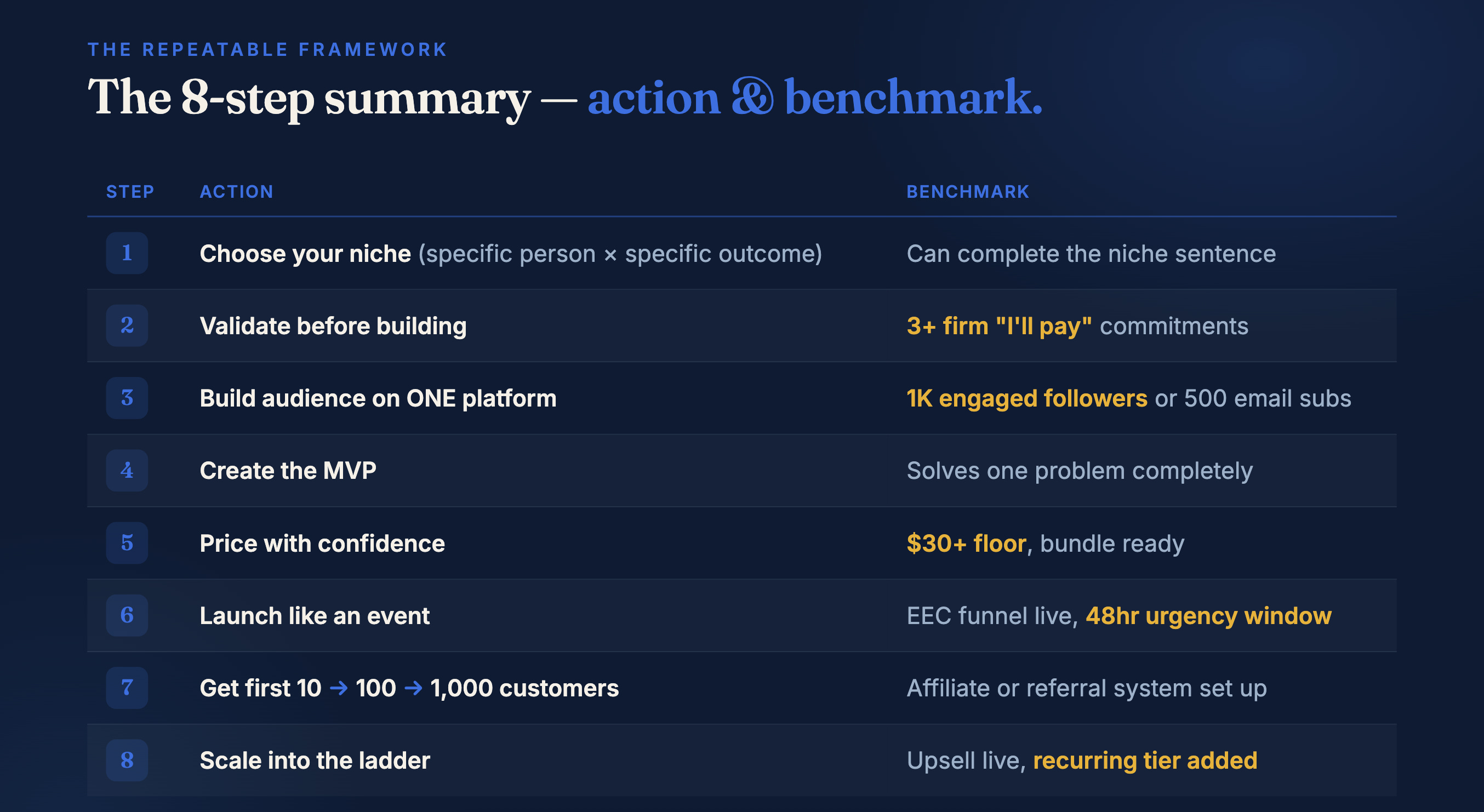
This is the framework. Eight steps, proven pattern, real results from named creators who did exactly this.
But here’s where it gets interesting for you specifically.
Because every single one of these steps…niche research, validation, building, launching, scaling…can now be done faster and leaner with AI.
That’s exactly what we’re covering in the next section. 👇
The AI Execution Layer: How to Compress Years into Months
Let me tell you about two creators who used AI at very different levels.
⏩ Creator A treats AI like a search engine.
They open ChatGPT, type “write me a blog post about productivity,” copy the output, paste it directly, and wonder why it doesn’t convert.
⏩ Creator B builds an AI system.
They have a Claude Project loaded with their brand voice, their audience profile, their product context. Every workflow is saved. Every output goes through a human layer. They produce 4–5 high-quality pieces of content per week in roughly 2 hours.
Same tool. Completely different results.
The difference isn’t the AI.
The difference is how systematically you use it.
Here’s what the data shows:
Teams using AI for both creation and automation produce 75% more content per week while saving an average of 14 hours. AI-powered creators are capturing a disproportionate share of the creator economy….which hit $253 billion globally in 2025.
But here’s the part that matters most for you right now:
AI doesn’t just compress the creation process.
It compresses every single step of the product ladder we covered.
Research. Validation. Building. Launching. Scaling.
All of it…faster, leaner, with one person doing the work of a whole team.
Let me show you exactly how.
The Solo Creator AI Org Chart
Before we get into specific tools and workflows, here’s the mental model I want you to carry.
Think of your AI stack not as a collection of chatbots…but as a team.
Every great business has roles. As a solo creator, AI fills those roles for you:
Most successful solo founders spend $80–$200/month on this stack.
That’s not an expense. That’s the cost of replacing a team that would otherwise run you $10,000+/month.
AI by Task: The Exact Tool for Every Step of the Ladder
Here’s the part that most creators get wrong.
They pick one AI tool and use it for everything.
That’s like using a hammer for every job in your house…including the ones that need a screwdriver.
Different tasks need different tools.
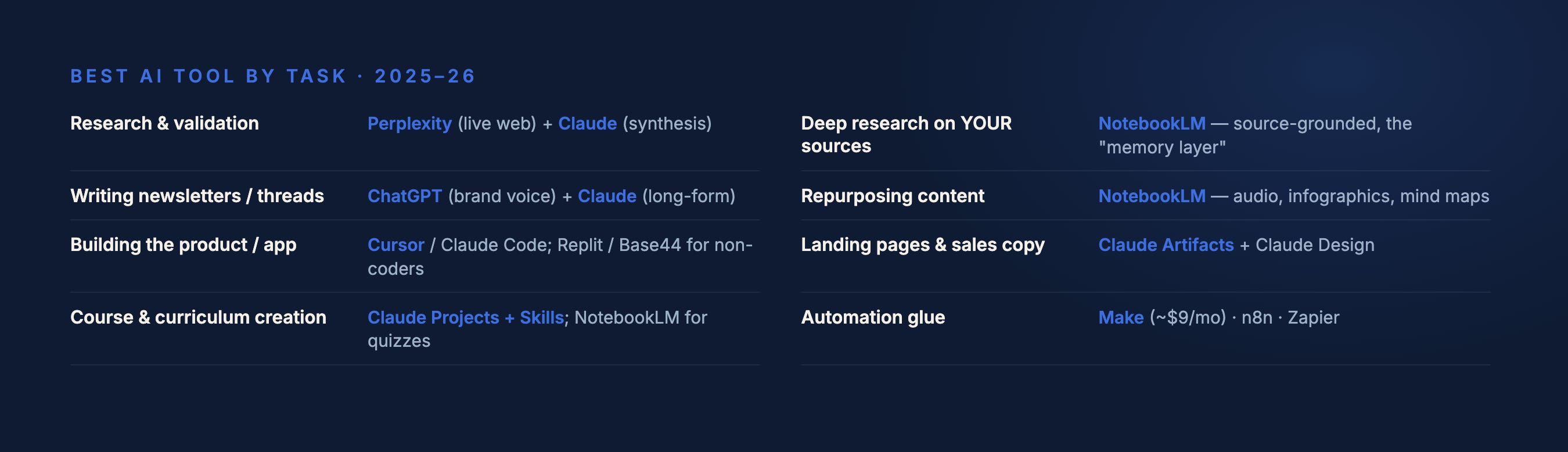
Here’s the map:
🔍 Step 1 — Niche Research & Validation
→ Perplexity for live web research: what’s trending, what’s selling, what people are asking right now
→ Claude for synthesis: “Here’s what I found…what does this tell me about positioning?”
→ Reddit + Claude for demand scanning: dump relevant Reddit threads into Claude, ask it to extract the top pain points, the exact language people use, and the solutions they’re currently buying

💡 This is literally the process I described inside the AI Digital Product Builder — with live data to validate your idea before building a single slide.
✍️ Step 2 — Content Creation (Free Value + Newsletter)
→ Claude is the best tool for long-form writing, editing, and voice consistency. Hands down.
In head-to-head tests, Claude consistently produces writing that sounds more natural and human than any other AI. Zapier’s 2026 analysis confirmed Claude “thinks strategically and offers options unprompted”...it doesn’t just execute instructions, it anticipates what you actually need.
But the key is building a system, not using one-off prompts.
The 4-layer Claude content system:
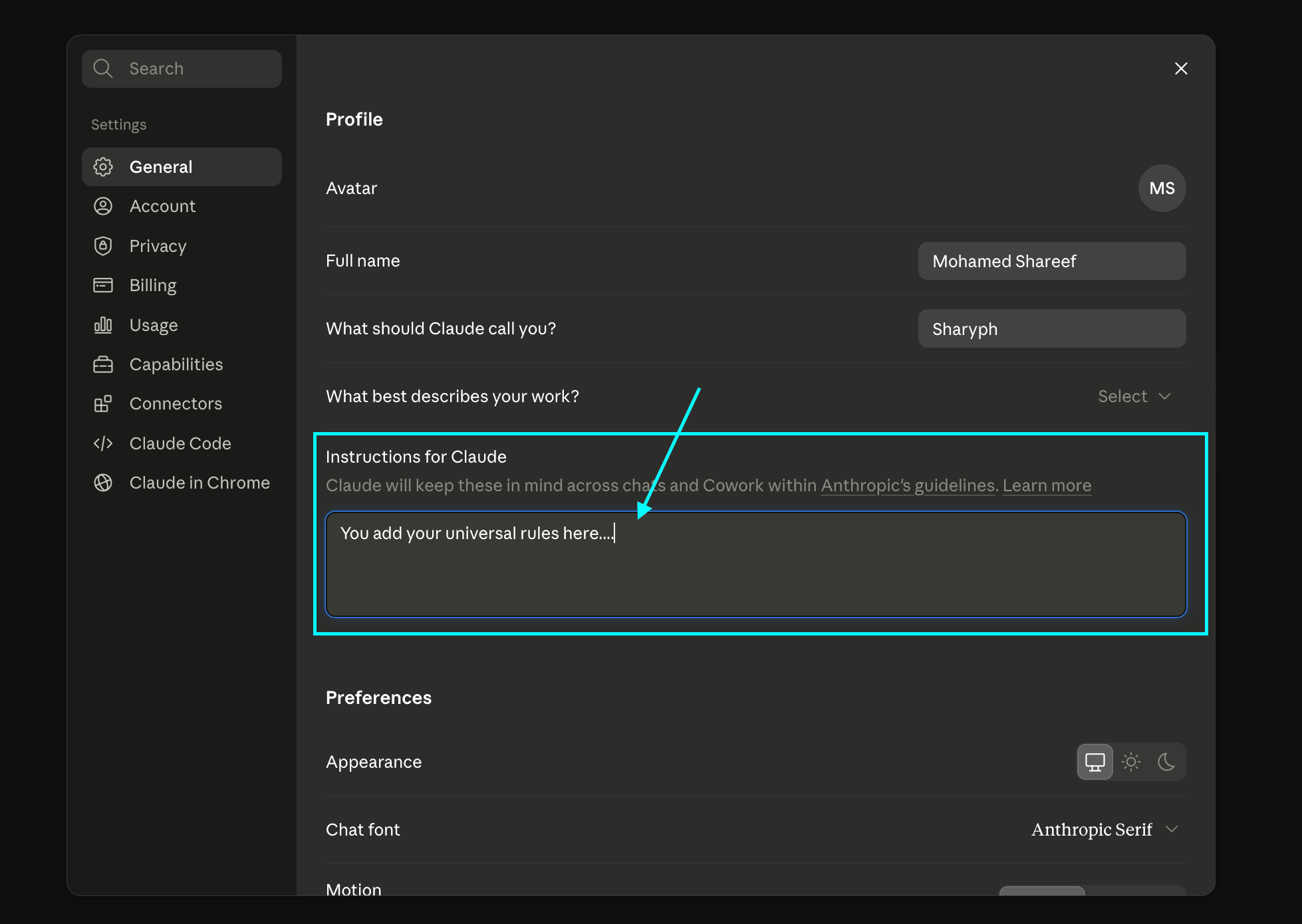
Layer 1 — Personal Preferences: Set your universal rules in Claude’s settings. Your default tone, your writing style, what you never want Claude to do. This applies to every conversation automatically.
Layer 2 — Claude Projects: Create one project per content type…newsletter, threads, product content. Each project holds your brand voice guide, your audience persona, your formatting rules. You upload these once. Every conversation in that project stays on-brand automatically.
💡 I’ve covered exactly how to set this up for your newsletter content system here: Newsletter Content System with Claude Skills
Layer 3 — Claude Skills: Build reusable workflow modules for your most repetitive tasks. A Hook Creator skill. A Newsletter Drafter skill. A CTA Writer skill. Each one is a markdown file that encodes your standards, your voice, your output format. You build it once and use it forever.
💡 Start here if you’re new to Skills: The 3 Claude Skills Every One-Person Business Needs — and if you want to understand the difference between Skills and Projects: Claude Skills vs. Claude.md — Context Engineering
Layer 4 — Automation: Connect Claude to your tool stack using n8n or Make. New subscriber joins → welcome sequence triggers.
New newsletter published → social posts auto-generated.
New product sold → delivery email fires.
💡 I built this exact kind of agentic automation workflow here: AI Agentic Workflow for Building a Substack Employee — it shows how to wire Claude into your content pipeline so the system does the distribution work while you focus on creation.
After the initial setup of 15–25 hours, this system runs on 1–2 hours per week.
I covered how to build this entire system in detail here: How I Built a Claude-Powered Operating System
📦 Step 3 — Building the Product
This is where AI becomes a genuine game-changer.
What used to take months now takes a weekend.
Here’s the proof:
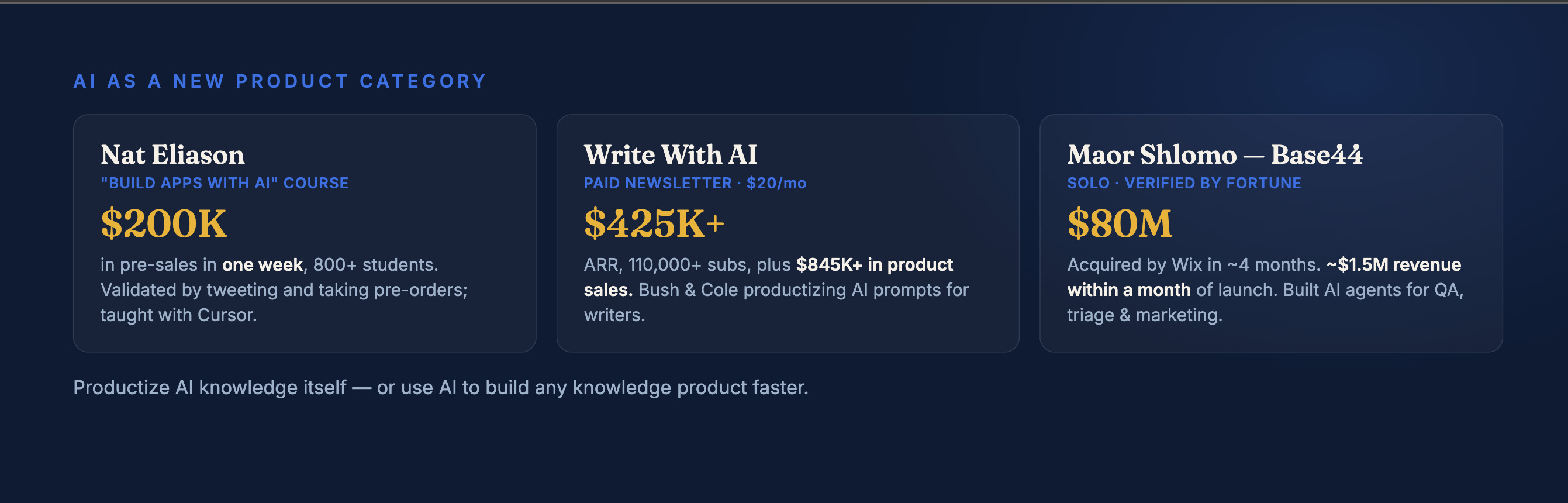
Nat Eliason went from tweet to $200,000 in pre-sales for his AI app-building course in one week.
He validated by posting, took pre-orders immediately, then used Cursor to build the actual course content at speed.
Nicolas Cole and Dickie Bush loaded their entire Category Newsletter Creator curriculum — 50,000+ words — into Claude as reusable Skills.
That curriculum has generated over $10 million in revenue. AI didn’t replace their expertise. It organized and delivered it at scale.

If you want to follow along with me, here you go 🚀
🚀 Step 4 — Launching and Selling
→ Claude for sales copy:
Landing page copy, email sequence drafts, launch tweets, and thread hooks…all in your voice, all in one project.
The key is how you prompt it. I broke down the exact prompting system that makes Claude write in your voice (not generic AI output) in The Prompting Playbook from Claude — including the specific structures that work for sales copy and launch sequences.
→ Claude Skills for the Educational Email Course:
Build the nurture sequence once, let Kit deliver it automatically to every new subscriber forever.
If you haven’t built your Skills yet, start here: The 3 Claude Skills Every One-Person Business Needs — it covers exactly which Skills move the needle first, including the ones built specifically for email and content delivery.
If you want to go deeper on how Skills and your newsletter content system connect, this one goes further: Newsletter Content System with Claude Skills.
→ NotebookLM for repurposing:
Drop your newsletter issue or product content into NotebookLM and generate audio overviews, mind maps, and social content variations from a single source.
The full repurposing workflow…how to turn one piece of content into 10 assets across platforms — is inside the 30-Day One-Person Business Playbook with Claude. It includes the exact sequence for building this into your weekly content system so repurposing stops being an afterthought and becomes automatic.
⚙️ Step 5 — Automating Delivery and Support
This is where solo creators build real leverage.
Once your product is live and your email sequences are set up, automation turns your business into a machine that runs while you sleep.
The automation flows that matter most at the start:
✅ New subscriber → welcome email → nurture sequence → product offer
✅ New product purchase → delivery email → thank you → upsell offer
✅ New newsletter published → social posts auto-drafted in Claude → queued in Typefully for review
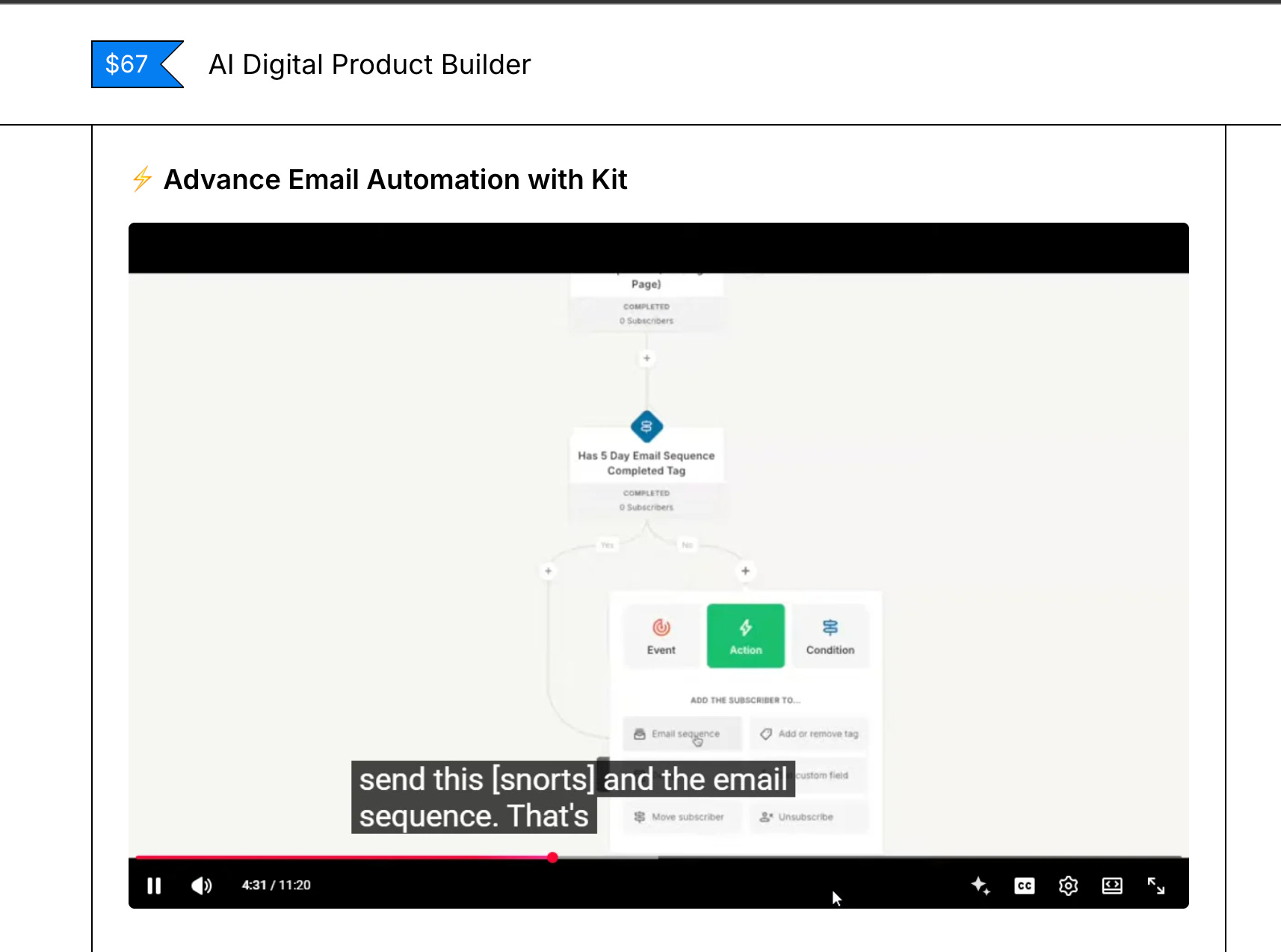
💡 Watch me doing the automation using Kit here
AI Is the New Standard — Not a Shortcut
Let me be clear about something important.
AI gives you speed.
You give it soul.
The creators who fail with AI are the ones who hand over the thinking. Who treat Claude as a ghostwriter and paste outputs without editing. Who skip the human layer entirely.
Ali Abdaal’s Head of Content said it best:
“AI is really good at giving us adequate stuff. It’s like a cover band that hits all the notes perfectly, but you’re never gonna feel that element of personality, that element of jazz.”
The human 20–30% is what makes content connect.
But that 70–80% that AI handles? Research, structure, formatting, repurposing, optimization, delivery, automation?
That used to take a team.
Now it takes one person with a $100/month stack and a clear system.
That’s not a shortcut. That’s a structural advantage.
And right now — in 2026 — the creators who build that system are going to have a gap between them and everyone else that only grows wider over time.
Don’t get left behind.
The Real Timeline (AI Compresses Execution, Not Trust)
This is the most important thing in this entire section.
Write it down.
AI compresses execution. It does not compress trust.
Here’s what I mean.
Building a product? AI cuts that from months to a weekend.
Writing your email sequence? AI cuts that from weeks to an afternoon.
Repurposing your content across platforms? AI cuts that from days to an hour.
But the time it takes for a stranger to trust you enough to give you money?
That can’t be automated. It can’t be prompted. It can’t be shortcut.
Lenny Rachitsky wrote weekly for 9 months before he charged a dollar.
Tiago Forte ran 9 cohorts before his revenue became meaningful.
AI didn’t exist when they started. So in that sense, you have a real advantage…the building is faster now.
But the trust still compounds the same way it always has.
Through showing up. Consistently. With genuine value. Over time.
Here’s the realistic timeline to keep in mind:
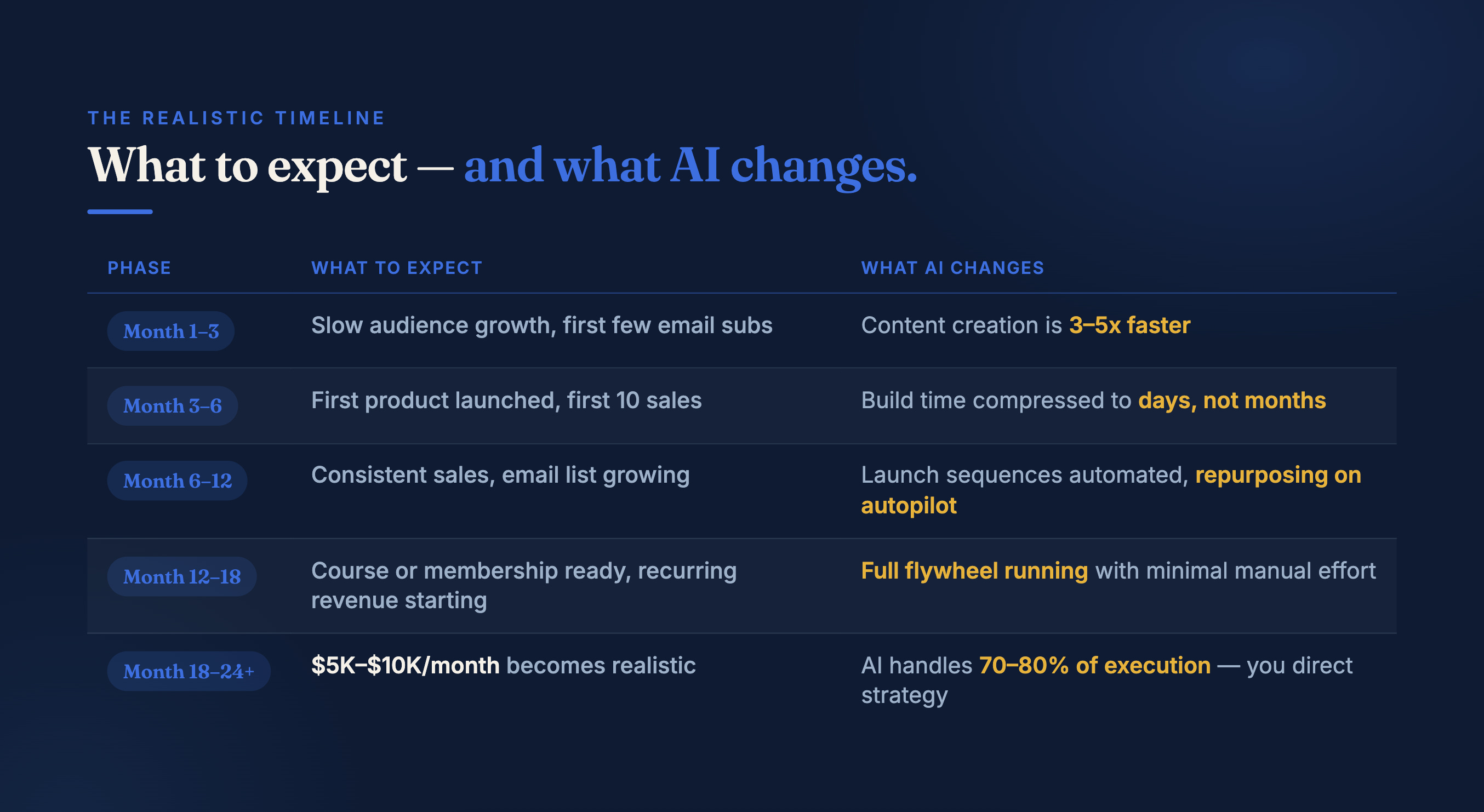
This isn’t a guarantee. But it is the pattern.
And with AI in your corner, you’re doing this in months what used to take creators years.
The One Thing That Separates Creators Who Make It
I’ve watched a lot of creators go through this journey.
The ones who build real businesses aren’t always the most talented.
They’re not always the best writers.
They’re not always the ones with the biggest networks or the most polished products.
The ones who make it have one thing in common.
They don’t stop before the compounding kicks in.
That’s it.
They post when nobody is watching.
They email a list of 43 people like it’s 43,000.
They build the product even when they’re not sure it’ll sell.
They refine and iterate instead of starting over.
The compounding is real. The ladder works. The framework has been proven by dozens of creators across different niches and platforms.
But it only works if you’re still in the game when it starts to click.
So stay in it.
Build the rung in front of you.
One step at a time. 👇
Here’s Where You Go From Here
We’ve covered a lot of ground today.
Let me bring it all together before you close this tab.
Here’s what you now have that most creators don’t:
✅ The truth about why most digital products earn $0…and what separates the top 1%
✅ A 4-rung product ladder with real creator proof at every level
✅ An 8-step repeatable framework pulled from the people who actually made it
✅ An AI execution layer that compresses months of work into days
✅ A reality filter so you go in with the right expectations…and don’t quit before the compounding kicks in
This is not theory.
Every framework in this issue has been lived by real creators…and tested in my own business.
I went from a relatively unknown creator with a few thousand followers to 75,000+ on X, 18,000+ newsletter subscribers, and 1,000+ digital products sold…with zero paid ads.
Not because I had some secret advantage.
Because I followed a system. Rung by rung.
And now you have that system too.
The question is: what are you going to do with it?
Your Next Step Depends on Where You Are Right Now
I don’t believe in one-size-fits-all CTAs.
So here’s what I’d recommend based on where you are in the journey:
If you’re just starting out and haven’t built your system yet…
Start with the free playbook.

It’s the same lean framework I use…condensed into a guide you can implement this week. It covers how to identify your niche, set up your lead magnet, and get your first piece of content working for you before you spend a single dollar.
→ Grab the Lean AI-Powered Business Playbook for Creators — Free 🚀
If you’re ready to build and launch your first digital product…
This is exactly what the AI Digital Product Builder course is built for.

It walks you through every step…skill discovery, audience validation, product creation, landing page copy, launch sequence, and the evergreen sales system…with AI doing the heavy lifting at every stage.
It’s the most complete resource I’ve built for going from “I have an idea” to “I have a product that sells.”
→ Get the AI Digital Product Builder — $67
If you’re already creating and want to go deeper, faster…
Join as a Premium Member.
For $39/month (or $150/year — that’s less than $3/week), you get:
✅ 45% off all paid courses — including the AI Digital Product Builder
✅ Premium Claude Skills — built for creators who want to produce better content faster
✅ The AI Agents Collection — automations you can plug into your business immediately
✅ Substack SEO/AEO Implementation Toolkit — for growing your newsletter on autopilot
✅ Direct community access — where builders share wins, questions, and systems
This is for the creators who are done consuming and ready to build.
One Last Thing Before You Go
I want to say something directly.
The creator economy is not slowing down. It’s accelerating.
And the gap between creators who build systems and creators who stay on the treadmill is widening every single month.
AI has made it cheaper, faster, and more accessible than ever to build a real knowledge business.
But it’s also raised the bar on what “good” looks like.
The creators who will win the next 2–3 years are not the ones who just use AI.
They’re the ones who build systems with AI…and then show up with the human layer that no tool can replicate.
Your perspective. Your experience. Your voice.
That’s the asset AI can’t build for you.
Everything else? This playbook has you covered.
Now go build the next rung.
Your next level awaits. Go get it.
Sharyph
P.S. If this issue gave you a useful framework, the single best thing you can do is share it with one creator who needs it. Forward this email. Post about it. Tag me on X @sharyph_. Nothing grows a creator’s business faster than word of mouth from people who got genuine value. And nothing makes me happier than seeing this land in the right hands.
P.P.S. If you’re not yet a Premium Member, the AI Digital Product Builder course alone is worth more than the annual membership price. Join here and get access to everything — including 45% off the course — from day one.
Until next time — Sharyph | Founder of The Digital Creator
Want to put your product or service in front of 18,000+ creators? → Sponsor this newsletter
Consistency matters, but turning attention into something sustainable takes a different set of skills.
Real income comes from a structured product ladder that connects audience, trust, and offers, now accelerated by AI for faster creator monetization.