

Welcome to The Digital Creator, helping creators accelerate with AI.
Sponsored by The Lettuce Solo Summit — a free one-day virtual event where every session is a masterclass with a real output.
You’re great at what you do.
You’ve spent years getting good at it. People come to you for advice. They DM you with questions. They tell you “you should turn this into a course”… and then go pay someone else for it.
Here’s what most experts don’t realize:
The problem isn’t that you don’t have a product. It’s that you’ve never translated your expertise into something a stranger will pay for in 30 days.
While you’re reading another “find your niche” guide, refreshing X, or testing your 14th AI tool of the month, you’re sitting on a skill that could generate $5K–$50K in the next 90 days.
If you knew the operating system.
The numbers from creators actually doing this in 2026 are not subtle:
66 days — median time-to-first-dollar for newsletters launched in 2025 (beehiiv 2026 report)
$0 → $62K MRR in 3 months — Kleo, built by Jake Ward and Lara Acosta with Claude as the engine
$4.15M/year, 86% margins, one VA — Justin Welsh’s solo business, running on a course-newsletter-social loop
$80M cash exit in 6 months — Maor Shlomo’s Base44, built solo with Claude Code
$0.024 per request — what it costs to run a Claude-powered AI tool at $19/month subscription (≈87% gross margin)
This isn’t theory.
This isn’t another “AI is changing everything” essay.
Today, I’m giving you the complete 30-day operating system…day-by-day actions, the exact Claude features to use, and the three monetization paths that actually work for skilled professionals starting from zero.
No fluff. No hype. Just the system.
Let’s go.
🧑🏻💻 If you want the full setup as a free download:
👉 Download The Lean AI-Powered Business Playbook (Free)
The same playbook 18,000+ creators are using to start, build, and monetize with AI…the lean way.
Subscribe to The Digital Creator and learn to build a one-person business with AI — one playbook at a time.
Newsletter is brought to you by, The Lettuce Solo Summit
The Lettuce Solo Summit is a free, one-day virtual conference on May 14th where every session is a working masterclass, and every attendee leaves with something they can use that day.
We surveyed 600+ solopreneurs and found a clear pattern: the ones who grow aren’t more talented, they’re more intentional. They’ve each found their version of what works. This Summit helps you find yours. Sessions include a financial framework from a CPA who strategizes for solos, a positioning statement that makes you the obvious choice, an AI critique of your LinkedIn visuals, and a partner strategy to turn your existing network into a real pipeline.
Two tracks. Eleven sessions. All led by experts who know what it takes to make the climb.

Why Most Experts Never Monetize Their Skills
Let me be direct about something.
The problem isn’t that you need more followers.
It isn’t that you need a bigger email list, a better camera, a smarter niche, or another “build in public” sprint.
The problem is structural.
Most skilled professionals…the consultants, the writers, the designers, the operators, the engineers who could charge $200/hour without blinking…are trying to monetize their expertise using the wrong unit of work.
They write more posts.
They join more communities.
They consume more “content strategy” frameworks.
And six months later, they’re still trading hours for dollars (or trading hours for nothing, hoping the audience will eventually pay).
Read that again…
The gap isn’t audience size. It’s the missing 30 days where most people give up before the system compounds.
Here’s the truth nobody wants to tell you…
A skill becomes income when three things lock into place:
A specific person with a specific problem they’re already trying to solve
An offer that translates your skill into their outcome — clearly, in one sentence
A distribution loop that puts that offer in front of that person consistently
That’s it.
That’s the entire one-person business equation.
You don’t need 50K followers. You don’t need a podcast. You don’t need to be on every platform. You don’t need to “find your voice” for 8 months before launching.
You need an operating system that takes you from skill → offer → first dollar → repeatable revenue in a defined window of time.
Most creators don’t have that system.
They have content. They have a vibe.
They have intentions.
And in 2026, with AI making it cheap to ship, easy to publish, and trivial to spin up another landing page… the gap between people thinking about building and people actually building has never been wider.
The ones closing that gap aren’t doing it with willpower.
They’re doing it with a system.
A 30-day system.
Powered by Claude.
Let me show you exactly what that looks like.
The 3 Hidden Killers of One-Person Business Attempts
Before I hand you the system, you need to know what kills people who try this.
Not the obvious stuff…bad niche, bad timing, bad luck.
The hidden stuff. The killers that look like progress until they’re not.
I’ve watched hundreds of skilled professionals try to build a one-person business in 2025 and 2026. The ones who fail almost always fail in one of three specific ways.
Here they are.
Killer #1: Building before validating
This is the #1 reason solo businesses die in 2026.
AI made shipping cheap. So everyone ships first. They build the course, the SaaS, the Notion template, the digital product — and then they go look for buyers.
By that point, it’s too late.
A creator I know spent 3 months building a $497 course on “AI for [niche].” Beautiful sales page. 12 polished modules. Custom Notion workspace. Launch day: zero sales. Not “low” sales. Zero. He’d never asked a single buyer if they wanted it.
42% of startups fail because of “no market need”…and AI makes this worse, not better, because the cost of building has collapsed while the cost of being wrong stays exactly the same.
You can ship a half-finished product in a weekend with Claude.
That doesn’t mean you should.
Pro Tip: If you can’t get 10 strangers to pay deposits before you build, the offer doesn’t work. Refund the deposits. Pivot. Don’t argue with the market.
Killer #2: Tool-hopping instead of systemizing
The second killer is subtler.
It looks like learning. It looks like being on the cutting edge. It looks like staying ahead.
It’s actually a slow-motion ship-stopper.
ChatGPT → Claude → Cursor → Cowork → n8n → some new MCP tool launched on Tuesday → back to ChatGPT because the new GPT just dropped → maybe try Replit Agent again…
A solopreneur I worked with last year tested 14 different AI tools in 60 days. He had folders full of prompts. Three half-built workflows. Two abandoned newsletters. And a new SaaS idea every Monday. He shipped nothing. Zero offers live. Zero revenue.
This is the trap of being an “AI native” without being a business native.
Tools are not your business. Tools are infrastructure.
And infrastructure should be boring, stable, and rarely replaced
Pro Tip: Pick a 3-tool floor for 90 days. Claude + one publishing platform + one payment processor. New tools have to replace two existing ones to earn a spot. No exceptions.
Killer #3: Treating Claude as a scribe instead of a strategist
This is the killer that’s quietly destroying creator businesses in 2026.
Most people use Claude to write.
They prompt it for a tweet. A newsletter. A hook. A landing page draft. They paste their voice doc, hit generate, and ship.
The result?
Generic content that sounds like the 50,000 other creators using the same model with the same lazy prompts.
A writer I follow had her newsletter open rate drop from 48% to 19% in three issues. Readers started replying: “this doesn’t sound like you.” Subscribers churned. She’d quietly switched from drafting in her voice and editing with Claude… to drafting in Claude and editing for her voice. The order matters.
Here’s the truth nobody wants to tell you…
Claude is a strategy machine first. A copywriter second.
Most creators have it backwards.
You should be using Claude to red-team your positioning, mine your audience’s exact language, pressure-test your offer, simulate skeptical buyers, and find the holes in your sales page…before it ever writes a single line of customer-facing copy.
Pro Tip: Use Claude to red-team your positioning before it ever writes a sentence. The best output isn’t a draft — it’s a list of reasons your idea won’t work, generated by your most ruthless customer.
If you’re nodding your head to any of these, you’re not alone.
These three killers don’t show up in the AI courses. They don’t show up in the “build in public” threads. They show up in your bank account 90 days from now.
The 30-day operating system below is built specifically to kill all three.
Let’s get into it.
The Business-First Truth
Let me be direct about something.
You are not a content creator.
You are a business owner who happens to use content as distribution.
That distinction is not semantic.
It changes what you build. It changes what you measure. It changes what you ignore.
A content creator wakes up and asks:
“What should I post today?”
A business owner wakes up and asks:
“What system needs to run today so revenue compounds tomorrow?”
A content creator chases reach.
A business owner builds assets…offers, lists, products, systems, skills…that keep working when they’re not online.
The reason most skilled professionals never monetize their expertise isn’t that they’re bad at content.
It’s that they’re playing the wrong game entirely.
They’re optimizing for likes when they should be optimizing for leverage.
They’re chasing audience when they should be building operating systems.
The shift looks like this:
Content creator → Digital architect.
Manual labor → Asset builder.
Posting → Shipping.
Hoping → Selling.
Here’s the truth:
You don’t need an audience. You need an operating system.
Let me show you exactly what that looks like.
The 30-Day One-Person Business OS
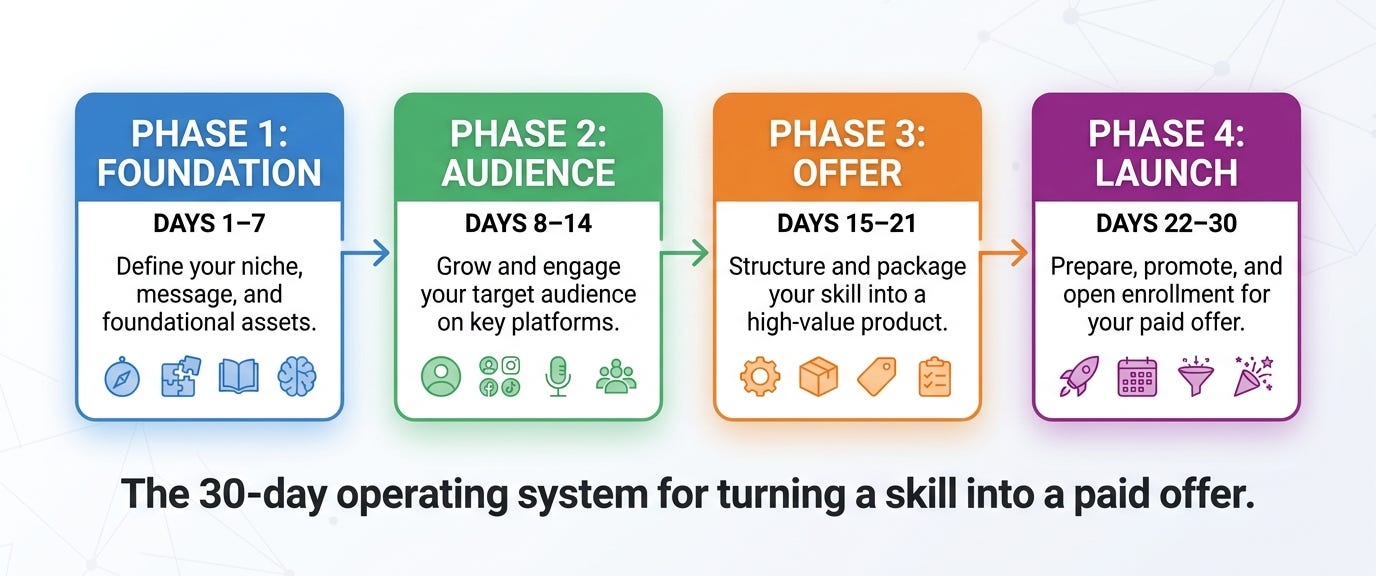
Four phases.
Thirty days.
One specific action mapped to one specific Claude feature each day.
By the end of Day 30, you’ll have:
✅ A validated niche with a one-line positioning statement
✅ A live newsletter with at least 50 real subscribers
✅ A pre-sold offer (course, digital product, or productized service)
✅ A working launch sequence and your first paying customers
✅ A repeatable system that runs every week without you starting from scratch
No theory. No “find your why.”
No 90-day audience-building before you sell anything.
Just clean execution.
Let’s go.
Phase 1 — Foundation (Days 1–7)
This week is the one most people skip.
They want to “start posting.” They want to “build the audience.” They want to do something visible.
Don’t.
The first 7 days are the operating system layer. Get this right and the next 23 days run on rails. Get it wrong and you’ll spend month 2 wondering why nothing is converting.
Here are the 5 setup actions that determine everything.
1. Claude Pro setup + privacy lockdown
What you need: A Claude Pro subscription ($20/month) and 10 minutes.
How to do it: Subscribe at claude.com/pricing.
Go to Settings → Privacy and turn off “Help improve Claude.” This stops your inputs from being used for model training — non-negotiable if you’re going to paste client data, audience research, or unreleased offers into it.
Then go to Settings → Profile and fill in: your role, your audience, your tone, and a do-not-use list.
Example: A fully configured Pro account with profile fields populated and privacy off takes under 10 minutes. After this, every Claude session starts with your context already loaded…you stop wasting the first 5 prompts of every chat re-explaining yourself.
Benchmark: Done in under 10 minutes.
Action: Do this before you do anything else in this playbook.
2. Niche shortlist via a Claude Project
What you need: A Claude Project (the file-and-context layer above chats), your résumé, 3 pieces of past work, and your LinkedIn export.
How to do it: Create a new Project called “Business Architect.” Upload all four files as Project knowledge. Then run this prompt:
You are my business architect. Based on the résumé, work samples, and
LinkedIn export in your knowledge, do the following:

1. Identify 5 niches where my skill stack creates measurable outcomes.
2. For each niche, give me:
   - Ideal customer profile (role, company size, stage)
   - Top 3 problems they're already paying to solve
   - Estimated willingness-to-pay range for an info product
   - Why I'm credible to serve this niche specifically
   - One reason this niche would NOT work for me

Be ruthless. Reject niches where I have no real edge.
Example: When I ran this on my own profile, Claude returned 5 niches…three of which I would have never picked on my own. I disqualified two of them on the spot. The remaining three became my shortlist.
Benchmark: 5 niches, ranked, with one disqualified by you within 30 minutes.
Action: Run the prompt. Pick your top 2 niches to validate next.
3. Audience-lexicon mining (the un-fakeable layer)
What you need: Claude Cowork (or Claude in Chrome) + Firecrawl MCP, plus 60–90 minutes.
How to do it: This is where you steal your audience’s language, verbatim. Point Claude at:
3 relevant subreddits (sort by Top → Year)
The top 10 G2 or Capterra reviews in your niche (5-star and 1-star)
5 competitor newsletters from Substack’s Top 100 in your category
Prompt Claude to extract:
✅ Verbatim phrases describing the pain (in their words, not yours)
✅ The “magic wand” outcomes they fantasize about
✅ Objections they raise repeatedly
✅ Tools and methods they’re already using (and hating)
Save it as audience-lexicon.md and load it into your Project as permanent knowledge.
Benchmark: 30+ verbatim pain phrases, 10+ desired outcomes, 5+ objections.
Action: This file becomes the source-of-truth for every piece of copy you write for the next 12 months. Don’t skip it.
4. One-line positioning + red-team
What you need: Your niche + your audience lexicon + 20 minutes.
How to do it: Write your positioning statement in this exact format:
“I help [WHO] do [WHAT] using [HOW] so they can [WHY].”
Then…and this is the part most creators skip….paste it back into Claude with this prompt:
You are the most skeptical, hostile prospect in my niche.
Argue against this positioning statement using the strongest
counter-evidence possible. List every reason a buyer would
reject this. Be brutal.
Benchmark: Your positioning survives a Claude red-team with no more than 2 unresolved objections.
Action: Don’t move to Phase 2 until your one-liner is bulletproof.
5. Brand voice document + master Project + 3 starter Skills
What you need: 3–5 pieces of your best writing, 45 minutes, and the Claude Skills feature.
How to do it: Upload your writing samples to a new chat. Prompt Claude to extract not just the patterns (sentence rhythm, vocabulary, paragraph structure) but the absences — words you avoid, structures you skip, tones you never use. Save the output as brand-voice.md.
Then create a master Project called “[Your Name] HQ.” Add 4 child Projects: Newsletter, Sales, Offers, Retros. Load brand-voice.md and audience-lexicon.md as knowledge in every Project.
Finally, install or build 3 starter Skills:
✅ idea-generator — turns one input into 10 newsletter angles
✅ research-summarizer — turns 50 source URLs into a structured brief
✅ social-repurposer — turns one newsletter into 3 LinkedIn posts + 5 X posts
These three Skills will save you 5–8 hours every week for the rest of the year.
Benchmark: Master Project live, child Projects nested, 3 Skills installed and tested.
Action: Test each Skill on a real piece of your existing content before you trust it.
That’s Phase 1.
5 actions. ~6 hours of focused work spread across 7 days.
Most readers won’t do this week.
They’ll skip to Phase 2 because it feels more productive — building newsletters, posting on LinkedIn, scheduling Looms.
Don’t be most readers.
The 90-day winners I know all have one thing in common: their Phase 1 was airtight.
The system compounds from here.
Phase 2 — Audience Start (Days 8–14)
Phase 1 was the operating system.
Phase 2 is the distribution engine.
This is the week you stop being invisible. Newsletter live. Lead magnet live. Landing page live. First 50–100 subscribers in the door. And…most importantly…a repurposing workflow that turns one newsletter into a week of social content automatically.
Notice what’s not on this list:
❌ “Posting daily on 5 platforms”
❌ “Building an audience first, then figuring out the offer”
❌ “Spending Week 2 designing the perfect logo”
You’re not building an audience.
You’re building a list of people who pay attention…because in 30 days, some of them will become buyers.
Big difference.
Here’s the 7-day breakdown.
Day 8 — Launch your newsletter on beehiiv (or Substack to validate)
What you need: beehiiv free plan ($0), or Substack if you only need validation.
How to do it: beehiiv if you’re serious about monetization (better deliverability, better automation, real subscribe widgets). Substack only if you want to test the niche with zero infrastructure first. Pick a name that signals the outcome, not the topic. Set up the welcome email today…not next week.
Benchmark: Newsletter live, welcome email written, 1 hour total.
Action: Don’t spend more than 60 minutes on setup. Logo, colors, “about” page…all of that is Phase 4 work.
Day 9 — Build a one-deliverable lead magnet
What you need: Your audience-lexicon.md file + Claude + 90 minutes.
How to do it: Open the lexicon.
Find the #1 pain phrase that appears most often. Build a single-deliverable lead magnet that solves that one pain in 10 minutes of reading.
Not a 40-page ebook. Not a course. One Notion template, one prompt pack, one checklist, or one decision tree.
Pro Tip: If your lead magnet takes more than 90 minutes to build, you picked the wrong format. The free thing exists to prove you can solve the small problem — not to be your magnum opus.
Benchmark: Lead magnet drafted, designed in Gamma or Notion, hosted as a PDF or page link.
Action: Save the deliverable. You’ll wire it to your landing page on Day 10.
Day 10 — Spin up a landing page (Carrd or Framer)
What you need: Carrd ($19/year) or Framer (free tier), 60–90 minutes.
How to do it: Carrd if you want it live in an hour. Framer if you want it to scale into a full site later. Use Claude Design’s Tweak Panel to polish copy, headlines, and CTA — paste your positioning statement and lead magnet description, and let it generate 5 headline variants. Pick the one that uses the most lexicon language.
Example: Page structure — headline (lexicon-driven), one-line subhead, lead magnet visual, email capture, three social proof bullets. That’s it.
Benchmark: Page live, email capture wired to beehiiv, lead magnet auto-delivered.
Action: Test the flow yourself with a fake email before promoting it anywhere.
Day 11 — Build the weekly-newsletter and social-repurposer Skills
What you need: 60 minutes, your brand-voice.md, your audience-lexicon.md.
How to do it: Build (or install and customize) two Skills:
✅ weekly-newsletter — takes a topic + 3 source links → outputs a full draft in your voice
✅ social-repurposer — takes one newsletter → outputs 3 LinkedIn posts + 5 X posts + 1 LinkedIn carousel outline
Both Skills load brand-voice.md and audience-lexicon.md automatically.
Test each one on a real piece of your existing content. Iterate the Skill prompts until the output needs less than 20% editing.
Benchmark: Both Skills produce drafts you’d actually publish (with light edits) in under 5 minutes.
Action: These two Skills are about to save you 6–8 hours a week. Build them once. Use them forever.
Day 12 — Ship Issue #1
What you need: Your weekly-newsletter Skill + 2–3 hours.
How to do it: Pick the highest-pain topic from your lexicon.
Use the Skill to draft.
Then — and this is non-negotiable — rewrite at least one section with a personal story only you could tell. That’s the un-AI-able layer. That’s why people will stay subscribed.
AI handles structure and speed. You provide the soul.
Tease it on LinkedIn and X with a 2-sentence hook + the link. Then DM 30 people in your network individually with a personal note: “Just launched this — would love your eyes on it.” Not a mass blast. Real DMs.
Benchmark: Issue #1 published, teased on 2 platforms, 30 personal DMs sent.
Action: Reply to every comment and DM within 24 hours this week. Every single one.
Day 13 — Wire the n8n + Claude MCP repurposing workflow
What you need: n8n free tier (or Zapier if you prefer no-code), Claude API key, 60–90 minutes.
How to do it: Build a workflow that triggers when a new newsletter publishes in beehiiv:
Pull the newsletter content
Pass it to Claude via MCP using the
social-repurposerSkillDrop the outputs into a Notion database (or Typefully drafts)
Notify you when drafts are ready to review
You review. You publish. The system handles the rest.
Benchmark: Workflow tested end-to-end. New newsletter → 8 social drafts in your queue, no manual prompting.
Action: This single workflow will save you 4 hours a week, every week, for the next 12 months. Build it now.
Day 14 — Push to 50–100 subscribers
What you need: One cornerstone post + three niche-community drops.
How to do it: Write one cornerstone newsletter issue that solves the #1 problem in your niche better than anything else publicly available. Then drop value (not links) into 3 niche communities — Reddit, Slack, Discord, or relevant Substack comment sections — over the course of the day. The link in your bio does the work.
Benchmark: 50–100 subscribers by end of Day 14. If you hit 100+, you’re ahead. If you’re under 30, your niche or hook needs sharpening — go back and red-team.
Action: Track every subscriber source. The channels that converted in Week 2 are the ones you double down on in Week 5.
That’s Phase 2.
Newsletter live. Lead magnet live. Landing page live. Two Skills built. One automation running. 50–100 real subscribers.
You’ve now done in 7 days what most creators stretch over 3 months.
The asset is built.
Now we make it pay.
Phase 3 — Build the Offer (Days 15–21)
You have a list. Small, but real.
Now you build the thing they’ll pay for.
This is the phase most creators avoid for months. They keep “growing the audience.” They keep “warming up.” They keep telling themselves they’re not ready.
Here’s the truth nobody wants to tell you…
You’re not waiting for readiness. You’re avoiding rejection.
The only way out is through.
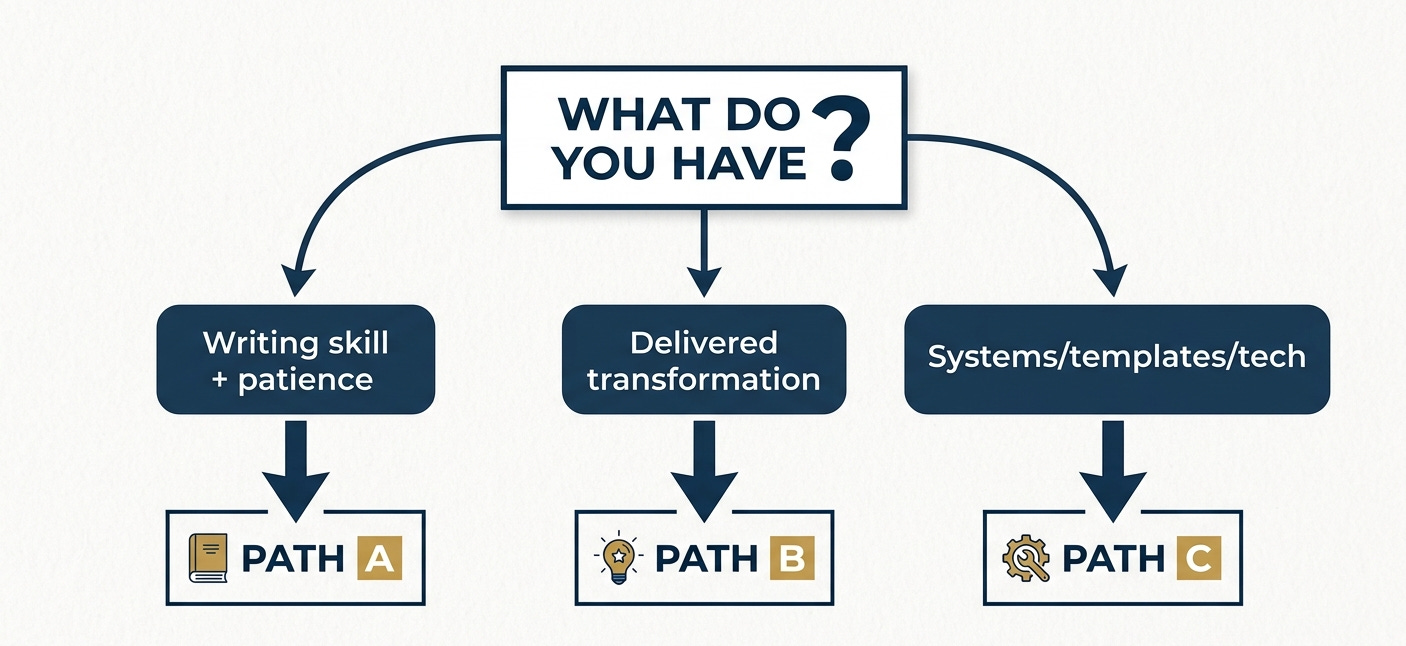
You have 7 days to pick a path, validate the offer, and have a sales page live with a working payment link.
Pick one path. Pick now.
Path A — Newsletter monetization
When to pick it: You’re writing-first. You love the long game. You’re willing to compound for 6–12 months before the revenue gets serious.
The monetization order:
✅ 0 → 500 subs: Build trust. No offers. Just consistency.
✅ 500 → 1K: Affiliate links + a small paid community ($9–$19/month).
✅ 1K → 5K: Your first $50–$200 digital product.
✅ 5K → 15K: Paid newsletter tier or sponsorships.
✅ 15K+: Course or cohort program.
Reality check: This is the slowest path. It also has the lowest ceiling at small audience sizes. Pick it only if writing is the job you want…not the marketing for the job.
Path B — Course
When to pick it: You’ve delivered a transformation before. You can teach someone to go from State A to State B because you’ve done it (or watched clients do it) repeatedly.
The validation rule: 10–25 pre-sales at target price before you build a single module. If you can’t get 10 humans to send money based on a sales page and a 3-bullet outline, the course doesn’t exist yet…the idea does.
Industry pricing:
✅ Low-ticket: $27–$97
✅ Mid-ticket: $199–$497
✅ High-ticket: $997+
The pricing ladder:
Beta cohort at 50–60% off
Founding members at 25–35% off
Full price for cohort 3 onward
Pro Tip: Real validation = commitment. Time, money, or referral. Anything less is a zombie lead — they’ll cheer you on, then disappear at checkout.
Path C — Digital product
When to pick it: You have systems, templates, frameworks, prompts, or technical skill that can be packaged once and sold a thousand times.
Pricing tiers:
✅ Low: $9–$49 (templates, prompt packs, swipe files)
✅ Mid: $79–$199 (toolkits, mini-courses, system bundles)
✅ Bundle: $199–$499 (multiple products grouped)
Anchor pricing is mandatory: “Value: $640. Price: $299.” Without an anchor, the buyer has no reference frame and your price feels arbitrary.
For AI-powered products: the unit economics are obscene right now. $0.024 per request on Sonnet 4.6 → 87% gross margin at $19/month. If you can build a focused tool that solves one painful workflow, you can run it solo and keep almost all the revenue.
This is the path I’ve taken…and the one I see working fastest for skilled professionals starting from zero.
If you want to skip the trial-and-error of figuring out which product to build, what format to use, and how to validate before you waste 3 months building the wrong thing… that’s exactly what I built AI Digital Product Builder for. It’s the system I used to sell 1,000+ digital products without ads…broken into a step-by-step path you can follow this week. (Details here →)
The shared 7 days
Whichever path you picked, the next 7 days look the same:
Day 15 — The Hormozi Grand Slam Offer prompt. Run this on your shortlist:
You are Alex Hormozi. Take my niche, audience pain, and
core skill below. Generate 3 Grand Slam Offer variants:
  - Low-ticket entry ($)
  - Mid-ticket flagship ($$)
  - High-ticket premium ($$$)
For each, include: dream outcome, perceived likelihood of
achievement, time delay, effort required, and a guarantee
that removes the buyer's biggest objection.
Pick one variant. Move forward.
Day 16 — 10 cold-DM Mom-Test interviews. DM 10 ICP matches with a 5-question Mom-Test script. Don’t pitch. Don’t sell. Listen. Their exact words become your sales page.
Day 17 — Build the outline (course) or MVP (product). 5 modules × 4 lessons for a course. For a digital product, the first usable version, not the polished one.
Day 18 — Stand up a waitlist page. Beta pricing. Visible founding-member discount. Counter showing how many slots are left (real, not fake).
Day 19 — Sales-page draft. Lexicon + brand voice + offer doc → into Claude Design. Generate the structural draft. Then manually inject one personal story per section. That’s the un-AI-able layer.
Day 20 — Synthesize the interviews. Pull 10 verbatim phrases from the 10 conversations. Drop them straight onto the sales page as headlines, subheads, and FAQ entries. The buyer’s words convert better than yours, every time.
Day 21 — Run Claude in 10th-man mode.
You are the most skeptical buyer in this market.
Your job is to find every reason NOT to buy this.
List the top 10 objections, ranked by how many
buyers will share them. Be brutal.
Fix the top 3 objections directly on the sales page. Add the rest to the FAQ.
That’s Phase 3.
Path picked. Offer validated. Sales page live. Pre-sales counter ticking.
If you’re still asking “is this offer good enough?” on Day 22 — the answer is: it’s good enough to launch. Better-good-enough that you’ll make great when buyers tell you what’s missing.
Done beats perfect.
Every single time.
Now let’s launch it.
Phase 4 — Launch, Sell, Systemize (Days 22–30)
This is the phase where it all becomes real.
You’ve validated. You’ve built. You’ve teased. The page is live.
Now you launch.
Let me be direct about something:
Most one-person businesses die in this exact 9-day window.
Not because the offer is bad. Not because the audience is too small. Not because the timing is wrong.
They die because the founder loses nerve.
They extend the cart “just one more day.”
They send only 2 of the 5 launch emails because they “don’t want to be annoying.” They check Stripe at 11pm on Day 4, see two sales, panic, and discount the price by 50% in a desperate “flash sale” email that breaks every promise they made to their early buyers.
Don’t be that founder.
Here’s the launch sequence I run on every product I sell. It’s the same one Justin Welsh, Marc Lou, and every solo creator hitting $200K+/year is running — variations on a theme.
The deadline is the whole product.
The 9-day open-cart sequence
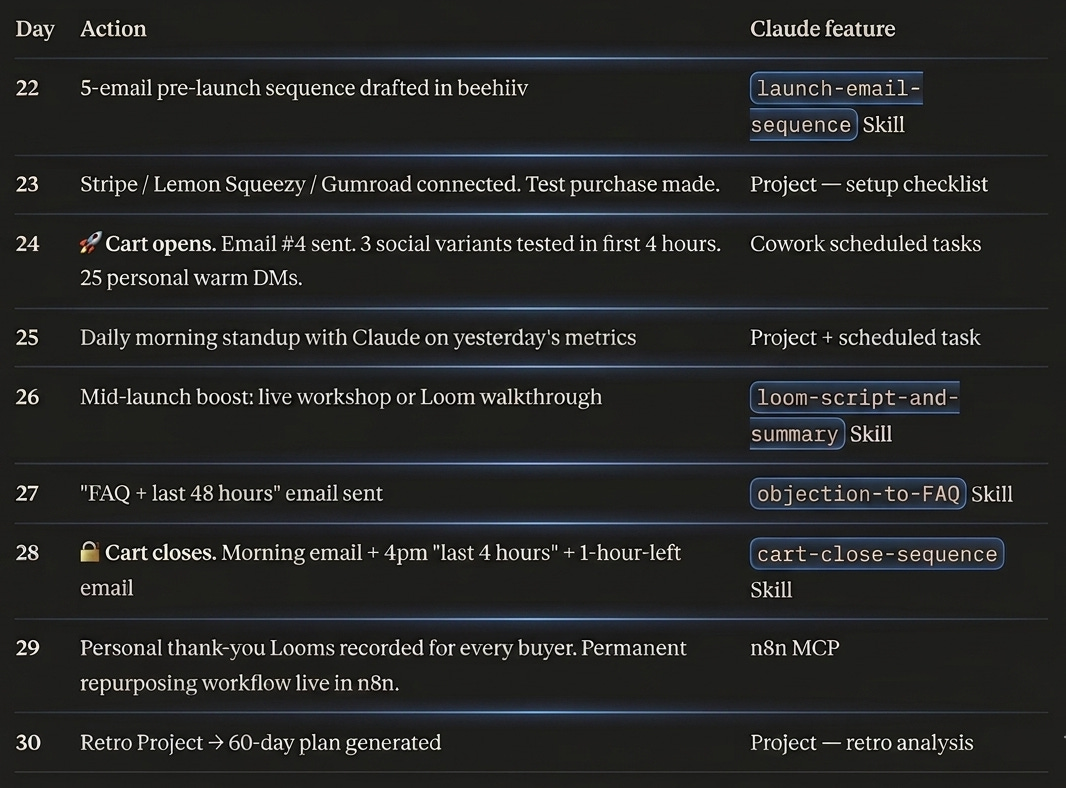
Let’s break the non-obvious days down.
Day 22 — The 5-email pre-launch sequence
What you need: Your offer doc, audience lexicon, brand voice doc, and 2 hours.
How to do it: Build (or run your existing) launch-email-sequence Skill. The 5 emails are:
✅ Email 1: The story — why this exists (use one personal anecdote)
✅ Email 2: The transformation — what changes for the buyer
✅ Email 3: The objection — name and dismantle the #1 reason they won’t buy
✅ Email 4: The cart opens — what’s inside, who it’s for, deadline
✅ Email 5: The midweek nudge — social proof, FAQ, time pressure
Schedule emails 1–3 before cart opens. Schedule 4 for Day 24 morning. Schedule 5 for Day 26.
Benchmark: 5 emails written, scheduled, and proofread in under 4 hours.
Action: Don’t rewrite these from scratch every launch. The Skill earns its keep on launch #2.
Day 24 — Cart opens
This is the day everything you’ve built compresses into a single window.
The first 4 hours determine the launch. Test 3 social variants…different hooks, different angles, same offer. The variant that gets the most engagement in 4 hours is the one you double down on for the rest of the week. The other two get retired.
Send 25 personal DMs. Not a mass blast. Real DMs to people you’ve talked to in the past 60 days, with a personal note about why this offer is relevant to them specifically.
Pro Tip: 50% of launch sales come in the last 24–48 hours. Don’t panic on Day 24 if it’s quiet. Panic is what makes founders extend carts and discount prices. Hold the line.
Day 25 — Daily standup with Claude
Every morning of the launch, run this prompt in your master Project:
Here are yesterday's metrics: [paste sales, email opens,
click rates, social engagement, DMs sent, replies received].

Tell me:
1. What's working — what should I double down on today?
2. What's not — what should I stop?
3. What's the single highest-leverage action for today?
4. What's the sentiment of the replies? Any objection theme
   I should address in the next email?
Claude becomes your co-founder for 9 days.
You’re not making decisions alone in your head at 11pm.
You’re making them with a system that’s reading the data with you.
Day 28 — Cart closes
The hardest day. Three emails:
⚠️ 10am: “Cart closes today” — restate the transformation, drop the link
⚠️ 4pm: “Last 4 hours” — short, urgent, one CTA
⚠️ 9pm (1 hour before close): “60 minutes left” — single sentence + link
Then close the cart. At the time you said you would. To the minute.
Pro Tip: Don’t extend the cart. Once. Ever. The deadline is the whole product. Every time you extend, you train your audience that your deadlines are negotiable. Future launches do half the volume.
Day 29 — Onboard like the buyer is your only customer
Every single buyer gets a personalized Loom welcome video. 90 seconds. Use their name. Reference what they said in the checkout survey (you should have one). Tell them exactly what to do first.
This is the difference between a one-time launch and a referral engine.
The buyers who feel personally welcomed talk about you publicly. The ones who get an automated “thanks for buying” email don’t.
Day 30 — Retro and the 60-day plan
The launch is over. But the system isn’t done.
Open your master Project and run this prompt:
Here's the launch data: [revenue, conversion rate,
top traffic sources, buyer feedback, refund requests,
biggest surprises].

Generate:
1. A retro of what worked, what didn't, and why.
2. A 60-day plan: what's the next offer, the next
   audience push, and the next system to build?
3. The 3 highest-leverage things to NOT do in the
   next 60 days based on this data.
You now have a launch you can repeat.
A system you can compound.
A business — not a content treadmill.
That’s the 30-Day OS.
4 phases. 30 days. One system.
By Day 30, you have:
✅ A validated niche, a one-line positioning, a brand voice doc
✅ A live newsletter with real subscribers and a working repurposing engine
✅ A pre-sold offer with a tested sales page
✅ A completed launch with paying customers and a retro-driven 60-day plan
This isn’t theory.
This isn’t another framework you’ll bookmark and forget.
This is the operating system.
The only question left is whether you’ll run it.
Using Claude as a Thinking Partner, Not a Writer
Let me be direct about something.
Most creators have the Claude relationship backwards.
They prompt it for tweets. Newsletters. Headlines. Hooks.
They paste their voice doc, hit generate, ship the output, and wonder why their open rates flatten and their offers don’t convert.
Here’s the truth nobody wants to tell you…
Claude is a strategy machine first. A copywriter second.
The highest-leverage way to use Claude isn’t to write faster. It’s to think sharper, see clearer, and pressure-test harder than your competitors who are still using it as a fancy autocomplete.
The creators making real money in 2026 use Claude to red-team positioning, mine voice-of-customer language, simulate skeptical buyers, and find the holes in their funnel — before it ever drafts a single line of customer-facing copy.
Here are the 5 prompts every solopreneur should run weekly.
1. Niche red-team
Argue against my niche using the strongest counter-evidence possible. Why is this niche too small, too crowded, or too shallow to build a real business in? Be brutal.✅ What this reveals: Whether your niche has structural ceilings you’ve been ignoring.
2. Spiky POV generator
Generate 20 contrarian beliefs in [your niche]. Each should be specific, provocative, defensible, and held by less than 20% of practitioners. No safe takes. No hedging.✅ What this reveals: The angles your content can own that no one else is willing to claim.
3. Voice-of-customer mining
Here are 50 reviews / DMs / Reddit threads from my target audience. Extract the verbatim phrases they use to describe their pain. Group by emotional intensity. Flag the phrases that appear in 3+ sources.✅ What this reveals: The exact sentences that should appear on your sales page (in quotes, not paraphrased).
4. Sales page 10th-man
You are the most skeptical buyer in this market. List every reason you wouldn't buy this offer. Rank by how many prospects share each objection. Be ruthless.✅ What this reveals: The 3 objections you must address directly in your copy or lose the sale.
5. Weekly retro
Here are this week's metrics: [paste]. What worked? What
didn't? What surprised you? What single thing should I
double down on next week? What should I stop doing?
✅ What this reveals: The compounding pattern that’s invisible week-over-week but obvious week-over-month.
Run these five prompts every Monday morning.
20 minutes total.
You’ll start the week with sharper positioning, clearer language, validated angles, and a list of objections to dismantle…not a half-drafted newsletter that sounds like everyone else’s.
Strategy first.
Then writing.
Always in that order.
Using Claude as a Thinking Partner, Not a Writer
Let me be direct about something.
Most creators have the Claude relationship backwards.
They prompt it for tweets. Newsletters. Headlines. Hooks. They paste their voice doc, hit generate, ship the output, and wonder why their open rates flatten and their offers don’t convert.
Here’s the truth nobody wants to tell you…
Claude is a strategy machine first. A copywriter second.
Read that again.
The highest-leverage way to use Claude isn’t to write faster. It’s to think sharper, see clearer, and pressure-test harder than your competitors who are still using it as a fancy autocomplete.
The creators making real money in 2026 use Claude to red-team positioning, mine voice-of-customer language, simulate skeptical buyers, and find the holes in their funnel — before it ever drafts a single line of customer-facing copy.
Here are the 5 prompts every solopreneur should run weekly.
1. Niche red-team
Argue against my niche using the strongest counter-evidence
possible. Why is this niche too small, too crowded, or too
shallow to build a real business in? Be brutal.
✅ What this reveals: Whether your niche has structural ceilings you’ve been ignoring.
2. Spiky POV generator
Generate 20 contrarian beliefs in [your niche]. Each should
be specific, provocative, defensible, and held by less than
20% of practitioners. No safe takes. No hedging.
✅ What this reveals: The angles your content can own that no one else is willing to claim.
3. Voice-of-customer mining
Here are 50 reviews / DMs / Reddit threads from my target
audience. Extract the verbatim phrases they use to describe
their pain. Group by emotional intensity. Flag the phrases
that appear in 3+ sources.
✅ What this reveals: The exact sentences that should appear on your sales page (in quotes, not paraphrased).
4. Sales page 10th-man
You are the most skeptical buyer in this market. List
every reason you wouldn't buy this offer. Rank by how
many prospects share each objection. Be ruthless.
✅ What this reveals: The 3 objections you must address directly in your copy or lose the sale.
5. Weekly retro
Here are this week's metrics: [paste]. What worked? What
didn't? What surprised you? What single thing should I
double down on next week? What should I stop doing?
✅ What this reveals: The compounding pattern that’s invisible week-over-week but obvious week-over-month.
Run these five prompts every Monday morning.
20 minutes total.
You’ll start the week with sharper positioning, clearer language, validated angles, and a list of objections to dismantle — not a half-drafted newsletter that sounds like everyone else’s.
Strategy first.
Then writing.
Always in that order.
Beyond Claude: The Minimal Stack
Let me be direct about something.
More tools doesn’t mean more productive.
I went from 21 tools to 3 core tools in 18 months. My output went up. My monthly subscription bill went down by $400. The tool I cut last? The one I was sure I “needed.”
Here’s the truth: every new tool you add is a tax on your attention.
The stack below is what I actually run. Claude sits at the center. Everything else is wired to it.
The Power Stack:
✅ Newsletter: beehiiv (or Substack if you only need to validate the niche)
✅ Course: Podia or Maven
✅ Digital products: Lemon Squeezy or Gumroad
✅ Site / landing pages: Carrd → Framer when you outgrow it
✅ Slides / lead magnets: Gamma
✅ Scheduling: Cal.com
✅ Analytics: Plausible
✅ Automation: n8n + Zapier MCP
✅ Video: Loom + Riverside
Total cost: ~$60–95/month for the working stack.
Or ~$0/month if you run the free tiers (Substack + Carrd free + Gumroad + Gamma free + Cal.com free + Plausible 30-day trial + n8n self-hosted + Loom free + Lemon Squeezy free until first sale).
You can build a one-person business on $0/month for the first 90 days and not be missing a single capability.
That’s not a marketing line. That’s the actual math.
Pro Tip: Add a new tool only when it replaces two existing ones. Otherwise, you’re not adding leverage — you’re adding a tab.
The Real Monetization — This Is the Way Forward
Most creators get the monetization order backwards.
They chase audience first.
They tell themselves: “Once I hit 10K subscribers, I’ll launch something.” Then 10K becomes 25K. Then 25K becomes “I need a brand refresh first.” Then the brand refresh becomes another 6 months of “I’m not ready.”
Read that again.
The path forward in 2026 is not audience-first.
It’s offer-first.
Let me show you the math.
The math nobody runs
A creator with 1,000 engaged subscribers launching a $200 digital product at a 4% conversion rate:
✅ $8,000 in a single launch.
A creator with 5,000 free subscribers running a $5/month paid newsletter at a 2% conversion rate:
⚠️ $500/month recurring. ~$6,000/year.
One product launch beats one year of paid newsletter at most realistic scales.
And that’s just the first launch. The same product, relaunched 3–4x a year with the same audience, becomes $24K–$32K/year — without writing a single new module.
The math isn’t subtle.
The math is screaming at you.
The Digital Product Opportunity
Here’s what most creators don’t realize…
You don’t need 10K subscribers to make $5K–$10K a month.
You need the right offer in front of the right 500 people with the right deadline.
That’s it.
Most creators get stuck on the audience. The path forward is the offer.
The creators I see hitting $10K, $20K, $50K months in 2026 aren’t the ones with the biggest lists. They’re the ones who stopped optimizing for likes and started optimizing for leverage…packaging their expertise into something a stranger will pay for, then putting it in front of a small list of the right strangers.
Productized expertise.
A list of 500–2,000 humans who actually pay attention.
A repeatable launch system.
That’s the entire game.
The 30-day OS in this newsletter exists for one reason: to compress the time between “I have a skill” and “I have a product people are paying me for.”
Not to grow your audience.
Not to optimize your aesthetic.
Not to find your niche by Year 3.
To get the first dollar moving…because every system after that compounds on top of it.
The audience comes second.
The offer comes first.
That’s the way forward.
Introducing: The 30-Day OS, Fully Loaded
You now have the system.
You have the 30-day map. You have the prompts. You have the rules. You have the stack.
Most readers will close this newsletter, feel inspired for 24 hours, and never run a single phase.
A few of you will.
If you’re in the second group...and you want the full operating system in your hands today, not in 30 days of figuring it out alone…here’s what I built for you.
🚀 The Digital Creator Premium Membership
$39/month or $150/year
Everything you need to run the 30-Day OS, every month, on rails:
✅ 5 Premium Claude Skills — weekly-newsletter, social-repurposer, launch-email-sequence, sales-page-generator, objection-to-FAQ — all installable in one click
✅ The AI Agents Collection — pre-built Claude Projects with knowledge files, Skills, and prompts wired together (Newsletter Agent, Sales Agent, Research Agent, Repurposing Agent)
✅ Substack SEO/AEO Implementation Toolkit — the exact system I used to grow to 18K+ subscribers, distilled into a step-by-step playbook
✅ 45% off every paid course I sell — including AI Digital Product Builder, AI SEO Playbook, and Viral X Thread Blueprint
✅ Community access — direct line to me and a small group of creators running the same system ✅ Lifetime updates + founding-member rate locked forever
If a recurring membership isn’t your move and you want to skip straight to Phase 3 of this newsletter — the offer-build week — here’s the shortcut:
📦 AI Digital Product Builder ($67)
The full 7-week course I built from the system that sold 1,000+ digital products without ads. Validation, outline, MVP, sales page, launch sequence — every step, every prompt, every template. The deeper version of what’s compressed into this newsletter.
🚀 Get AI Digital Product Builder →
Either path beats reading another newsletter and doing nothing.
The system is here.
The only question left is: which version of it do you want in your hands by tonight?
Before You Go
One last thing.
Don’t try to run the whole 30-Day OS this week.
Don’t bookmark this newsletter and tell yourself you’ll “block out a weekend later this month.” Later this month never comes. You know this.
Here’s what I want you to do instead:
Block 90 minutes next Sunday. Run Phase 1, Action 1.
That’s it.
90 minutes. One action. Before Monday morning.
Most readers won’t.
The few who do will email me from a different bank account in 90 days.
I want that email to be yours.
That’s the playbook.
The system is yours.
Now run it.
Until next time — Sharyph | Founder of The Digital Creator.
P.S. If this issue helped you, the highest compliment you can pay is to forward it to one skilled friend who’s still trading hours for dollars. They’ll thank you in 90 days.
P.P.S. Founding-member rate on Premium Membership ($150/year — locked forever) is the smartest move you can make if you’re going to actually run the 30-Day OS. 🚀 Join here →
The people treating AI as a scribe are losing to the ones treating it as a thinking partner.
I want to do this. I've read through half so far, and I'm feeling confident. However, I don't even know what N8N is or MCP... In the past, this kind of thing is what always derails me because I'm asked to do something that I then have to go down multiple rabbit holes, (search, watch 10 YT videos of which nine don't help) to figure out what it is and how to do it. Then I struggle to get back on the original track. So can I do this or is this just a pipe dream?