

Welcome to The Digital Creator…helping creators accelerate with AI.
Before we dive in — I want to make sure you have this.
If you’re building a one-person creator business with AI, you need a starting point that actually makes sense.
I put together The Lean AI-Powered Business Playbook for Creators…it’s free, and it covers the exact foundation you need before you start building Skills, systems, or any of what we’re about to get into.
Think of it as the “read this first” guide.

No cost. No catch. Just the playbook.
Now, let's get into today's issue…
Your problem is not prompts. It’s architecture.
Most creators don’t have a “Claude problem.”
They have an architecture problem.
Here’s what it looks like:
You open Claude. You type in whatever’s on your mind that day. You get a few good responses. Maybe a solid email, a content idea, a half-decent outline.
Then it all disappears into the void.
Next week? You start from scratch. Same panic. Same blank page. Same prompting from nothing.
Here’s the truth nobody wants to say out loud:
Using Claude like a search engine is not a system. It’s a habit — and a very expensive one.
You’re burning time, energy, and creative output re-explaining yourself to an AI every single week. Re-uploading context. Re-writing your audience description. Re-setting your voice.
And the worst part?
You’re probably doing this while telling yourself you’re “using AI in your business.”
You’re not. Not really.
If you’re a one-person business, that approach doesn’t scale. You don’t need 20 random prompts saved in a Notion doc. You don’t need a graveyard of half-finished Claude conversations. You don’t need more tools.
You need a tiny, opinionated operating system that matches how your business actually works.
Think of it this way:
A mechanic doesn’t reach into a pile of random tools and grab whatever feels right. They have a system. The right tool for the right job, every time — fast, repeatable, reliable.
Your Claude setup should work the same way.
In this issue, I’ll show you exactly how to build it.
Here’s what you’re getting:
✅ The three Claude Skills every one-person creator business actually needs
✅ How each Skill maps to a core business function (not a random tool)
✅ How to wire them together into one OS you run every single week
By the end, you’ll have a minimal Skill stack you can use to plan offers, ship content, and distribute it — without grinding yourself into the ground.
Let’s get into it.
The One-Person Business OS: Three Jobs, Three Skills
Let me strip this down to what actually matters.
A one-person creator business is simple. Not easy…but simple.
When you cut through the noise, the tools, the shiny automations, and the dopamine hits from launching things… you’re left with three core jobs.
Job 1: Decide what you’re selling and who it’s for.
Job 2: Create content that sells it.
Job 3: Get that content in front of people.
That’s it.
Everything else…landing pages, funnels, carousels, email sequences, Notion dashboards…hangs off these three jobs. They’re not the foundation. The three jobs are.
So here’s the mistake I see creators make when they start building Claude Skills:
They build around tools.
“I need a Skill for writing tweets.”
“I need a Skill for Notion.”
“I need a Skill for summarising research.”
That’s backwards.
You don’t need Skills that map to tools. You need Skills that map to jobs.
Because when you build around tools, you end up with 15 disconnected Skills that don’t talk to each other…and you’re still back to square one, prompting from scratch every time.
When you build around jobs, you end up with something completely different:
A system.
Here’s how the three Jobs map to three Skills:
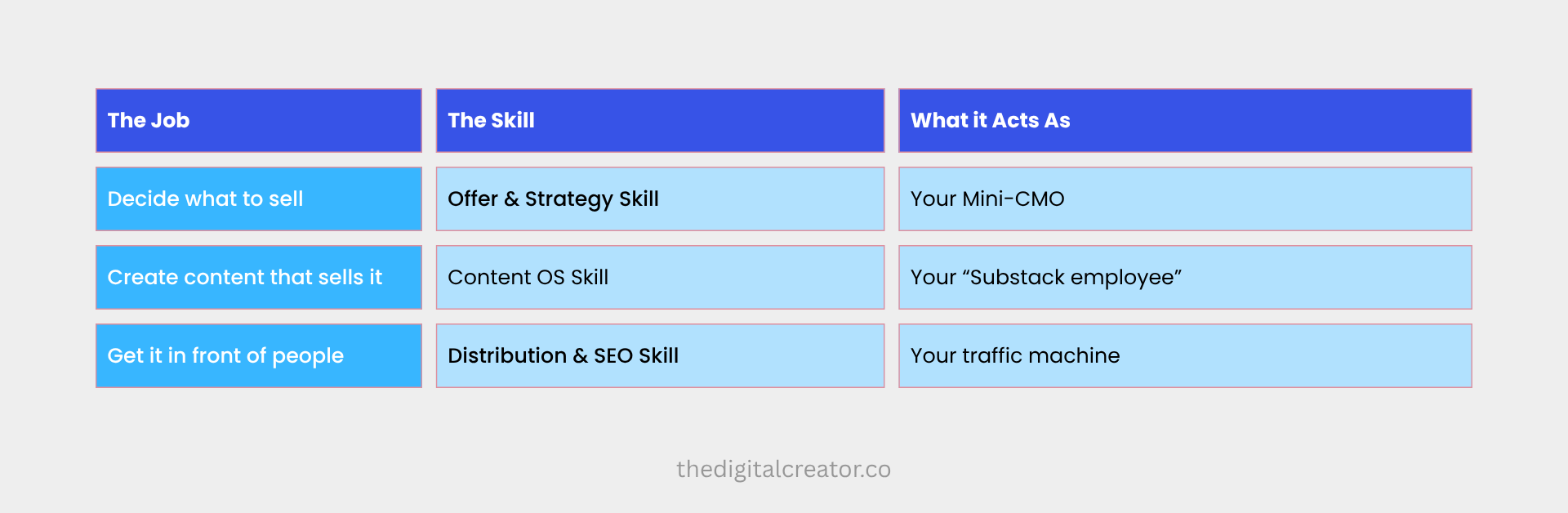
Three Skills. One Project. One shared brain.
Think of this as the Skills layer of your one-person business playbook. If you’ve gone through the 30-Day Claude-Powered Business Roadmap, this is the wiring layer that turns that strategy into a weekly practice…something you actually run, week after week, without reinventing yourself.
Let me break down each Skill.
Skill 1: The Offer & Strategy Skill (Your Mini-CMO)
Let me ask you something.
When was the last time you sat down and clearly answered this question:
“What should I sell next — to whom, and why?”
Not a vague “I should probably make a course” thought.
Not a 3-hour Notion spiral where you list 40 ideas and commit to none of them.
A clear, specific answer. One offer. One audience. One reason it makes sense right now.
If you’re like most one-person creators, that answer doesn’t come easy.
And that’s not a creativity problem. It’s a system problem.
Without a dedicated structure for this thinking, most creators default to content first and offers later. They publish for months…sometimes years…with no clear product in mind. Then burnout hits. Then they scramble to monetise. Then they wonder why nothing converts.
The Offer & Strategy Skill exists to break that cycle.
Its one job: answer “what should I sell next, to whom, and why?” — with structure, not guesswork.
What This Skill Does
Instead of staring at a blank page or debating ideas in your head, you give Claude structured inputs about your situation…and it proposes clear offers, positioning, and a simple roadmap.
This is not a brainstorming session where you generate 100 ideas.
This is a decision-making session where you choose one good idea you can actually ship in the next 30–60 days.
That’s the shift. From ideation to execution.
Inputs and Outputs
Design this Skill around a simple, repeatable pattern.
You bring:
A short description of your main skill(s) and experience
A list of problems your audience keeps talking about (DMs, comments, replies — their actual words)
Your constraints: how many hours per week you can commit, your preferred formats (course, template, 1:1, community, etc.)
The Skill gives you:
3–5 concrete offer concepts, each with: who it’s for, what problem it solves, and a format + price range
A simple one-page roadmap — “This month: validate. Next month: build the V1. After: automate or turn into an agent.”
You can reuse this same Skill every single time you feel stuck on “what’s next.”
No more starting your strategy from zero. No more decision paralysis dressed up as productivity.
Why a One-Person Business Needs This Skill
Most creators don’t have a content problem.
They have an offer clarity problem.
They’re posting. They’re growing. They’re getting engagement.
But they don’t know what they’re building toward…so nothing converts.
The Offer & Strategy Skill forces you to answer three questions that everything else in your business depends on:
What is this business actually about?
Who am I serving?
What am I selling?
Once those three questions have clear answers, content gets easier. Distribution gets easier. Even pricing gets easier…because you’re no longer guessing what your audience wants. You’ve decided.
And if you want to understand how this Skill connects to real monetisation…the idea that your skill × AI can actually generate income…that’s something I’ve written about in depth. 👇

Already have a roadmap but not sure which level you’re operating at? 👇

Skill 2: The Content OS Skill (Your “Substack Employee”)
If the Offer & Strategy Skill is your mini-CMO…
The Content OS Skill is your content manager.
The person who takes your best thinking…already written, already in your voice…and turns it into a full week of content across every platform you’re publishing on.
I call it the “Substack employee.”
Not because it lives on Substack. But because it does what a great content employee would do: take your flagship piece and squeeze every drop of value out of it, without you having to lift a finger for each individual output.
You create once. The Skill helps you distribute many times.
That’s the whole idea.
The Problem It Solves
Here’s what most one-person creators do:
They write a newsletter on Tuesday.
Then they stare at a blank tweet composer on Wednesday.
Then they write a LinkedIn post from scratch on Thursday.
Then they wonder why they’re exhausted…and why none of it feels connected.
Every platform gets a different version of you. Not because you’re inconsistent, but because you’re recreating from nothing each time.
The Content OS Skill fixes this.
Instead of starting from scratch on every platform, you start from one strong piece…usually your weekly newsletter…and let the Skill do the repurposing work.
One flagship piece. Multiple derived outputs. Your voice, consistent across all of it.
What This Skill Does
Think of it this way: you are the writer. The Skill is the production engine.
Your job is to draft one strong newsletter in your own words. That’s it. That’s your creative contribution for the week.
The Skill takes that draft and turns it into:
Several social posts (threads, carousels, short updates…formatted for the platforms you’re on)
A shorter follow-up email for a segment of your list
Optional: a video script or talking-points outline if you’re on video
A one-page content plan for the week…what to post, when, and why
And here’s what makes this different from just prompting Claude to “write some tweets”:
The Skill already knows your voice. Your style guide is baked in. Your audience segment is defined. Your constraints…phrases you avoid, tones you don’t use, topics that are off-limits…are all part of the Skill’s instructions.
So the output doesn’t sound like generic AI content.
It sounds like you…just produced faster.
Inputs and Outputs
You bring:
Your weekly newsletter draft or a past issue you want to repurpose
A short style guide: tone, constraints, phrases to avoid
Your audience segment for this week: beginner, intermediate, or advanced
The Skill gives you:
Social posts ready to edit and schedule
A follow-up email for your list
Optional video script or outline
A one-page weekly content plan tied to your current offer
You can run this Skill on both new content and your back catalogue.
That second part matters more than most people realise.
You have posts, newsletters, and threads sitting in your archive right now that still have value. The Content OS Skill can take a newsletter from six months ago and turn it into a full week of fresh content — without it feeling recycled.
Over time, this becomes your default way of thinking about publishing: one flagship piece, multiple derived outputs. Always.
Why a One-Person Business Needs This Skill
One-person businesses don’t have content teams.
They have limited energy, limited hours, and an endless list of tasks competing for both.
Without a system like this, you end up in one of two places:
Option A: You post inconsistently because creating for every platform from scratch is too draining.
Option B: You post consistently but lose your voice…because you’re prompting from a blank page every time, and the outputs start sounding like everyone else.
The Content OS Skill is the way out of both.
You draft in your own voice. You feed that into the Skill. You edit the outputs…keeping full control of quality. And you ship.
That’s not cutting corners. That’s how professional content operations work.
Want to see exactly how this Skill is set up…the full breakdown of inputs, outputs, and the system behind it?
Read this… 👇

And if you’ve ever wondered what I mean when I say “Substack employee”…this is the post that started it all.
My AI Agentic Workflow: Meet Your Substack Employee 👇

Skill 3: The Distribution & SEO Skill (Your Traffic Machine)
Here’s something most creators never want to admit:
Publishing without a distribution strategy is just journaling in public.
You write. You post. You share. And then… it evaporates.
No one finds the post three weeks later. No one discovers it through search. No one stumbles on it because it ranked for something. It just exists…somewhere in your feed, quietly decaying.
That’s not a content problem. That’s a distribution problem.
And it’s the one problem most one-person creators never actually solve…because “SEO” sounds technical, expensive, and like a full-time job in itself.
Here’s the truth:
You don’t need to become an SEO expert.
You don’t need to chase keyword rankings obsessively or build 300 backlinks or spend three hours optimising every post.
You just need some percentage of your work to be discoverable on purpose.
That’s what the Distribution & SEO Skill does.
What This Skill Does
Its job is to answer one question:
“How do I turn my existing content into long-term discoverability?”
Instead of writing random posts and hoping for virality, this Skill gives you a lightweight strategic layer on top of your content…one that compounds over time instead of evaporating after 48 hours.
It scans your niche and your existing content. It proposes SEO-friendly topics and keywords that actually align with what you’re already building. And it helps you turn your best content into assets — pieces that keep working for you long after you’ve moved on to the next idea.
Think of it less as an SEO tool and more as a strategic brain that sits above your content operation.
Inputs and Outputs
You bring:
Your niche or topic focus
A list of offers or products you want to drive traffic toward
Links or text from 3–10 of your existing posts, newsletters, or articles
Your traffic goal: more email subscribers, more product sales, more visibility
The Skill gives you:
A simple SEO and content map with 3–5 pillar topics
Supporting content ideas for each pillar — so you always know what to write next
A few content briefs: outline, angle, and keywords for upcoming posts
Optional: suggestions for collaborations, guest posts, or link-building moves that make sense for your size and niche
The output isn’t a 40-page SEO audit.
It’s a one-page map you can actually use — and update every month in about 30 minutes.
How It Connects to the Rest of Your OS
This is where the architecture starts to pay off.
Once you run the Distribution & SEO Skill, those content briefs don’t sit in isolation. You plug them directly into your Content OS Skill.
The brief becomes the newsletter draft input. The newsletter becomes the week of content. The content drives traffic back to the offer your Offer & Strategy Skill defined.
One loop. Three Skills. All connected.
That’s what separates a system from a collection of tools.
Why a One-Person Business Needs This Skill
Without a distribution layer, your publishing system is a treadmill.
You’re always one post away from disappearing.
Post today, get some likes, get some opens…and then next week you start from zero again. Your older content isn’t working for you.
Your best ideas aren’t being found. And the only way to grow is to keep posting forever, at full pace, without ever building anything that compounds.
The Distribution & SEO Skill changes the equation.
It gives you a lightweight “SEO brain” without dragging you into technical rabbit holes.
It forces you to think in terms of assets and pillars…not one-offs.
And it makes sure that some of what you publish today is still bringing in readers, subscribers, and buyers six months from now.
That’s the difference between a content treadmill and a content machine.
I’ve built this exact machine inside Claude…and written about the full setup in detail.

And if you want to understand why compounding content is the actual business model here…not just a nice idea…this is the post that breaks it down.

Wiring the Three Skills Together: Your Claude Business OS
You now have three Skills.
But three isolated Skills is not a system.
Three isolated Skills is just a more organised version of the same problem…you’re still switching contexts, copy-pasting briefs between conversations, and manually carrying information from one place to another.
That’s not an OS. That’s just a slightly better graveyard of prompts.
Here’s what you actually want:
One Claude Project. Three Skills. One shared brain.
The Simple Architecture
Inside a single Claude Project, you house all three:
The Offer & Strategy Skill
The Content OS Skill
The Distribution & SEO Skill
Because they live inside the same Project, they share context automatically.
That means:
Your Offer & Strategy outputs are available when you’re drafting content.
Your Distribution Skill already knows which offers you’re focused on driving traffic to.
You’re not re-explaining your business to Claude every time you switch between tasks.
This is the difference between three tools and one system.
The Business Brief: Your Shared Context Document
To make this work, you need one central document that all three Skills draw from.
I call it the Business Brief.
It’s not complicated. It’s a short, structured document that answers the four things every Skill needs to know:
Who you serve…your specific audience, their situation, their language
The main offer you’re focused on right now…not all your offers, just the one you’re actively pushing this month
The core promise of that offer…what transformation does it deliver, in plain language
Your voice notes and constraints…how you write, what you avoid, what makes your content sound like you and not a generic AI output
Save this as a persistent document inside the Project.
Every Skill reads from it.
Every Skill writes back to it when something changes.
How Context Flows Between the Three Skills
Here’s what this looks like in practice:
The Offer & Strategy Skill updates your “current offer” field in the Business Brief after each strategy session. This week’s focus is locked in. Everything else flows from it.
The Content OS Skill pulls that field when shaping angles and CTAs. It knows what you’re selling, so it naturally weaves the right hooks and calls to action into your content — without you having to remind it every time.
The Distribution Skill uses the current offer to prioritise which topics and channels to focus on. It’s not just building generic traffic…it’s building traffic toward the thing you’re actually trying to sell right now.
Instead of thinking “three Skills,” think “three roles working from one shared brain.”
Your mini-CMO sets the direction. Your content manager executes. Your traffic machine amplifies.
All three know what the others are doing…because they’re all reading from the same brief.
Why This Architecture Matters
Most creators who start using Claude Skills build them in isolation.
They set up a great Content Skill. It works well. Then they set up a Distribution Skill. Also works well. But the two Skills don’t know about each other…so the content doesn’t reinforce the distribution strategy, and the distribution strategy doesn’t account for what’s being published.
The result is effort without compounding.
When you wire the Skills together through a shared Project and a shared Business Brief, something different happens.
Each Skill makes the others more effective.
The strategy informs the content.
The content feeds the distribution.
The distribution drives traffic back to the offer.
The offer gets refined based on what the audience responds to.
That’s a loop. That’s compounding. That’s what a real operating system looks like.
Want to go deeper on how to design Skills that actually work together…the 2.0 patterns that most people miss?

And if your Skills ever start drifting or underperforming, here’s how to fix them without rebuilding from scratch.

Not sure why Skills beat a bloated CLAUDE.md file for this kind of setup? This post breaks it down clearly.

How to Evolve the Stack (Without Breaking It)
Here’s what happens after a few weeks of running this system.
It starts working.
The calibration takes ten minutes instead of thirty.
The Content OS outputs get tighter because the Skill has learned your patterns.
The Distribution map starts producing briefs you can actually execute…not just admire.
And then, right when the system starts clicking…
You get ideas.
“What if I add a Launch Skill for product launches?”
“What if I build a Customer Research Skill to analyse DMs and replies?”
“What if I let clients plug into this OS and sell it as a service?”
These are good ideas. Genuinely.
But this is also the exact moment most people break their system.
They add too much, too fast. The core three Skills get buried under new experiments. The Business Brief gets crowded with competing context. The weekly rhythm falls apart because there are now seven Skills to run and no clear order to run them in.
Don’t do that.
Here’s how to evolve the stack the right way.
Rule 1: Don’t Add Until the Core Three Are a Habit
This sounds obvious. It almost never gets followed.
The core three Skills only count as a habit when you’ve run them consistently for at least four weeks…not perfectly, but consistently.
If you haven’t hit that mark yet, adding a fourth Skill is just adding distraction.
New Skills take mental energy to design, test, and refine. That energy comes directly out of the focus you need to make the core three work.
Earn the right to expand by running what you have first.
Rule 2: Treat New Skills as Plugins, Not Replacements
When you do add a new Skill, it should slot into the existing OS…not replace a piece of it.
Think of the core three as the engine. New Skills are the attachments.
A Launch Skill? It plugs into the Offer & Strategy Skill…it activates when you’re in launch mode, not as a permanent replacement for your strategy layer.
A Customer Research Skill? It feeds into the Business Brief…it’s an input mechanism, not a standalone operation.
A Client-facing Skill? It reads from the same shared context your internal Skills use… same brief, same voice, same offer clarity.
Every new Skill you add should answer one question before you build it:
“Does this make the core three more effective…or does it just add complexity?”
If the answer is complexity, park it.
Rule 3: Run a Monthly Skill Improvement Routine
This is the one most people skip…and it’s the one that separates a system that compounds from a system that slowly degrades.
Once a month, set aside 30–45 minutes to review how each Skill performed.
Ask yourself:
Where did the Offer & Strategy Skill give me vague or unhelpful outputs?
Where did the Content OS Skill drift from my voice…and why?
Where did the Distribution Skill produce briefs I didn’t actually use?
Then make one small fix to each Skill’s instructions.
Not a full rewrite. One small, specific change…a clearer constraint, a tighter output format, a better example added to the context.
Test it the following week.
This is how Skills compound over time. Not through big overhauls, but through small, consistent iterations…the same way any good system improves.
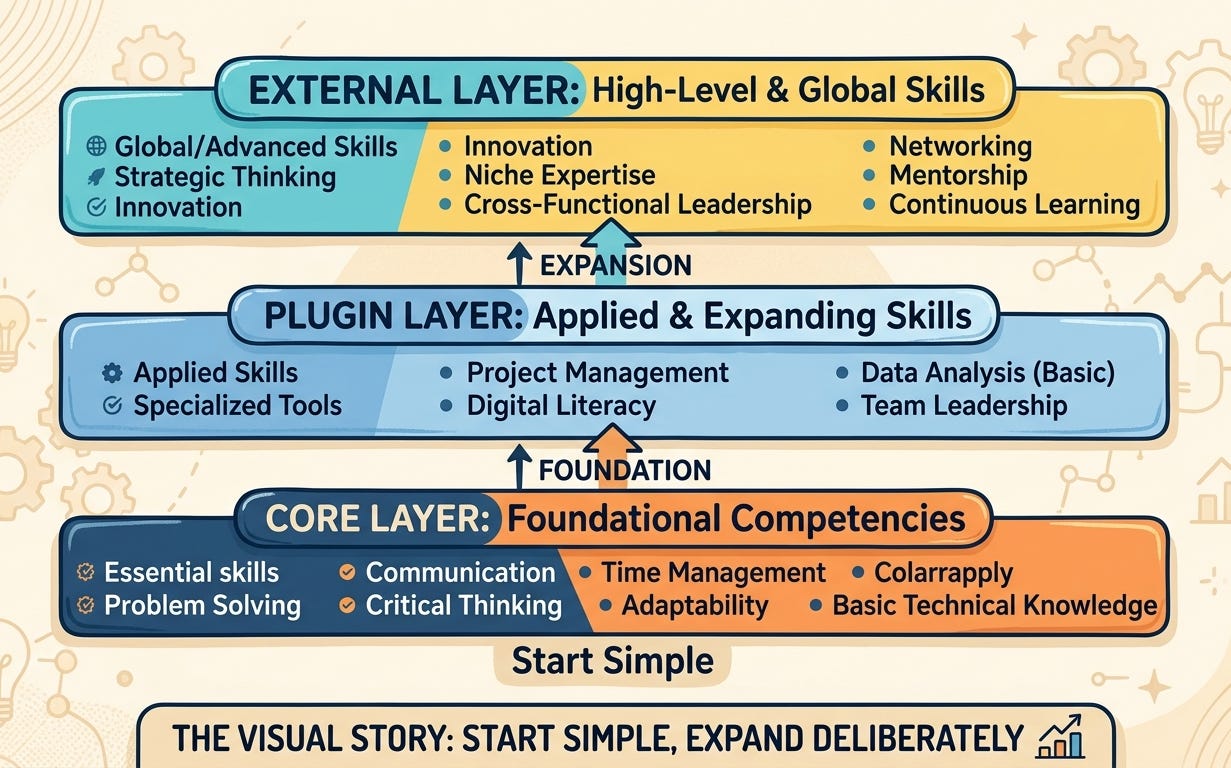
What the Evolved Stack Eventually Looks Like
For reference — not as a target to hit immediately, but as a picture of where this goes:
Core layer (always running):
Offer & Strategy Skill
Content OS Skill
Distribution & SEO Skill
Plugin layer (activated when needed):
Launch Skill — activated during product launches or promotions
Customer Research Skill — activated monthly to analyse audience signals
Repurposing Skill — activated for deep-dive repurposing of your back catalogue
Optional external layer (for those selling the OS):
Client-facing version of the Content OS Skill
Onboarding Skill for new clients or community members
You don’t need all of this right now.
You need the core three working reliably. Everything else is a layer you earn by running what you have.
The Real Goal Here
This system isn’t about building an impressive Claude setup.
It’s about building a business that doesn’t depend on your energy being perfect every week.
Because it won’t be. Some weeks you’ll be tired. Some weeks life will interrupt. Some weeks you’ll ship something and it won’t land the way you hoped.
The system holds when you don’t.
That’s what a real OS does — it carries your business forward even on the weeks you’re running at 60%.
And that’s worth building.
Make This Your Default OS
You’ve made it to the end.
And if you’ve read this far, you already know more about building a real Claude operating system than 95% of creators using AI right now.
Most of them are still opening Claude, throwing in a prompt, getting a decent response, and closing the tab.
You’re thinking about architecture.
That gap? That’s where the leverage lives.
Here’s What I’d Do Next If I Were You
Don’t overthink the setup.
Don’t spend three days designing the perfect Business Brief before you’ve run a single Skill.
Don’t wait until you have the perfect offer, the perfect style guide, or the perfect understanding of SEO before you start.
Start with what you have. Run it for four weeks. Let the system teach you what needs to be better.
Here’s the sequence:
Step 1: Open a new Claude Project. Name it something simple — “My Business OS” works fine.
Step 2: Build the three core Skills inside it. Start with the Offer & Strategy Skill — it anchors everything else.
Step 3: Write your Business Brief. One page. Four fields. Who you serve, what you’re selling, what the core promise is, and your voice constraints.
Step 4: Run the weekly workflow above for the next four weeks.
Step 5: After four weeks, review. Fix one thing in each Skill. Then run it for another four weeks.
That’s it.
No big launch. No complex automation. No 47-step onboarding process.
Just a simple system, run consistently, improving over time.
Ready to Turn Your Internal OS Into Products You Can Sell?
Here’s something worth thinking about.
The same Skills you’re building to run your own business?
Other creators, coaches, and consultants would pay for them.
Your Content OS Skill could become a done-for-you service.
Your Distribution Skill setup could become a productised offer.
Your entire Business OS could become a template pack or a course someone buys to shortcut the work you just did.
That’s the next level…going from internal OS to external offers.
And if you want the blueprint for how to do that, I’ve written it. It covers how to identify which of your Skills have commercial potential, how to package and price them, and how to go from “I built this for myself” to “I sell this to clients.”

Or — Join the Community Where This All Lives
If you want the Skills, the systems, and the community in one place:
The Digital Creator Premium Membership gives you:
5 Premium Claude Skills — including a fully built Content OS Skill and Distribution Skill you can install and customise immediately
AI Agents Collection — pre-built agents for common creator business tasks
Substack SEO/AEO Implementation Toolkit — so your newsletter actually gets found
45% off all paid courses — including the AI Digital Product Builder
Community access — a group of builders running the same systems, sharing what’s working
$39/month or $150/year.
If you’re serious about running your creator business on systems instead of willpower…this is where that happens.
One Last Thing
You don’t need ten more tools.
You don’t need a bigger audience, a more polished brand, or a perfect product before you start building systems.
You need one simple Claude OS…and the discipline to run it.
Everything else follows.
Until next time — Sharyph | Founder of The Digital Creator
Great breakdown, further evidence I need to rethink how I set up my Skills, Agents and AI workspaces!
Shared with colleagues. Thanks for publishing Sharyph